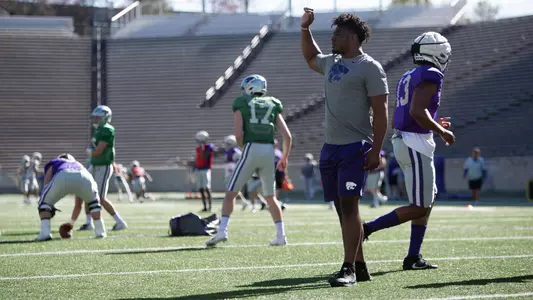
SE: McCoy Keeps Positive After Injury Ends Playing Career, Opens Path to Coaching
Apr 09, 2019 | Football, Sports Extra
By Corbin McGuire
Mike McCoy is almost always smiling. It's the first thing people who know McCoy well will say about him.
"Every day he has a smile on his face," said K-State running backs coach Brian Anderson.
"He's always happy and smiling," added K-State Director of Football Recruiting Taylor Braet.
The second thing is how much football means to K-State's fourth-year junior. This made February 12, 2019, one of the hardest days in McCoy's life. He announced, via social media, that his playing career was officially over after only 10 collegiate carries.
The reason: A condition called spinal stenosis, an abnormal narrowing of the spaces within his spine that could render all of his physical gifts, most importantly his ability to walk, useless if he continued to play.
"I never really cried in my life until that day," McCoy said. "I couldn't stop."
McCoy's post, on Twitter, was retweeted more than 250 times, received nearly 2,400 likes and got 86 comments. His phone got even more text messages and phone calls, so many that he turned it on Do Not Disturb.
The overflowing amount of support from friends, family and K-State fans he never knew, or got a chance to really show what he could do on the field, was overwhelming.
"I didn't think that many people cared about me. The love I had from the fans… I was surprised about that," he said. "I was, like, 'I'd do anything to play for you.'"
Soon, about five minutes after he posted the announcement, McCoy found himself smiling again. A few minutes after that, laughing. The old McCoy, the one who used to get out of trouble in elementary school by flashing his grin, was back.
"I'll never be down and out," he said.
***
McCoy can remember his first tackle-level football practice like it was yesterday.
It was a tryout for a local Topeka team, the Bears, in fourth grade. McCoy, however, forgot to bring pads, and nobody else had an extra set. He played anyway.
The first time he touched the ball, he scored.
"Ever since then I was, like, 'This is what I want to do,'" he said. "I wanted to make it to my dreams one day."
McCoy's dreams were a life led by football. Ideally, at a professional level. Specifically, with one in his hands and others trying to take it from him or, at the very least, bring him to the ground.
Neither were easy tasks.
McCoy was always one of the biggest players in his age group. He earned the nickname, Big Mike, during that fourth-grade season. Even now, the 6-foot-2, 235-plus pound Wildcat looks like a middle linebacker or defensive end. Legs like tree trunks. Hands that make a football look a size or two too small.
Combined with his love for the game, McCoy's physical gifts made him a special force. He ran for nearly 1,500 yards and 24 touchdowns as a senior at Topeka High School, where he earned All-City Offensive Player of the Year honors and became a top-five recruit in the state.
His grades, however, gave some schools caution in his recruitment.
K-State, McCoy said, stuck with him when other schools did not. When his qualification came down to his last semester at Topeka High, the Wildcat coaching staff believed he could get the two As and a B that he needed.
"I ended up getting them," McCoy said. "That's why I committed here. It was just a blessing. I knew this is where I'm supposed to be."

***
It was a normal drill, a typical play, a block McCoy had executed hundreds of times without issue. In a spring practice last year, on a designed quarterback run, he went to block with his hands, missed and his forward lean carried his head into a collision with the defender.
McCoy's neck compressed the wrong way. His body went numb from below the neck. He fell to the ground.
"I was thinking it was over," McCoy said.
After about 30 seconds, McCoy said feeling started to return everywhere. He likened the scary experience to when circulation is cut off to a person's hands or feet, only everywhere.
"It didn't really hurt," he said. "I just didn't have any feeling."
A trip to the University of Kansas Medical Center in Kansas City brought the news of McCoy's spinal stenosis, a condition he was born with. The doctor told him that, in a certain portion of his spine, there is not a normal amount of spinal fluid.
For some, this means a hit with enough force to the wrong area could result in permanent paralysis. McCoy said he was told his condition was not that severe yet, but if the symptoms returned, he was done. He rested the remainder of the spring and prayed time would fix it.
It didn't.
McCoy continued to have tingly, unnatural feelings that summer when he stretched or moved a certain way. He knew something was not right but brushed it off. He knew what telling someone would mean.
How could he end his own dreams after two years of paying his dues on scout team and the sideline? This was supposed to be his time to shine
So, he ignored his better judgment and pushed on. He prayed often, that it was just a pinched nerve or that he could get used to the symptoms. He tried every type of rehabilitation method he could, including several ice baths during the summer of 2018.
"Nothing was helping," McCoy said. "I knew something was wrong."
Still, McCoy went into fall camp thinking he could work around it.
In the first padded practice, he started to question that thought.
On one play, McCoy took a carry and cut outside. When one of his teammates jumped on his shoulders, McCoy shook him off, like he had countless times before, and ran into the end zone. In between, McCoy said he felt that familiar "jolt."
"That wasn't right," McCoy remembered thinking. He kept the intuition to himself.
The next practice, he said "every little thing I was doing was hurting me." At one point, he absorbed another normal hit from the side, ran through it into the end zone and felt the numbness again. This time, he admitted to K-State's coaching staff what he was feeling.
"Right after that, I knew it was over," he said. "I had a little bit of tears right then."
McCoy has since gone to two other doctors, last-ditch efforts to save his career. Neither gave him the news he wanted. The last one, a spine specialist in Texas, told McCoy in February that even if he could return to the field, his condition would be a major flag for NFL teams that he could not hide.
Then, the realization set in for McCoy. His dreams as a player were over.
In the same breath, it did not mean his football career was done. K-State's new staff, under head coach Chris Klieman, welcomed him to become a student assistant coach and remain part of the team.
"Everything happened for a reason," McCoy said. "I'm just blessed to be able to walk, get this chance to stay on the staff and try to do what I can to do to get into coaching world because I love football so much."

***
McCoy's daily routine does not look extremely different this spring.
He still works out, attends position and team meetings, and goes to every practice. He still riles up the defensive players with some trash talk, telling them one of these days he's going to sneak into the equipment room and come out padded up.
He still smiles as if nothing's wrong in the world.
"There's no doubt this has been tough and hard," Braet said, "but he always comes through everything with a smile."
McCoy said the positivity has come somewhat naturally. It's part of who he is, but it's also been kept alive by his surroundings. The encouragement from fans, coaches and teammates made sure he did not lose that part of his identity.
"When you don't have that support," he said, "you just feel lost, empty-hearted and like you don't have anybody that cares for you anymore."
McCoy has never felt that way during this transition.
K-State's coaches have been helpful in sharing their knowledge and perspective as he tries to follow many of their same paths from player to coach. McCoy said Braet, who's known him the longest, has been the "closest thing you can get to a family member."
"It's perfect that God put this person in my life," McCoy said, "and I can learn the ropes from him and all the other coaches."
McCoy will often come watch tape of potential recruits with Braet. He's even helped with recruiting visits this spring, something Braet said has come naturally for McCoy.
"He's so personable. He's a relatable kid, and when he tells his story to kids, I think they also realize that K-State's a place that is going to take care of a guy, even if he's injured," Braet said. "That's what I tell them. He's done (playing). But he's not done here."
Anderson said McCoy has been "very positive" in this transition. As a former player, Anderson remembered his and how tough it was on him. Ultimately, he said it comes down to figuring out that you can have a positive effect on a team and other people without being able to play.
"Mike's going to be able to affect his own teammates' lives in a positive way," Anderson said. "He's embraced it."
Part of embracing it has been taking school more seriously. McCoy said that's the biggest change from this whole situation. This spring, he has put more time into his studies than ever before. He's focused on raising his GPA so he can get into a master's program after he graduates, which he's currently on track to do in May of 2020. From there, he wants to become a graduate assistant somewhere, another step toward a new dream.
"I always wanted to be much more than a football player. That's one of the things that I always cared about," McCoy said, now aware of what that means. "I would like to share any type of knowledge I can to any players that I can and help them become better. Then, I'll feel like I accomplished my dream."
And with that said, he smiled.

Mike McCoy is almost always smiling. It's the first thing people who know McCoy well will say about him.
"Every day he has a smile on his face," said K-State running backs coach Brian Anderson.
"He's always happy and smiling," added K-State Director of Football Recruiting Taylor Braet.
The second thing is how much football means to K-State's fourth-year junior. This made February 12, 2019, one of the hardest days in McCoy's life. He announced, via social media, that his playing career was officially over after only 10 collegiate carries.
The reason: A condition called spinal stenosis, an abnormal narrowing of the spaces within his spine that could render all of his physical gifts, most importantly his ability to walk, useless if he continued to play.
"I never really cried in my life until that day," McCoy said. "I couldn't stop."
McCoy's post, on Twitter, was retweeted more than 250 times, received nearly 2,400 likes and got 86 comments. His phone got even more text messages and phone calls, so many that he turned it on Do Not Disturb.
Thank you wildcat nation????! pic.twitter.com/vr6V5uA9qT
— Mike McCoy (@ssb_miko) February 12, 2019
The overflowing amount of support from friends, family and K-State fans he never knew, or got a chance to really show what he could do on the field, was overwhelming.
"I didn't think that many people cared about me. The love I had from the fans… I was surprised about that," he said. "I was, like, 'I'd do anything to play for you.'"
Soon, about five minutes after he posted the announcement, McCoy found himself smiling again. A few minutes after that, laughing. The old McCoy, the one who used to get out of trouble in elementary school by flashing his grin, was back.
"I'll never be down and out," he said.
***
McCoy can remember his first tackle-level football practice like it was yesterday.
It was a tryout for a local Topeka team, the Bears, in fourth grade. McCoy, however, forgot to bring pads, and nobody else had an extra set. He played anyway.
The first time he touched the ball, he scored.
"Ever since then I was, like, 'This is what I want to do,'" he said. "I wanted to make it to my dreams one day."
McCoy's dreams were a life led by football. Ideally, at a professional level. Specifically, with one in his hands and others trying to take it from him or, at the very least, bring him to the ground.
Neither were easy tasks.
McCoy was always one of the biggest players in his age group. He earned the nickname, Big Mike, during that fourth-grade season. Even now, the 6-foot-2, 235-plus pound Wildcat looks like a middle linebacker or defensive end. Legs like tree trunks. Hands that make a football look a size or two too small.
Combined with his love for the game, McCoy's physical gifts made him a special force. He ran for nearly 1,500 yards and 24 touchdowns as a senior at Topeka High School, where he earned All-City Offensive Player of the Year honors and became a top-five recruit in the state.
His grades, however, gave some schools caution in his recruitment.
K-State, McCoy said, stuck with him when other schools did not. When his qualification came down to his last semester at Topeka High, the Wildcat coaching staff believed he could get the two As and a B that he needed.
"I ended up getting them," McCoy said. "That's why I committed here. It was just a blessing. I knew this is where I'm supposed to be."
***
It was a normal drill, a typical play, a block McCoy had executed hundreds of times without issue. In a spring practice last year, on a designed quarterback run, he went to block with his hands, missed and his forward lean carried his head into a collision with the defender.
McCoy's neck compressed the wrong way. His body went numb from below the neck. He fell to the ground.
"I was thinking it was over," McCoy said.
After about 30 seconds, McCoy said feeling started to return everywhere. He likened the scary experience to when circulation is cut off to a person's hands or feet, only everywhere.
"It didn't really hurt," he said. "I just didn't have any feeling."
A trip to the University of Kansas Medical Center in Kansas City brought the news of McCoy's spinal stenosis, a condition he was born with. The doctor told him that, in a certain portion of his spine, there is not a normal amount of spinal fluid.
For some, this means a hit with enough force to the wrong area could result in permanent paralysis. McCoy said he was told his condition was not that severe yet, but if the symptoms returned, he was done. He rested the remainder of the spring and prayed time would fix it.
It didn't.
McCoy continued to have tingly, unnatural feelings that summer when he stretched or moved a certain way. He knew something was not right but brushed it off. He knew what telling someone would mean.
How could he end his own dreams after two years of paying his dues on scout team and the sideline? This was supposed to be his time to shine
So, he ignored his better judgment and pushed on. He prayed often, that it was just a pinched nerve or that he could get used to the symptoms. He tried every type of rehabilitation method he could, including several ice baths during the summer of 2018.
"Nothing was helping," McCoy said. "I knew something was wrong."
Still, McCoy went into fall camp thinking he could work around it.
In the first padded practice, he started to question that thought.
On one play, McCoy took a carry and cut outside. When one of his teammates jumped on his shoulders, McCoy shook him off, like he had countless times before, and ran into the end zone. In between, McCoy said he felt that familiar "jolt."
"That wasn't right," McCoy remembered thinking. He kept the intuition to himself.
The next practice, he said "every little thing I was doing was hurting me." At one point, he absorbed another normal hit from the side, ran through it into the end zone and felt the numbness again. This time, he admitted to K-State's coaching staff what he was feeling.
"Right after that, I knew it was over," he said. "I had a little bit of tears right then."
McCoy has since gone to two other doctors, last-ditch efforts to save his career. Neither gave him the news he wanted. The last one, a spine specialist in Texas, told McCoy in February that even if he could return to the field, his condition would be a major flag for NFL teams that he could not hide.
Then, the realization set in for McCoy. His dreams as a player were over.
In the same breath, it did not mean his football career was done. K-State's new staff, under head coach Chris Klieman, welcomed him to become a student assistant coach and remain part of the team.
"Everything happened for a reason," McCoy said. "I'm just blessed to be able to walk, get this chance to stay on the staff and try to do what I can to do to get into coaching world because I love football so much."
***
McCoy's daily routine does not look extremely different this spring.
He still works out, attends position and team meetings, and goes to every practice. He still riles up the defensive players with some trash talk, telling them one of these days he's going to sneak into the equipment room and come out padded up.
He still smiles as if nothing's wrong in the world.
"There's no doubt this has been tough and hard," Braet said, "but he always comes through everything with a smile."
McCoy said the positivity has come somewhat naturally. It's part of who he is, but it's also been kept alive by his surroundings. The encouragement from fans, coaches and teammates made sure he did not lose that part of his identity.
"When you don't have that support," he said, "you just feel lost, empty-hearted and like you don't have anybody that cares for you anymore."
McCoy has never felt that way during this transition.
K-State's coaches have been helpful in sharing their knowledge and perspective as he tries to follow many of their same paths from player to coach. McCoy said Braet, who's known him the longest, has been the "closest thing you can get to a family member."
"It's perfect that God put this person in my life," McCoy said, "and I can learn the ropes from him and all the other coaches."
McCoy will often come watch tape of potential recruits with Braet. He's even helped with recruiting visits this spring, something Braet said has come naturally for McCoy.
"He's so personable. He's a relatable kid, and when he tells his story to kids, I think they also realize that K-State's a place that is going to take care of a guy, even if he's injured," Braet said. "That's what I tell them. He's done (playing). But he's not done here."
Anderson said McCoy has been "very positive" in this transition. As a former player, Anderson remembered his and how tough it was on him. Ultimately, he said it comes down to figuring out that you can have a positive effect on a team and other people without being able to play.
"Mike's going to be able to affect his own teammates' lives in a positive way," Anderson said. "He's embraced it."
Part of embracing it has been taking school more seriously. McCoy said that's the biggest change from this whole situation. This spring, he has put more time into his studies than ever before. He's focused on raising his GPA so he can get into a master's program after he graduates, which he's currently on track to do in May of 2020. From there, he wants to become a graduate assistant somewhere, another step toward a new dream.
"I always wanted to be much more than a football player. That's one of the things that I always cared about," McCoy said, now aware of what that means. "I would like to share any type of knowledge I can to any players that I can and help them become better. Then, I'll feel like I accomplished my dream."
And with that said, he smiled.
Players Mentioned

RB
/ FootballK-State FB | Welcome back Collin Klein
Monday, December 08
K-State FB | Head Coach Collin Klein Radio Interview
Friday, December 05
K-State FB | Head Coach Collin Klein Official Introductory Event
Friday, December 05
K-State FB | Thank You Coach Klieman
Wednesday, December 03