SE: Rees Ready to Bring Wide Range of Experience to K-State Tennis
Sep 11, 2019 | Tennis, Sports Extra
By Corbin McGuire
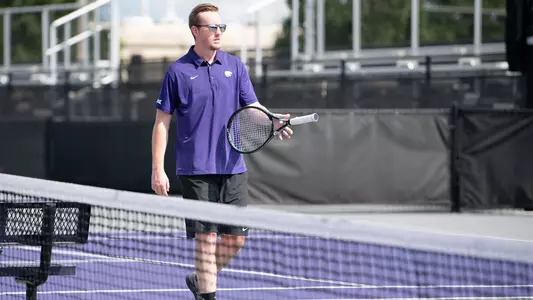
Tom Rees knew he wanted to coach tennis the first week he got to the United States to play the sport. The Worcestershire, England native's reasoning was innate. It took him down his desired path, most recently leading him to become K-State tennis' assistant coach.
"Something about the environment of the college system, what it can do for a player personally; developing their characters and skills," Rees said when he started at K-State in August, "it was just a feeling I had of, 'This is what I wanted to do for a living.'"
That feeling arose more than 10 years ago. Now, Rees said he looks to utilize what he's learned along the way. And there's a lot.
Early in his coaching career, Rees said he had to break out of the individualistic mindset often found in tennis players. His focus quickly became outward. Also, he had to retool his competitiveness. Winning will always be a goal, he said, but not above everything else.
"As a first-time head coach (at Illinois-Springfield), I did think that it was about amassing as many wins on the schedule as possible and probably not focusing enough on long-term development, which is now my priority," Rees said. "I feel strongly that it's all about the process and it's all about setting the players up as individuals for success, on the court and in life.
"I want to make sure that when they finish their playing career, they have an attitude of gratitude, they appreciative everything they've done, and they feel prepared and ready for the next step."
Rees experienced this as a player, especially in his three seasons at UNC Asheville. There, he won 67 matches and a Big South doubles championship. More importantly, at least now, is he played for Lise Gregory, a highly-successful player at the University of Miami who also excelled as a coach, and then-assistant Tom Hand, who previously built Tulane's program into an NCAA Tournament regular and is now UNC Asheville's head coach.
Both shaped how Rees said he coaches now.
"They did a great job of getting to know you as a player, learning about your family, investing in your life, and also working individually with you as a player on the court, helping the players out as much as possible," he said. "Keeping players grounded, I think, was an important thing. We're not inflating egos, but we're not super strict disciplinarians. We're going to keep things grounded, keep everybody level-headed, work hard, focus on the process, focus on the people."
At K-State, his focus on building those relationships at K-State will not be as spread out.
That's because Rees' past coaching positions, first as an assistant at North Georgia (2012-14) and then as a head coach for Illinois-Springfield (2014-16) and Lenoir Rhyne's (2016-18), have all been for both the men's and women's teams.
"Going from a roster of 23 or 24 players down to nine means I'll be able to develop even better relationships with the ladies that we have on the roster here," Rees said.
Once those relationships are established, Rees said he can coach players more effectively. Not only will they trust what he's saying, but he will better understand what works well for them on the court.
"I like to focus on playing a style of tennis that suits the character of each player, so I've got to figure out what works for each girl, what their game style and personality are, and I have to be able to match them up to produce success on the tennis court," he said. "So, really being flexible, being adaptable, staying calm, level headed, investing in the players and focusing on little things that we can do every day to make percentage differences."
Rees also got an opportunity to coach a pair of professional players in the last few years. He said there's plenty of carryovers from each experience that he can use now.
Rubin Statham, ranked as high as No. 279 in singles and No. 139 in doubles, was the first professional Rees coached. Rees said Statham taught him the importance of balance. And not the physical kind, either.
"You have to have everything in balance, or as close to in balance, as you possibly can off the court in order to be able to perform optimally on the court," Rees said. "So, some examples of that would be sleep management, social management, time management, mindset management. Just making sure all aspects of your life, which have potential to cause you unnecessary stress or fatigue, are managed as best as possible to allow you to perform on gameday."
Last summer, Rees worked with Marcos Giron, currently ranked No. 126 in the world. Giron won an NCAA singles championship for UCLA in 2014, and Rees said his short time with the 26-year-old gave him insight into how he reached that level.
"What I learned from him and that experience the most is the importance of doing everything with heightened professionalism, making sure everything from the way you tie your shoelaces and make your bed in the morning, to the way you hit your forehand in practice and on the match court is done to an elite standard, with a high performance mindset," Rees said. "When you do everything every day with that attitude, that endeavor and have those intentions, you're going to be successful."
Alongside K-State head coach Jordan Smith, Rees said he hopes his experience can further the program's success that includes back-to-back winning seasons and a second-round appearance in the 2018 NCAA Tournament.
Ultimately, Rees said this boils down to two areas: Recruiting and culture. Both were essential in Lenoir Rhyne's rise under his leadership, capped by the men and women's teams each setting program records for wins in his last season there. They went a combined 36-9. Both teams earned a national ranking for the first time ever.
"You can't be successful in the long term unless you have both consistently. You have to recruit well. You have to get talent in, otherwise you're not going to win," Rees said, as K-State opens its fall schedule at the Auburn Invitational next week. "And you have to have a strong culture, where you're developing meaningful relationships with all the players, showing that you care for them, that you'll do whatever it takes for them to be successful, and keep their mind in the right place, focus on what you can control. If you do it every day for four years, you're going to be successful."
Tom Rees knew he wanted to coach tennis the first week he got to the United States to play the sport. The Worcestershire, England native's reasoning was innate. It took him down his desired path, most recently leading him to become K-State tennis' assistant coach.
"Something about the environment of the college system, what it can do for a player personally; developing their characters and skills," Rees said when he started at K-State in August, "it was just a feeling I had of, 'This is what I wanted to do for a living.'"
That feeling arose more than 10 years ago. Now, Rees said he looks to utilize what he's learned along the way. And there's a lot.
Early in his coaching career, Rees said he had to break out of the individualistic mindset often found in tennis players. His focus quickly became outward. Also, he had to retool his competitiveness. Winning will always be a goal, he said, but not above everything else.
"As a first-time head coach (at Illinois-Springfield), I did think that it was about amassing as many wins on the schedule as possible and probably not focusing enough on long-term development, which is now my priority," Rees said. "I feel strongly that it's all about the process and it's all about setting the players up as individuals for success, on the court and in life.
"I want to make sure that when they finish their playing career, they have an attitude of gratitude, they appreciative everything they've done, and they feel prepared and ready for the next step."
Rees experienced this as a player, especially in his three seasons at UNC Asheville. There, he won 67 matches and a Big South doubles championship. More importantly, at least now, is he played for Lise Gregory, a highly-successful player at the University of Miami who also excelled as a coach, and then-assistant Tom Hand, who previously built Tulane's program into an NCAA Tournament regular and is now UNC Asheville's head coach.
Both shaped how Rees said he coaches now.
"They did a great job of getting to know you as a player, learning about your family, investing in your life, and also working individually with you as a player on the court, helping the players out as much as possible," he said. "Keeping players grounded, I think, was an important thing. We're not inflating egos, but we're not super strict disciplinarians. We're going to keep things grounded, keep everybody level-headed, work hard, focus on the process, focus on the people."
At K-State, his focus on building those relationships at K-State will not be as spread out.
That's because Rees' past coaching positions, first as an assistant at North Georgia (2012-14) and then as a head coach for Illinois-Springfield (2014-16) and Lenoir Rhyne's (2016-18), have all been for both the men's and women's teams.
"Going from a roster of 23 or 24 players down to nine means I'll be able to develop even better relationships with the ladies that we have on the roster here," Rees said.
Once those relationships are established, Rees said he can coach players more effectively. Not only will they trust what he's saying, but he will better understand what works well for them on the court.
"I like to focus on playing a style of tennis that suits the character of each player, so I've got to figure out what works for each girl, what their game style and personality are, and I have to be able to match them up to produce success on the tennis court," he said. "So, really being flexible, being adaptable, staying calm, level headed, investing in the players and focusing on little things that we can do every day to make percentage differences."
Rees also got an opportunity to coach a pair of professional players in the last few years. He said there's plenty of carryovers from each experience that he can use now.
Rubin Statham, ranked as high as No. 279 in singles and No. 139 in doubles, was the first professional Rees coached. Rees said Statham taught him the importance of balance. And not the physical kind, either.
"You have to have everything in balance, or as close to in balance, as you possibly can off the court in order to be able to perform optimally on the court," Rees said. "So, some examples of that would be sleep management, social management, time management, mindset management. Just making sure all aspects of your life, which have potential to cause you unnecessary stress or fatigue, are managed as best as possible to allow you to perform on gameday."
Last summer, Rees worked with Marcos Giron, currently ranked No. 126 in the world. Giron won an NCAA singles championship for UCLA in 2014, and Rees said his short time with the 26-year-old gave him insight into how he reached that level.
"What I learned from him and that experience the most is the importance of doing everything with heightened professionalism, making sure everything from the way you tie your shoelaces and make your bed in the morning, to the way you hit your forehand in practice and on the match court is done to an elite standard, with a high performance mindset," Rees said. "When you do everything every day with that attitude, that endeavor and have those intentions, you're going to be successful."
Alongside K-State head coach Jordan Smith, Rees said he hopes his experience can further the program's success that includes back-to-back winning seasons and a second-round appearance in the 2018 NCAA Tournament.
Ultimately, Rees said this boils down to two areas: Recruiting and culture. Both were essential in Lenoir Rhyne's rise under his leadership, capped by the men and women's teams each setting program records for wins in his last season there. They went a combined 36-9. Both teams earned a national ranking for the first time ever.
"You can't be successful in the long term unless you have both consistently. You have to recruit well. You have to get talent in, otherwise you're not going to win," Rees said, as K-State opens its fall schedule at the Auburn Invitational next week. "And you have to have a strong culture, where you're developing meaningful relationships with all the players, showing that you care for them, that you'll do whatever it takes for them to be successful, and keep their mind in the right place, focus on what you can control. If you do it every day for four years, you're going to be successful."

K-State Tennis | Weekend Recap vs Old Dominion & Minnesota
Tuesday, February 24
K-State Tennis | Court Updates and Resurfacing
Tuesday, November 11
K-State TEN | Court Resurfacing
Thursday, November 06
K-State Tennis Practice highlights
Tuesday, September 02