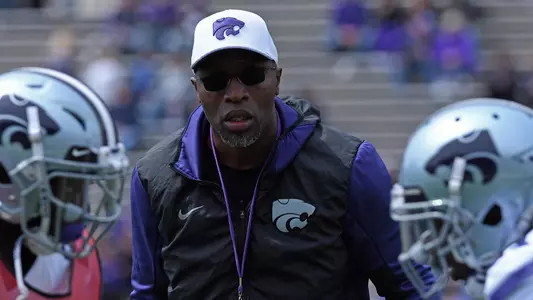
SE: Q&A with K-State Football Assistant Head Coach Van Malone
Jun 17, 2020 | Football, Sports Extra
Van Malone spoke with Austin Siegel of K-State Sports Extra about how the Wildcats coaching staff is supporting student-athletes as they speak up on social issues and racial equality. The conversation has been condensed and edited for clarity.
AS: There's no playbook for how coaches should support their players during a time like this, but what influenced you to be such a strong voice over the last few weeks?
VM: At the end of the day, yes, I'm a coach, but I'm a man first. And I'm an African-American man in this country. When I got into coaching, I wanted to influence young men and teach them things that they need to know about football, but also make them better men and productive citizens in our society.
I lead with that, and I think about where I am in my faith, leading our guys in a way that teaches them to do the right thing. I'm just trying to support them when they're doing right, because I always say that if you're not doing the right things, just look back, because I'm coming after you. But if you're doing the right thing, then I've got your back. You stand behind me and I'll protect you.
AS: It seems like more than ever before, we're in a culture where student-athletes can speak up and are encouraged to speak up about social issues and racial injustice. How has that platform evolved during your career as both a former player and a coach?
VM: There's a group of people out there in the world that would probably say, 'OK athletes, you stick to playing football.' But at the end of the day, student-athletes are growing and want to be productive members of society. They have a voice. They have a platform. I tell our guys, 'You don't want to get into a back-and-forth argument on social media.' But what we have to do is be productive as we use our platforms. This is a moment for change.
AS: Do you think that attitude has changed because of social media, or is it more this culture where student-athletes can shape the national conversation?
VM: I think social media has allowed those things to be readily available. Many of our student-athletes live on social media, so I think it's a perfect storm where all of these worlds can collide, both social justice issues and student-athletes understanding that they have a voice and a platform. For them to be able to use that platform in a positive way is huge. For us as coaches, we want to direct them to use the positive energy of this generation to elicit change. I think it's very powerful.
AS: You've said in the past that you consider yourself a player's coach. During a time like this, what does that look like and how can coaches take the extra step to be available?
VM: Our student-athletes live in a world that's different than ours. I've said this with social media, but sometimes we need to able to spend time and dive into that place where they live. I think they appreciate that, especially in recruiting. It just gives some insight in to what they think and the life that they live. Even when we talk about these social issues, you have to be respectful enough of the other person to see the world through their lens.
As coaches, if we can do that, then it takes the relationship we have with our players to a different level. When we can do that as different ethnic groups and understand people who are different, who grew up different from us, or have different challenges, we can understand the way I think and the way I see the world is not the only way the world can be seen.
AS: When you're meeting with recruits, is there more of an emphasis on finding a coaching staff that is willing to engage with them not just as a football player but also as a man?
VM: I've always recruited with that as a backdrop. Yes, we're going to do everything we can to make you a good football player and ensure that you graduate. But that's the minimum. Coach Klieman always says that if all we've done is develop you as a football player, then we've failed.
That idea is even more prominent as we walk through the life of a student-athlete today. We're going to have to grow all of our guys, black and white, so that they can leave our program prepared for what's going to happen after their time in Manhattan is over.
AS: You've only been at K-State for one season, but what do you think the last few weeks have revealed about the culture you're building in Manhattan as a coaching staff?
VM: When we talk about the issues that we face, one thing that Coach Klieman has built is a system of communication. A system where, when we say family, it's about being able to talk through sensitive issues. There are things that in the general public, you might not be able to talk about.
So, I'm proud of our football team and our athletic department, where Gene Taylor has built that framework and shown that there is a place for people to be direct with their feelings. I've talked with people across the country who don't have that. There are different football programs that don't have that in place, where they are living in a society that says nothing is happening. They go into their athletic department and they can't feel a certain way because nothing is happening. Well, that's not how it is here and I'm proud of that.
AS: There's no playbook for how coaches should support their players during a time like this, but what influenced you to be such a strong voice over the last few weeks?
VM: At the end of the day, yes, I'm a coach, but I'm a man first. And I'm an African-American man in this country. When I got into coaching, I wanted to influence young men and teach them things that they need to know about football, but also make them better men and productive citizens in our society.
I lead with that, and I think about where I am in my faith, leading our guys in a way that teaches them to do the right thing. I'm just trying to support them when they're doing right, because I always say that if you're not doing the right things, just look back, because I'm coming after you. But if you're doing the right thing, then I've got your back. You stand behind me and I'll protect you.
AS: It seems like more than ever before, we're in a culture where student-athletes can speak up and are encouraged to speak up about social issues and racial injustice. How has that platform evolved during your career as both a former player and a coach?
VM: There's a group of people out there in the world that would probably say, 'OK athletes, you stick to playing football.' But at the end of the day, student-athletes are growing and want to be productive members of society. They have a voice. They have a platform. I tell our guys, 'You don't want to get into a back-and-forth argument on social media.' But what we have to do is be productive as we use our platforms. This is a moment for change.
AS: Do you think that attitude has changed because of social media, or is it more this culture where student-athletes can shape the national conversation?
VM: I think social media has allowed those things to be readily available. Many of our student-athletes live on social media, so I think it's a perfect storm where all of these worlds can collide, both social justice issues and student-athletes understanding that they have a voice and a platform. For them to be able to use that platform in a positive way is huge. For us as coaches, we want to direct them to use the positive energy of this generation to elicit change. I think it's very powerful.
AS: You've said in the past that you consider yourself a player's coach. During a time like this, what does that look like and how can coaches take the extra step to be available?
VM: Our student-athletes live in a world that's different than ours. I've said this with social media, but sometimes we need to able to spend time and dive into that place where they live. I think they appreciate that, especially in recruiting. It just gives some insight in to what they think and the life that they live. Even when we talk about these social issues, you have to be respectful enough of the other person to see the world through their lens.
As coaches, if we can do that, then it takes the relationship we have with our players to a different level. When we can do that as different ethnic groups and understand people who are different, who grew up different from us, or have different challenges, we can understand the way I think and the way I see the world is not the only way the world can be seen.
AS: When you're meeting with recruits, is there more of an emphasis on finding a coaching staff that is willing to engage with them not just as a football player but also as a man?
VM: I've always recruited with that as a backdrop. Yes, we're going to do everything we can to make you a good football player and ensure that you graduate. But that's the minimum. Coach Klieman always says that if all we've done is develop you as a football player, then we've failed.
That idea is even more prominent as we walk through the life of a student-athlete today. We're going to have to grow all of our guys, black and white, so that they can leave our program prepared for what's going to happen after their time in Manhattan is over.
AS: You've only been at K-State for one season, but what do you think the last few weeks have revealed about the culture you're building in Manhattan as a coaching staff?
VM: When we talk about the issues that we face, one thing that Coach Klieman has built is a system of communication. A system where, when we say family, it's about being able to talk through sensitive issues. There are things that in the general public, you might not be able to talk about.
So, I'm proud of our football team and our athletic department, where Gene Taylor has built that framework and shown that there is a place for people to be direct with their feelings. I've talked with people across the country who don't have that. There are different football programs that don't have that in place, where they are living in a society that says nothing is happening. They go into their athletic department and they can't feel a certain way because nothing is happening. Well, that's not how it is here and I'm proud of that.
Tuesday, September 01
Tuesday, September 01
Tuesday, September 01
Tuesday, September 01