SE: K-State Defense Trying to Carry On the Mob Legacy
Sep 24, 2021 | Football, Sports Extra
By: D. Scott Fritchen
Kansas State doesn't have to look too far back to recall when its staunch rush defense consistently held opponents to fewer than 100 yards on the ground and less than three yards per rushing attempt. The Wildcats ranked 12th nationally against the run in 2016 and 13th in 2017. Four current defensive players were on that 2017 squad — defensive back Ross Elder, linebacker Ryan Henington, defensive tackle Eli Huggins and defensive end Bronson Massie, who played in nine games as a freshman that season.
However, K-State's rush defense since 2017 has been less effective, finishing 55th, 76th and 78th against the run over the past three seasons. That makes what has transpired in Manhattan over the first three games of the 2021 season even more impressive. K-State ranks sixth in the FBS in rush defense in allowing just 54.7 yards per game. Stanford (39 rush yards on 22 carries), Southern Illinois (100 on 40 carries) and Nevada (25 on 22 carries) all were stuck in mud trying to run the ball against the Wildcats.
No. 25 K-State, 3-0, is off to its best start in rush defense in 20 years.
"Our guys are doing a good job of not allowing themselves to be blocked and are 'changing the math,'" K-State defensive coordinator Joe Klanderman said. "Sometimes when you get things drawn up offensively, you can get a hat on a hat, and sometimes it takes somebody with a super-human effort to change the math on the grease board. We're doing that with a lot of guys."
K-State allowed just 54.6 rushing yards per game after the first three games of the 2001 season against Southern California (100), New Mexico State (45) and Oklahoma (nine). The Wildcats finished 11th in rush defense (96.5) that year, marking one of just four times they have finished a season allowing fewer than 100 rushing yards per game over the last three decades.
Sure, it's early, but so far these Wildcats have demonstrated the propensity to consistently penetrate offensive lines and gobble up quarterbacks and ball carriers.
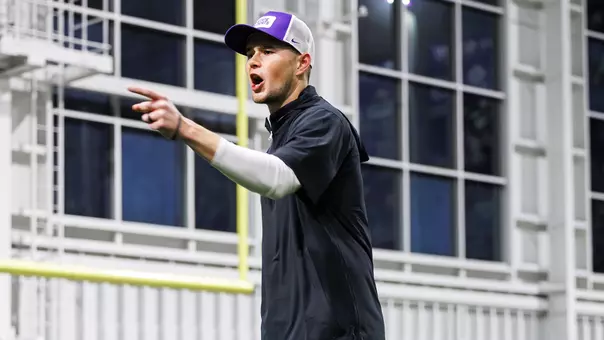
"I'm proud of our guys because they play with a lot of energy and a lot of passion," said Chris Klieman, the defensive-minded third-year K-State head coach who previously led North Dakota State to four FCS national championships. "We have a long way to go but all of us have seen that this is a different group on defense. It's exciting to watch. They're having fun."
In the eight months following the Wildcats' 4-6 campaign last fall, Klieman and Klanderman, who have been together for seven years, sought, among other things, to mend a rush defense that allowed a whopping 177.2 yards per contest. It was the most allowed by K-State since 2010. They spent time consulting fellow defensive gurus and devised the 3-3-5 base defense to alternate with a 4-3 front. It gives linebackers the green light to pursue running backs while multiple rushers confuse the quarterback in passing situations. It's a defense that's grown in popularity in college football in an effort to slow down spread offenses and a look that the Kansas City Chiefs and a host of other NFL teams utilize each year.
"Everything comes down to situational football," Klanderman said. "That's the bottom line. It's situations and what personnel gives us the best chance in those situations. It's all a numbers game, and we're trying to outnumber them at the point of attack with everything that we're doing — run game or pass game. Sometimes the presentation can look a little different with the three-down stuff and it gives you more flexibility to look different ways than the four-down stuff."
A strong rush defense might not cure all, but K-State is seeing the fruits of its labor. Stopping the run and forcing opposing offenses to become one dimensional against a speedy and athletic defensive secondary typically reaps the desired result. Nevada quarterback Carson Strong, a bonafide first-round NFL draft pick next April, had thrown just five interceptions in 449 passing attempts dating back to last season before cornerback Tee Denson picked him in the second quarter of a 38-17 win last Saturday. K-State defenders swarmed and Daniel Green, Reggie Stubblefield and Nate Matlack each recorded a sack. K-State also ranks ninth nationally in averaging 4.0 sacks per contest this season.
"It's been an eight-month process," said Elder, a senior safety who redshirted the 2017 season. "Coming off the COVID year as a team and staff, we had to reset our beliefs. Coach Klanderman and the defensive staff really instilled those values that has helped us to play fast. Our mentality has built up for eight months and it's great to see it paying off.
"We're just playing faster and having fun out there."
Just ask Stanford quarterback Tanner McKee if these Wildcats are fast. The Cardinal traveled 49 yards in 6 plays and faced first-and-10 at the K-State 24-yard line trailing 14-0 with 8 minutes, 39 seconds left in the third quarter. Shortly after McKee took the snap out of shotgun formation, senior defensive tackle Eli Huggins burst through a double team and twisted McKee to the ground for a six-yard loss, prompting one of the first hearty signs of the defense's "fun" side this season.
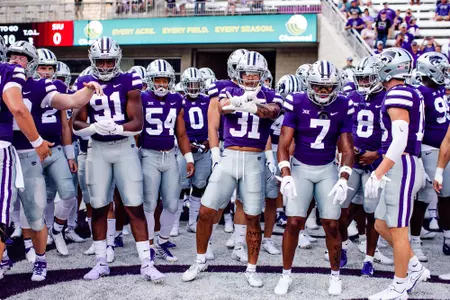
Following his tackle of McKee, Huggins excitedly stood up, raised his arms, and flashed the Mob sign — forming an "L" shape with the thumb and index finger on both hands, and then crossing his hands above his head — a gesture born by former K-State safety William Price in 1991 to symbolize the Wildcats' defensive prowess. In the 1990s and early 2000s, defensive players threw up the Mob symbol with regularity while ranking Top 25 in total defense every season between 1994-2003. In fact, the Wildcats were the only defense in the nation to finish Top 10 in total defense seven straight seasons from 1997-2003.
K-State currently ranks 23rd in total defense while giving up just 280.0 yards per game. The Wildcats haven't held opponents to under 300 yards per game since their 2003 Big 12 Championship season. Although many Big 12 offenses have stylistically changed since then — only 10 Big 12 defenses have allowed fewer than 350 yards per game since 2011 — the desire by these Wildcats to dominate shares a vein with those storied K-State units.
"You look at the great defenses in the past and see the history of the Mob defense, and that's something we wanted to carry on as a legacy," senior linebacker Cody Fletcher said. "It was something so special to the fans who got to watch those teams back in the day. They were so good. They were just flying around. It's something we watch. It gives you goosebumps. It's something we want to bring back."
One gauge to measure K-State's defensive standards rests in the video tape. The tape doesn't lie. Former K-State defensive coordinator Bob Stoops used to pause the tape and count the helmets on the TV screen following a made tackle. If there were fewer than eight helmets present in the frame, it resulted in extra running for the defense in practice. These Wildcats, too, also pause the video tape to inspect overall player involvement at the conclusion of a made tackle, and Klanderman wants to see 11 helmets on every play, adding, "That's the mentality we're trying to establish."
"It's something we emphasized throughout spring and fall camp to try and get that mentality," Klanderman continued. "Guys take pride in that right now."
K-State, behind its run-stopping ability and mob-like tendencies, will face its stiffest test yet when the Wildcats open their Big 12 Conference season at Oklahoma State, 3-0, which survived Missouri State (23-16), Tulsa (28-23) and Boise State (21-20) while harboring an offense that ranks 105th in total yards (336.7), 100th in passing yards (190.0) and 75th in rushing yards (146.7).
"This is going to be an exceptional rushing team that we're going to face in Oklahoma State," Klieman said. "They can beat you a lot of ways, but against Boise State they were able to rush the ball successfully."
The Wildcats, who have lost two straight in the series (26-13 in 2019 and 20-18 in 2020), seek their first victory in Stillwater, Oklahoma, since Skylar Thompson in his second-career start threw for 204 yards and three touchdowns and rushed for 93 yards and one score in a 45-40 victory in 2017, lifting the Wildcats to their first win at Boone Pickens Stadium since 1999.
Offense has proven at times troublesome for the Spencer Sanders-led Cowboys, who rank 98th in averaging 24.0 point per game. They'll be tested by a Wildcats' defense that ranks 21st in surrendering just 15.7 points per contest. Oklahoma State's best bet might lie in the legs of running back Jaylen Warren, a 5-foot-8, 215-pound redshirt senior who is one of the most-utilized ball carriers in the conference. Warren has 52 carries for 299 yards (5.08 yards per carry) and four touchdowns and is eighth in the league in rushing yards per game (88.0).
"We're excited for it," Fletcher said. "We know they can run the ball well. I think we're ready for it. We know what they want to do. The key is to shut down the running game and make them one dimensional and get them uncomfortable. Controlling the line of scrimmage and getting the pass rush is the most important thing."
It's been 12 years since a K-State defense has allowed opposing Big 12 offenses fewer than 115 rushing yards per game over the course of a league season, and 2003 was the last time the Wildcats' rush defense yielded, on average, fewer than 110 rushing yards over the course of an entire season schedule.
A stout rushing defense might not always cure all, but it's mightily important, and the attention to detail and courage demonstrated by Klieman and Klanderman in revamping their defense over the span of eight months, and then teaching it to six transfers and 11 returners that combined for 57 starts last season, appears to be the biggest home run of this early season.
Apparently, there's more in the works for the league season.
"Situational football is going to dictate what we do and how we do it," Klanderman said. "We've got a lot of stuff in the cache."
On paper, these Wildcats are stout. On the field, these Wildcats carry that old-school passion. Hopefully for the Wildcats, they can once again ride through the crisp autumn, conjuring visions of a dominant past, while snarling and swarming to the pigskin. All that is missing is the swag that only builds through consistent improvement, and that long ago turned cold fall months into the hottest time of the year for the K-State defense.
"They laid the foundation for us all to be successful," Klieman said. "We watch a lot of videos about K-State of the past. Why we have all this great stuff is because of what Coach Snyder did and all those players.
"It's trying to carry on some of the legacy that was built before us and trying to honor those guys."
Kansas State doesn't have to look too far back to recall when its staunch rush defense consistently held opponents to fewer than 100 yards on the ground and less than three yards per rushing attempt. The Wildcats ranked 12th nationally against the run in 2016 and 13th in 2017. Four current defensive players were on that 2017 squad — defensive back Ross Elder, linebacker Ryan Henington, defensive tackle Eli Huggins and defensive end Bronson Massie, who played in nine games as a freshman that season.
However, K-State's rush defense since 2017 has been less effective, finishing 55th, 76th and 78th against the run over the past three seasons. That makes what has transpired in Manhattan over the first three games of the 2021 season even more impressive. K-State ranks sixth in the FBS in rush defense in allowing just 54.7 yards per game. Stanford (39 rush yards on 22 carries), Southern Illinois (100 on 40 carries) and Nevada (25 on 22 carries) all were stuck in mud trying to run the ball against the Wildcats.
No. 25 K-State, 3-0, is off to its best start in rush defense in 20 years.
"Our guys are doing a good job of not allowing themselves to be blocked and are 'changing the math,'" K-State defensive coordinator Joe Klanderman said. "Sometimes when you get things drawn up offensively, you can get a hat on a hat, and sometimes it takes somebody with a super-human effort to change the math on the grease board. We're doing that with a lot of guys."
K-State allowed just 54.6 rushing yards per game after the first three games of the 2001 season against Southern California (100), New Mexico State (45) and Oklahoma (nine). The Wildcats finished 11th in rush defense (96.5) that year, marking one of just four times they have finished a season allowing fewer than 100 rushing yards per game over the last three decades.
Sure, it's early, but so far these Wildcats have demonstrated the propensity to consistently penetrate offensive lines and gobble up quarterbacks and ball carriers.
"I'm proud of our guys because they play with a lot of energy and a lot of passion," said Chris Klieman, the defensive-minded third-year K-State head coach who previously led North Dakota State to four FCS national championships. "We have a long way to go but all of us have seen that this is a different group on defense. It's exciting to watch. They're having fun."
In the eight months following the Wildcats' 4-6 campaign last fall, Klieman and Klanderman, who have been together for seven years, sought, among other things, to mend a rush defense that allowed a whopping 177.2 yards per contest. It was the most allowed by K-State since 2010. They spent time consulting fellow defensive gurus and devised the 3-3-5 base defense to alternate with a 4-3 front. It gives linebackers the green light to pursue running backs while multiple rushers confuse the quarterback in passing situations. It's a defense that's grown in popularity in college football in an effort to slow down spread offenses and a look that the Kansas City Chiefs and a host of other NFL teams utilize each year.
"Everything comes down to situational football," Klanderman said. "That's the bottom line. It's situations and what personnel gives us the best chance in those situations. It's all a numbers game, and we're trying to outnumber them at the point of attack with everything that we're doing — run game or pass game. Sometimes the presentation can look a little different with the three-down stuff and it gives you more flexibility to look different ways than the four-down stuff."
A strong rush defense might not cure all, but K-State is seeing the fruits of its labor. Stopping the run and forcing opposing offenses to become one dimensional against a speedy and athletic defensive secondary typically reaps the desired result. Nevada quarterback Carson Strong, a bonafide first-round NFL draft pick next April, had thrown just five interceptions in 449 passing attempts dating back to last season before cornerback Tee Denson picked him in the second quarter of a 38-17 win last Saturday. K-State defenders swarmed and Daniel Green, Reggie Stubblefield and Nate Matlack each recorded a sack. K-State also ranks ninth nationally in averaging 4.0 sacks per contest this season.
"It's been an eight-month process," said Elder, a senior safety who redshirted the 2017 season. "Coming off the COVID year as a team and staff, we had to reset our beliefs. Coach Klanderman and the defensive staff really instilled those values that has helped us to play fast. Our mentality has built up for eight months and it's great to see it paying off.
"We're just playing faster and having fun out there."
Just ask Stanford quarterback Tanner McKee if these Wildcats are fast. The Cardinal traveled 49 yards in 6 plays and faced first-and-10 at the K-State 24-yard line trailing 14-0 with 8 minutes, 39 seconds left in the third quarter. Shortly after McKee took the snap out of shotgun formation, senior defensive tackle Eli Huggins burst through a double team and twisted McKee to the ground for a six-yard loss, prompting one of the first hearty signs of the defense's "fun" side this season.
Following his tackle of McKee, Huggins excitedly stood up, raised his arms, and flashed the Mob sign — forming an "L" shape with the thumb and index finger on both hands, and then crossing his hands above his head — a gesture born by former K-State safety William Price in 1991 to symbolize the Wildcats' defensive prowess. In the 1990s and early 2000s, defensive players threw up the Mob symbol with regularity while ranking Top 25 in total defense every season between 1994-2003. In fact, the Wildcats were the only defense in the nation to finish Top 10 in total defense seven straight seasons from 1997-2003.
K-State currently ranks 23rd in total defense while giving up just 280.0 yards per game. The Wildcats haven't held opponents to under 300 yards per game since their 2003 Big 12 Championship season. Although many Big 12 offenses have stylistically changed since then — only 10 Big 12 defenses have allowed fewer than 350 yards per game since 2011 — the desire by these Wildcats to dominate shares a vein with those storied K-State units.
"You look at the great defenses in the past and see the history of the Mob defense, and that's something we wanted to carry on as a legacy," senior linebacker Cody Fletcher said. "It was something so special to the fans who got to watch those teams back in the day. They were so good. They were just flying around. It's something we watch. It gives you goosebumps. It's something we want to bring back."
One gauge to measure K-State's defensive standards rests in the video tape. The tape doesn't lie. Former K-State defensive coordinator Bob Stoops used to pause the tape and count the helmets on the TV screen following a made tackle. If there were fewer than eight helmets present in the frame, it resulted in extra running for the defense in practice. These Wildcats, too, also pause the video tape to inspect overall player involvement at the conclusion of a made tackle, and Klanderman wants to see 11 helmets on every play, adding, "That's the mentality we're trying to establish."
"It's something we emphasized throughout spring and fall camp to try and get that mentality," Klanderman continued. "Guys take pride in that right now."
K-State, behind its run-stopping ability and mob-like tendencies, will face its stiffest test yet when the Wildcats open their Big 12 Conference season at Oklahoma State, 3-0, which survived Missouri State (23-16), Tulsa (28-23) and Boise State (21-20) while harboring an offense that ranks 105th in total yards (336.7), 100th in passing yards (190.0) and 75th in rushing yards (146.7).
"This is going to be an exceptional rushing team that we're going to face in Oklahoma State," Klieman said. "They can beat you a lot of ways, but against Boise State they were able to rush the ball successfully."
The Wildcats, who have lost two straight in the series (26-13 in 2019 and 20-18 in 2020), seek their first victory in Stillwater, Oklahoma, since Skylar Thompson in his second-career start threw for 204 yards and three touchdowns and rushed for 93 yards and one score in a 45-40 victory in 2017, lifting the Wildcats to their first win at Boone Pickens Stadium since 1999.
Offense has proven at times troublesome for the Spencer Sanders-led Cowboys, who rank 98th in averaging 24.0 point per game. They'll be tested by a Wildcats' defense that ranks 21st in surrendering just 15.7 points per contest. Oklahoma State's best bet might lie in the legs of running back Jaylen Warren, a 5-foot-8, 215-pound redshirt senior who is one of the most-utilized ball carriers in the conference. Warren has 52 carries for 299 yards (5.08 yards per carry) and four touchdowns and is eighth in the league in rushing yards per game (88.0).
"We're excited for it," Fletcher said. "We know they can run the ball well. I think we're ready for it. We know what they want to do. The key is to shut down the running game and make them one dimensional and get them uncomfortable. Controlling the line of scrimmage and getting the pass rush is the most important thing."
It's been 12 years since a K-State defense has allowed opposing Big 12 offenses fewer than 115 rushing yards per game over the course of a league season, and 2003 was the last time the Wildcats' rush defense yielded, on average, fewer than 110 rushing yards over the course of an entire season schedule.
A stout rushing defense might not always cure all, but it's mightily important, and the attention to detail and courage demonstrated by Klieman and Klanderman in revamping their defense over the span of eight months, and then teaching it to six transfers and 11 returners that combined for 57 starts last season, appears to be the biggest home run of this early season.
Apparently, there's more in the works for the league season.
"Situational football is going to dictate what we do and how we do it," Klanderman said. "We've got a lot of stuff in the cache."
On paper, these Wildcats are stout. On the field, these Wildcats carry that old-school passion. Hopefully for the Wildcats, they can once again ride through the crisp autumn, conjuring visions of a dominant past, while snarling and swarming to the pigskin. All that is missing is the swag that only builds through consistent improvement, and that long ago turned cold fall months into the hottest time of the year for the K-State defense.
"They laid the foundation for us all to be successful," Klieman said. "We watch a lot of videos about K-State of the past. Why we have all this great stuff is because of what Coach Snyder did and all those players.
"It's trying to carry on some of the legacy that was built before us and trying to honor those guys."
Players Mentioned

DB
/ Football
LB
/ Football
LB
/ Football
LB
/ Football
DT
/ Football
DE
/ Football
DE
/ Football
DB
/ Football
QB
/ FootballK-State Men's Basketball | Postgame Press Conference at Colorado
Thursday, February 26
K-State Rowing | Media Day
Tuesday, February 24
K-State Rowing | Weights Practice
Tuesday, February 24
K-State Tennis | Weekend Recap vs Old Dominion & Minnesota
Tuesday, February 24