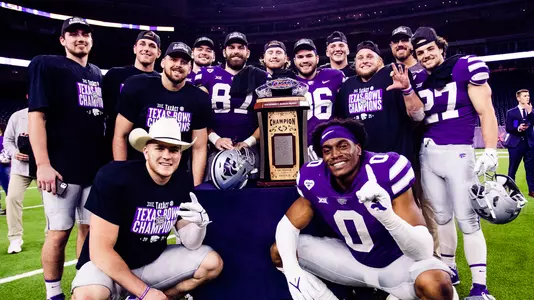
SE: Lepak, K-State a Great Fit
Feb 02, 2022 | Football, Sports Extra
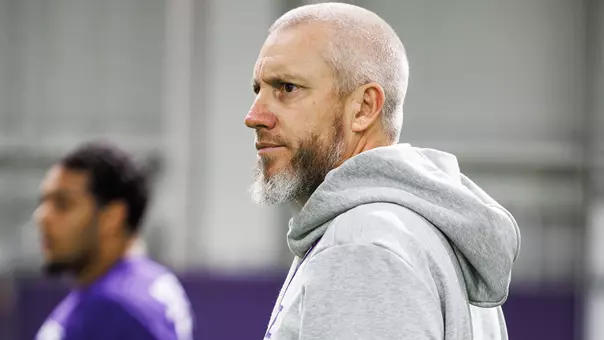
Brian Lepak was on the verge of serving as an attorney at a law firm in Oklahoma City. Then he received a phone call from Kevin Wilson that changed his life. A member of Oklahoma's 2010 Big 12 Championship team, the former lightly recruited offensive lineman from Claremore, Oklahoma, has now spent nearly a decade filling various roles on coaching staffs.
After graduate assistant stints at Indiana and Oklahoma, Lepak served as run game coordinator and offensive line coach at Southern for its 2021 spring season. Lepak then served as K-State's senior offensive quality control coach during the fall. It appears that Lepak, wife Colleen, and children Thomas and Penelope have found a home in Manhattan. K-State head coach Chris Klieman hired Lepak as tight ends and fullbacks coach last week.
K-State Sports Extra's D. Scott Fritchen sat down with Lepak to discuss his new role, his coaching influences, and his passion for being a part of the K-State coaching staff.
D. SCOTT FRITCHEN: Last Monday it was announced that Coach Klieman had elevated you to tight ends and fullbacks coach. How did you learn about your promotion and what was your first official week like on the job?
BRIAN LEPAK: I was down in Oklahoma. When Coach Klieman called me and told me about my new role, I was very honored. It's a good thing that it wasn't in person, you know? I was driving between high schools and had to pull over on the side of the road to do a FaceTime with him. We spoke for a minute, and then he offered me the job. He said, "Would you like that?" I immediately said "Yes." That wasn't a question. I got off the phone and called my wife right away. She's had to go along for the ride the whole time, all these years. It was a big deal for me, but also for my wife. She got emotional about it.
It's just been a lot of work. You put in a lot of time and sacrifice a lot. I was incredibly grateful. It inspires a lot of loyalty because Coach Klieman is taking his shot on me. It was a big deal. It's hard to put into words. I'm really excited. I'm really honored. I just feel a lot of energy. I don't know how else to describe it. It motivates you even more, but I was motivated when I got here, and I was really excited to get here in the first place.
There were a lot of congratulations and people reaching out, but more than anything I wanted to focus on the job in front of me. This last week has been straight recruiting. I was on the road, and I kept going and tried to identify people for the next recruiting classes and made a lot of phone calls, so there were a lot of moving parts and logistics with all of that.
I came here from Southern and to have the opportunity to work for Coach Klieman was a big deal for me. I spent the first six years as a graduate assistant at Power 5 schools. Then I went to Southern, and it is kind of lower on the totem pole. I saw what a great opportunity this was to be able to get affiliated with a program like this that has a reputation for development. This program is centered on developing athletes as opposed to always getting the game-ready guy and sticking them in. That was exciting for me and something personally for me, I felt like I fit in really well culture wise.
I didn't think I had the easiest path to play college football. I wasn't heavily recruited. I went to Colorado State and transferred to Oklahoma. I wasn't the most talented guy, but I was a hard-working guy, so I felt like a lot of the culture here at K-State reflected me personally. The moment I got here, what became apparent to me was this was a fit, this was a place where I belonged.
DSF: You mention your wife, Colleen, and all her support. It's seldom easy to be a coach's wife. How did you meet and what were her thoughts on you becoming a coach?
BL: She met me when I was in law school. Her older brother and I went to law school together. I was in the class behind him but we're the same age. He had seen me at an event and saw me at Mass the next day, and then he had me in class for a week, and he said, "I want to introduce you to my little sister." He didn't know what was going to happen with that. That was my second year of law school. I told her that I was interested in coaching, and she stuck with me through it. I was supposed to start my job at a law firm in Oklahoma City, about two weeks before the bar, and I got a call from Kevin Wilson. Wilson was the head coach at Indiana, and he was my offensive coordinator when I played at Oklahoma. He's the one that told me, "If you're thinking about coaching, make sure it's what you really want to do." A lot of guys get finished playing and they don't know if they just miss playing or if they really want to coach.
Kevin Wilson called me two weeks before the bar and said, "Do you still have an interest in coaching?" I said, "Yes." He said, "I have a graduate assistant position open, and I want you to come up here and interview for it." I flew up there the week before the bar, got the job, and came back. At this time, I was in Norman, my wife was working as a nurse at a children's hospital in Fort Worth, and she was taking a job at Oklahoma City where I was originally going to be working. We were dating at the time, and I planned at the time to take the signing bonus from the law firm I was going to work at, and buy a ring, and get engaged in September. All of that went out the window.
I took the bar exam Tuesday and Wednesday. On Thursday, I packed up. Friday, I took my stuff to my parents' house in Claremore, Oklahoma, and got engaged that night without a ring. Then Saturday morning, I got up, told my parents what I did, got into the car, drove to Bloomington, Indiana, and started fall camp on Sunday. She relocated to Bloomington after that first season. We got married that summer, Fourth of July of 2015. She's a trooper.
DSF: As you know, some programs across the country have gone away from tight ends and fullbacks, but both positions really are key ingredients within the Klieman footprint. How exciting is to be charged with directing some of the key cogs for this offense?
BL: It's huge. Tight ends and fullbacks are the adjusters in this offense here. They're critical to our running game and they're offensive skill positions that we need for our passing game. We're not always going to have three and four wide receivers on the field. For me, it's exciting because I come from an offensive line background. For me to be able to sit on both sides of that from how things work from a blocking perspective and an offensive line-focused, run-game perspective and attach that to the passing game is an exciting opportunity for me. It gives me the opportunity to sit between two different worlds.
I've always been someone that cares about the broader scheme. To be able to step into the skill position is exciting for me. I'm pretty excited about all of them on our roster. We have a very talented room and it's a room that has a lot of great competition and it's a room with a lot of guys who've had experience at different times. We've got a good group of guys. We've got talent in the room. It's the most tight ends and fullbacks I've seen in one room in anyplace I've been at. They all have different skill sets and they're all developing in different ways. It's fun to have that kind of diverse room.

DSF: Who are some of your coaching influences?
BL: First of all, I got recruited to Colorado State out of high school by Dave Arnold. He's been a huge influence in my life. Dave Arnold was a huge inspiration for me and he's a big part of the reason I'm coaching. He's a guy who identified me when I wasn't really getting recruited very much. He was a patient recruiter, a detailed recruiter, and a real relationship guy. He always cared about me and my family, and he's someone who cared about his players. He's always been a huge influence.
A big reason why I went to Colorado State was because of Sonny Lubick. Both of those men really reminded me of my grandfather and his brothers. When Coach Lubick was done at Colorado State, I transferred to Oklahoma. Obviously, Kevin Wilson had a big influence on me along with my offensive line coach James Patton. I got to work with both of them again at Indiana. Obviously, Coach Bob Stoops, the confidence and leadership he always brought was a major influence to me on how you approach things. Nothing would derail Bob. Nothing. If the bus broke down on the way to the Texas game, it didn't matter. Get on the next bus and let's go. That confidence is something that I always admired.
Coach Wilson's influence, playing for him and getting to work for him, I saw a view of the game that it's a lot more of a space game, and I gained the mentality of, "We're going this direction and we're going to get the job done. We're going to keep attacking." I keep in touch with Coach Wilson probably on a monthly basis, just to talking about life, and to pick his brain on different things. There are a lot more major influences. Kevin Johns was the first offensive coordinator I worked for at Indiana. Greg Frye was the offensive line coach I worked for at Indiana. They were great influences for me. Courtney Messingham. Many guys took time with me and helped develop me. There are more than I can name — Lincoln Riley and Cale Gundy were great influences, too.
DSF: What did the role as K-State offensive quality control entail?
BL: The big part of the role was I was the advance scout guy. So, I broke down opponents. I watched every game of the upcoming opponent that season and broke down with the help of our graduate assistants. Blitz tendencies and coverage tendencies, and basically looked at the frequency with which they'd do something in certain situations. So first and second down, what's the core of their defense and what pressures to they bring and what indicators do we have of that? More than anything, it's about keeping track of what you get to practice, so that as you game plan you say, "Hey, we hit that play against their base look, but we need to do it against their No. 1 blitz as well," or, "OK, we might not have the clip on film of them running corner blitz against this formation, but if we wind up in that formation, they have the defensive call in, how would they have to adjust to make it happen?" That's studying down to every time they bring a corner blitz, they bring it to a 3-technique, so we have to make sure the front is set the right direction, so when we do it against a different set, it still happens correctly. That's getting those looks practiced for our guys, so when we get to Saturday it's not the first time they're seeing it.
A lot of times that role when we're game planning, it was, "OK, this is up on film and we're watching this play, and I'm able to say, 'That was a bust defensively right there. We don't need to game plan against that because that only happened one time and they were probably trying to run this.'" I studied concepts that I saw on film that worked and plays that had big gains. I always brought those up. Obviously, I studied personnel and matchups, who's a good player and who's not. Everybody works pretty hard. Our days early in the week start at about 6 a.m. or 6:30 a.m. and run late into the evening hours. We've finish practice and watch it and we'd be out of here shutting down usually around 9 p.m. I usually stayed another two hours or so after that. Then I got up early, just to get through the volume of breaking stuff down. On Thursdays, I'd already be working on the next opponent. I got a jump on the next guy.
DSF: How cohesive is this offensive coaching staff?
BL: It is cohesive. The experience through the bowl game was great. Collin Klein did a very good job leading us. I thought we all understood each other and spoke the same language. For me, personally, being able to stand in between helping Coach Conor Riley with the offensive line to helping Collin, that was a very good functioning unit. Everybody kind of has a little bit different perspective, and some of that is by the position you coach. So, it's by your background. Right now, the current composition of the staff, Coach Riley comes from a lot of that North Dakota State background and comes with the culture that Coach Klieman brought in. Collin is Kansas State through and through. Coach Brian Anderson has a totally different background coming through Jerry Kill, so he has a background that's from a different style. Then there's my background being an Oklahoma guy and staying honestly within that tree all the way through going to Southern, more of a spread offense. That gives us a lot of different influences to bounce ideas off each other. I don't think anybody has a huge ego. I think a lot of times that's what brings down a staff and where guys have problems. We don't have egos. If an idea isn't going to be a good fit, no one is trying to fit a square peg into a round hole.
DSF: You've already done so much in your life, what have you learned most about yourself in the last couple years?
BL: The biggest thing is I have a lot of people that support me, whether it's my wife, my family growing up with my siblings and parents and aunts and uncles. I have a large support network and a lot of people who care about me and want me to be successful. Knowing how many people are like that is always surprising to me. You never realize that until you become older. The other thing I've learned over these last several years is you really have to listen and pay attention. Nobody is ever going to tell you exactly what to do, but if you stop and watch and really think about the why, you get a lot more out of it than somebody telling you what to do. That's something early on that I maybe didn't notice, but as time as worn on, I think, "Why was I asked to do that?" and when I stop and think about it, I figure out why. That's made me a better coach and better person. Those are two of the biggest things. I drink a lot of coffee. I figured that out, too. Way too much coffee. Coach Riley gives me crap about that all the time. I'll start drinking a cup of coffee at 5 p.m. He says I have to get more sleep and not drink as much coffee, but shoot, that started my first year of law school. I'd never been a coffee drinker prior to that.

DSF: Every place has its own characteristics and culture. What do you appreciate about K-State and the Manhattan community?
BL: I always knew about Kansas State by reputation. I grew up with one person who was a K-State grad, a friend of mine from high school went to Kansas State. One day he went on a driving tour of universities. He came to KU and then came to Manhattan. When he went to KU, he showed up unannounced, and they wouldn't work with him. He came to Kansas State, and Pat Bosco showed up at the student affairs office, and he personally gave him a campus tour on a random day. There's a real culture here of people who care about people and care about building relationships. I've noticed that people who are K-State people love their university and they come back all the time. I'm an OU guy and there are people who love OU and people who love their universities, but I've never seen the number of people who their dream is to retire and go back to Manhattan, Kansas. That's something to me that's very unique.
They pour into Kansas State a lot. They bleed purple. You notice that immediately when you get here. There's a deep love and appreciation, and they love the experience they had here, they love their university, and they want to come back. You see that with the charitable giving to the athletic department and to the university as well. You see it with the attendance. People come back for games, football or basketball, or any other sporting event, they're heavily invested because they care about the school. It's not just about watching sports. They care about their university and about this community, and they have great experiences and memories here. They want to be back.
After graduate assistant stints at Indiana and Oklahoma, Lepak served as run game coordinator and offensive line coach at Southern for its 2021 spring season. Lepak then served as K-State's senior offensive quality control coach during the fall. It appears that Lepak, wife Colleen, and children Thomas and Penelope have found a home in Manhattan. K-State head coach Chris Klieman hired Lepak as tight ends and fullbacks coach last week.
K-State Sports Extra's D. Scott Fritchen sat down with Lepak to discuss his new role, his coaching influences, and his passion for being a part of the K-State coaching staff.
D. SCOTT FRITCHEN: Last Monday it was announced that Coach Klieman had elevated you to tight ends and fullbacks coach. How did you learn about your promotion and what was your first official week like on the job?
BRIAN LEPAK: I was down in Oklahoma. When Coach Klieman called me and told me about my new role, I was very honored. It's a good thing that it wasn't in person, you know? I was driving between high schools and had to pull over on the side of the road to do a FaceTime with him. We spoke for a minute, and then he offered me the job. He said, "Would you like that?" I immediately said "Yes." That wasn't a question. I got off the phone and called my wife right away. She's had to go along for the ride the whole time, all these years. It was a big deal for me, but also for my wife. She got emotional about it.
It's just been a lot of work. You put in a lot of time and sacrifice a lot. I was incredibly grateful. It inspires a lot of loyalty because Coach Klieman is taking his shot on me. It was a big deal. It's hard to put into words. I'm really excited. I'm really honored. I just feel a lot of energy. I don't know how else to describe it. It motivates you even more, but I was motivated when I got here, and I was really excited to get here in the first place.
There were a lot of congratulations and people reaching out, but more than anything I wanted to focus on the job in front of me. This last week has been straight recruiting. I was on the road, and I kept going and tried to identify people for the next recruiting classes and made a lot of phone calls, so there were a lot of moving parts and logistics with all of that.
I came here from Southern and to have the opportunity to work for Coach Klieman was a big deal for me. I spent the first six years as a graduate assistant at Power 5 schools. Then I went to Southern, and it is kind of lower on the totem pole. I saw what a great opportunity this was to be able to get affiliated with a program like this that has a reputation for development. This program is centered on developing athletes as opposed to always getting the game-ready guy and sticking them in. That was exciting for me and something personally for me, I felt like I fit in really well culture wise.
I didn't think I had the easiest path to play college football. I wasn't heavily recruited. I went to Colorado State and transferred to Oklahoma. I wasn't the most talented guy, but I was a hard-working guy, so I felt like a lot of the culture here at K-State reflected me personally. The moment I got here, what became apparent to me was this was a fit, this was a place where I belonged.
"He brings a great amount of energy, intelligence and football knowledge to our staff room, and I know that our tight ends and fullbacks will benefit greatly from his leadership."@CoachBrianLepak - Tight Ends/Fullbacks
— K-State Football (@KStateFB) January 24, 2022
📄 https://t.co/fZehkyKNIR pic.twitter.com/U2kEJMxOxD
DSF: You mention your wife, Colleen, and all her support. It's seldom easy to be a coach's wife. How did you meet and what were her thoughts on you becoming a coach?
BL: She met me when I was in law school. Her older brother and I went to law school together. I was in the class behind him but we're the same age. He had seen me at an event and saw me at Mass the next day, and then he had me in class for a week, and he said, "I want to introduce you to my little sister." He didn't know what was going to happen with that. That was my second year of law school. I told her that I was interested in coaching, and she stuck with me through it. I was supposed to start my job at a law firm in Oklahoma City, about two weeks before the bar, and I got a call from Kevin Wilson. Wilson was the head coach at Indiana, and he was my offensive coordinator when I played at Oklahoma. He's the one that told me, "If you're thinking about coaching, make sure it's what you really want to do." A lot of guys get finished playing and they don't know if they just miss playing or if they really want to coach.
Kevin Wilson called me two weeks before the bar and said, "Do you still have an interest in coaching?" I said, "Yes." He said, "I have a graduate assistant position open, and I want you to come up here and interview for it." I flew up there the week before the bar, got the job, and came back. At this time, I was in Norman, my wife was working as a nurse at a children's hospital in Fort Worth, and she was taking a job at Oklahoma City where I was originally going to be working. We were dating at the time, and I planned at the time to take the signing bonus from the law firm I was going to work at, and buy a ring, and get engaged in September. All of that went out the window.
I took the bar exam Tuesday and Wednesday. On Thursday, I packed up. Friday, I took my stuff to my parents' house in Claremore, Oklahoma, and got engaged that night without a ring. Then Saturday morning, I got up, told my parents what I did, got into the car, drove to Bloomington, Indiana, and started fall camp on Sunday. She relocated to Bloomington after that first season. We got married that summer, Fourth of July of 2015. She's a trooper.
DSF: As you know, some programs across the country have gone away from tight ends and fullbacks, but both positions really are key ingredients within the Klieman footprint. How exciting is to be charged with directing some of the key cogs for this offense?
BL: It's huge. Tight ends and fullbacks are the adjusters in this offense here. They're critical to our running game and they're offensive skill positions that we need for our passing game. We're not always going to have three and four wide receivers on the field. For me, it's exciting because I come from an offensive line background. For me to be able to sit on both sides of that from how things work from a blocking perspective and an offensive line-focused, run-game perspective and attach that to the passing game is an exciting opportunity for me. It gives me the opportunity to sit between two different worlds.
I've always been someone that cares about the broader scheme. To be able to step into the skill position is exciting for me. I'm pretty excited about all of them on our roster. We have a very talented room and it's a room that has a lot of great competition and it's a room with a lot of guys who've had experience at different times. We've got a good group of guys. We've got talent in the room. It's the most tight ends and fullbacks I've seen in one room in anyplace I've been at. They all have different skill sets and they're all developing in different ways. It's fun to have that kind of diverse room.
DSF: Who are some of your coaching influences?
BL: First of all, I got recruited to Colorado State out of high school by Dave Arnold. He's been a huge influence in my life. Dave Arnold was a huge inspiration for me and he's a big part of the reason I'm coaching. He's a guy who identified me when I wasn't really getting recruited very much. He was a patient recruiter, a detailed recruiter, and a real relationship guy. He always cared about me and my family, and he's someone who cared about his players. He's always been a huge influence.
A big reason why I went to Colorado State was because of Sonny Lubick. Both of those men really reminded me of my grandfather and his brothers. When Coach Lubick was done at Colorado State, I transferred to Oklahoma. Obviously, Kevin Wilson had a big influence on me along with my offensive line coach James Patton. I got to work with both of them again at Indiana. Obviously, Coach Bob Stoops, the confidence and leadership he always brought was a major influence to me on how you approach things. Nothing would derail Bob. Nothing. If the bus broke down on the way to the Texas game, it didn't matter. Get on the next bus and let's go. That confidence is something that I always admired.
Coach Wilson's influence, playing for him and getting to work for him, I saw a view of the game that it's a lot more of a space game, and I gained the mentality of, "We're going this direction and we're going to get the job done. We're going to keep attacking." I keep in touch with Coach Wilson probably on a monthly basis, just to talking about life, and to pick his brain on different things. There are a lot more major influences. Kevin Johns was the first offensive coordinator I worked for at Indiana. Greg Frye was the offensive line coach I worked for at Indiana. They were great influences for me. Courtney Messingham. Many guys took time with me and helped develop me. There are more than I can name — Lincoln Riley and Cale Gundy were great influences, too.
DSF: What did the role as K-State offensive quality control entail?
BL: The big part of the role was I was the advance scout guy. So, I broke down opponents. I watched every game of the upcoming opponent that season and broke down with the help of our graduate assistants. Blitz tendencies and coverage tendencies, and basically looked at the frequency with which they'd do something in certain situations. So first and second down, what's the core of their defense and what pressures to they bring and what indicators do we have of that? More than anything, it's about keeping track of what you get to practice, so that as you game plan you say, "Hey, we hit that play against their base look, but we need to do it against their No. 1 blitz as well," or, "OK, we might not have the clip on film of them running corner blitz against this formation, but if we wind up in that formation, they have the defensive call in, how would they have to adjust to make it happen?" That's studying down to every time they bring a corner blitz, they bring it to a 3-technique, so we have to make sure the front is set the right direction, so when we do it against a different set, it still happens correctly. That's getting those looks practiced for our guys, so when we get to Saturday it's not the first time they're seeing it.
A lot of times that role when we're game planning, it was, "OK, this is up on film and we're watching this play, and I'm able to say, 'That was a bust defensively right there. We don't need to game plan against that because that only happened one time and they were probably trying to run this.'" I studied concepts that I saw on film that worked and plays that had big gains. I always brought those up. Obviously, I studied personnel and matchups, who's a good player and who's not. Everybody works pretty hard. Our days early in the week start at about 6 a.m. or 6:30 a.m. and run late into the evening hours. We've finish practice and watch it and we'd be out of here shutting down usually around 9 p.m. I usually stayed another two hours or so after that. Then I got up early, just to get through the volume of breaking stuff down. On Thursdays, I'd already be working on the next opponent. I got a jump on the next guy.
DSF: How cohesive is this offensive coaching staff?
BL: It is cohesive. The experience through the bowl game was great. Collin Klein did a very good job leading us. I thought we all understood each other and spoke the same language. For me, personally, being able to stand in between helping Coach Conor Riley with the offensive line to helping Collin, that was a very good functioning unit. Everybody kind of has a little bit different perspective, and some of that is by the position you coach. So, it's by your background. Right now, the current composition of the staff, Coach Riley comes from a lot of that North Dakota State background and comes with the culture that Coach Klieman brought in. Collin is Kansas State through and through. Coach Brian Anderson has a totally different background coming through Jerry Kill, so he has a background that's from a different style. Then there's my background being an Oklahoma guy and staying honestly within that tree all the way through going to Southern, more of a spread offense. That gives us a lot of different influences to bounce ideas off each other. I don't think anybody has a huge ego. I think a lot of times that's what brings down a staff and where guys have problems. We don't have egos. If an idea isn't going to be a good fit, no one is trying to fit a square peg into a round hole.
DSF: You've already done so much in your life, what have you learned most about yourself in the last couple years?
BL: The biggest thing is I have a lot of people that support me, whether it's my wife, my family growing up with my siblings and parents and aunts and uncles. I have a large support network and a lot of people who care about me and want me to be successful. Knowing how many people are like that is always surprising to me. You never realize that until you become older. The other thing I've learned over these last several years is you really have to listen and pay attention. Nobody is ever going to tell you exactly what to do, but if you stop and watch and really think about the why, you get a lot more out of it than somebody telling you what to do. That's something early on that I maybe didn't notice, but as time as worn on, I think, "Why was I asked to do that?" and when I stop and think about it, I figure out why. That's made me a better coach and better person. Those are two of the biggest things. I drink a lot of coffee. I figured that out, too. Way too much coffee. Coach Riley gives me crap about that all the time. I'll start drinking a cup of coffee at 5 p.m. He says I have to get more sleep and not drink as much coffee, but shoot, that started my first year of law school. I'd never been a coffee drinker prior to that.
DSF: Every place has its own characteristics and culture. What do you appreciate about K-State and the Manhattan community?
BL: I always knew about Kansas State by reputation. I grew up with one person who was a K-State grad, a friend of mine from high school went to Kansas State. One day he went on a driving tour of universities. He came to KU and then came to Manhattan. When he went to KU, he showed up unannounced, and they wouldn't work with him. He came to Kansas State, and Pat Bosco showed up at the student affairs office, and he personally gave him a campus tour on a random day. There's a real culture here of people who care about people and care about building relationships. I've noticed that people who are K-State people love their university and they come back all the time. I'm an OU guy and there are people who love OU and people who love their universities, but I've never seen the number of people who their dream is to retire and go back to Manhattan, Kansas. That's something to me that's very unique.
They pour into Kansas State a lot. They bleed purple. You notice that immediately when you get here. There's a deep love and appreciation, and they love the experience they had here, they love their university, and they want to come back. You see that with the charitable giving to the athletic department and to the university as well. You see it with the attendance. People come back for games, football or basketball, or any other sporting event, they're heavily invested because they care about the school. It's not just about watching sports. They care about their university and about this community, and they have great experiences and memories here. They want to be back.
K-State Men's Basketball | Interim Head Coach Driscoll Press Conference (West Virginia)
Wednesday, March 04
K-State Men's Basketball | Khamari McGriff & Nate Johnson Postgame Press Conference (West Virginia)
Wednesday, March 04
K-State Men's Basketball | Game Highlights vs West Virginia
Wednesday, March 04
K-State Football | Buddy Wyatt press conference
Tuesday, March 03