‘K-State Was Everything to Me’
Oct 31, 2023 | Track & Field, Sports Extra
By: D. Scott Fritchen
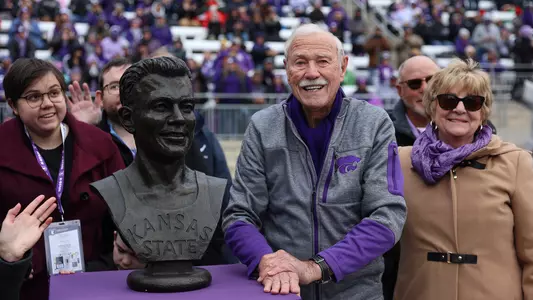
Tears welled up in the eyes of Thane Baker as the Kansas State great and four-time Olympic medalist stood upon a podium and gazed at his bronze bust during a Friday evening ceremony on the K-State campus in Manhattan.
The man who once took the top podium in the 1956 Olympics at Melbourne, Australia, was overcome with emotion once again. His bust someday soon adorning the lobby of the new track and field complex, Baker serves as a testament to hard work and ceaseless passion. His bust might demonstrate to the youngest of athletes that one can never dream too big.
"K-State was everything to me," Baker said. "Track was everything to me."
The 92-year-old Baker captured a silver medal in the 200 meters during the 1952 Olympics at Helsinki, Finland, then returned to win a gold medal as a member of America's 400-meter relay team, a silver in the 100 meters and bronze in the 200 meters in the 1956 Olympics at Melbourne.
Voted captain by his teammates on the 400-meter relay team, Baker accepted the gold medal and the National Anthem filled the air.
What does the 92-year-old Baker most recall about that moment?
"The tears running down my face," Baker said. "Track was everything to me."

A native of Elkhart, Kansas, Baker grew up running on gravel roads and joined K-State's track squad as a walk-on upon reading a story on the K-State Collegian that head coach Ward Haylett was seeking athletes for the team.
"I came from a small town without a scholarship, and I went to Ward Haylett my freshman year and asked if I could go out for track," Baker said. "He said, 'You can do that. We might be able to make a quarter-miler out of you.'"
Baker joined the ROTC and earned $27 per week. He worked for the athletic department for 50 cents an hour. He earned $10 per week working at a laundromat.
Eventually, he earned a scholarship — $67.50 per semester.
On the track, Baker blossomed.
Baker finished his K-State career with an NCAA title in the 220-yard dash in 1953, adding to his 10 Big Eight crowns, including three consecutive golds in both the 100 and 220-yard dashes in 1951-53.
One of his most vivid memories of K-State came in Lincoln, Nebraska, where he won the NCAA Championship in the 220.
"There was a wind, and I raced around the curve and had a tail wind," he said. "When I got to the finish line, they were huddled among themselves, and Ward ran down out of the stands and said, 'What time did you get?' I forgot to ask Ward, I never had the opportunity to ask Ward what time he had, but he and the other coach up there in the stands were jumping up and down.
"They gave me a 22.5 because they didn't get the smoke on the gun. So the opportunity I had to make a great race, that was the race that wasn't."
As an Olympian, he won the silver medal in the 220-yard dash at the 1952 games in Helsinki, then came back to claim three medals in 1956 in Melbourne. Aside from capturing gold in the 400-meter relay, he took silver in the 100 and bronze in the 200.
Away from track, Baker was one of two vice-presidents of the K-State Student Council. He graduated in 1953 with a degree in economics as a member of ROTC. His wife, Sally, graduated from K-State in 1956. He spent three years in the Air Force and 27 years in the Air Force Reserves, retiring as a Colonel.
In 1977, Baker was honored as one of College Athletics' Top 10 by the NCAA for contributions to society well beyond the playing field.
Baker continued to race in the master's competition and held two world records in different age groups.
At one point, Baker held eight world or American records over the course of his career.

And now Baker will be enshrined forever.
"I wish there was some way to express to all of you what K-State and track mean to me," Baker said at the podium at his ceremony. "It was the greatest thing that happened in my life. It opened doors and gave me opportunities to run in two Olympics and earn four Olympic medals. Without K-State, that would not have been possible.
"Glenn Cunningham was my hero. He ran down main street after the 1936 Olympics and I said, 'I'm going to race in the Olympics someday.'
"Thanks to Kansas State my dream came true."
Tears welled up in the eyes of Thane Baker as the Kansas State great and four-time Olympic medalist stood upon a podium and gazed at his bronze bust during a Friday evening ceremony on the K-State campus in Manhattan.
The man who once took the top podium in the 1956 Olympics at Melbourne, Australia, was overcome with emotion once again. His bust someday soon adorning the lobby of the new track and field complex, Baker serves as a testament to hard work and ceaseless passion. His bust might demonstrate to the youngest of athletes that one can never dream too big.
"K-State was everything to me," Baker said. "Track was everything to me."
The 92-year-old Baker captured a silver medal in the 200 meters during the 1952 Olympics at Helsinki, Finland, then returned to win a gold medal as a member of America's 400-meter relay team, a silver in the 100 meters and bronze in the 200 meters in the 1956 Olympics at Melbourne.
Voted captain by his teammates on the 400-meter relay team, Baker accepted the gold medal and the National Anthem filled the air.
What does the 92-year-old Baker most recall about that moment?
"The tears running down my face," Baker said. "Track was everything to me."
A native of Elkhart, Kansas, Baker grew up running on gravel roads and joined K-State's track squad as a walk-on upon reading a story on the K-State Collegian that head coach Ward Haylett was seeking athletes for the team.
"I came from a small town without a scholarship, and I went to Ward Haylett my freshman year and asked if I could go out for track," Baker said. "He said, 'You can do that. We might be able to make a quarter-miler out of you.'"
Baker joined the ROTC and earned $27 per week. He worked for the athletic department for 50 cents an hour. He earned $10 per week working at a laundromat.
Eventually, he earned a scholarship — $67.50 per semester.
On the track, Baker blossomed.
Baker finished his K-State career with an NCAA title in the 220-yard dash in 1953, adding to his 10 Big Eight crowns, including three consecutive golds in both the 100 and 220-yard dashes in 1951-53.
One of his most vivid memories of K-State came in Lincoln, Nebraska, where he won the NCAA Championship in the 220.
"There was a wind, and I raced around the curve and had a tail wind," he said. "When I got to the finish line, they were huddled among themselves, and Ward ran down out of the stands and said, 'What time did you get?' I forgot to ask Ward, I never had the opportunity to ask Ward what time he had, but he and the other coach up there in the stands were jumping up and down.
"They gave me a 22.5 because they didn't get the smoke on the gun. So the opportunity I had to make a great race, that was the race that wasn't."
As an Olympian, he won the silver medal in the 220-yard dash at the 1952 games in Helsinki, then came back to claim three medals in 1956 in Melbourne. Aside from capturing gold in the 400-meter relay, he took silver in the 100 and bronze in the 200.
Away from track, Baker was one of two vice-presidents of the K-State Student Council. He graduated in 1953 with a degree in economics as a member of ROTC. His wife, Sally, graduated from K-State in 1956. He spent three years in the Air Force and 27 years in the Air Force Reserves, retiring as a Colonel.
In 1977, Baker was honored as one of College Athletics' Top 10 by the NCAA for contributions to society well beyond the playing field.
Baker continued to race in the master's competition and held two world records in different age groups.
At one point, Baker held eight world or American records over the course of his career.
And now Baker will be enshrined forever.
"I wish there was some way to express to all of you what K-State and track mean to me," Baker said at the podium at his ceremony. "It was the greatest thing that happened in my life. It opened doors and gave me opportunities to run in two Olympics and earn four Olympic medals. Without K-State, that would not have been possible.
"Glenn Cunningham was my hero. He ran down main street after the 1936 Olympics and I said, 'I'm going to race in the Olympics someday.'
"Thanks to Kansas State my dream came true."
Saturday, October 17
Friday, October 16
Friday, October 16
Thursday, October 15