Returning to his Roots
Mar 04, 2025 | Football, Sports Extra
By: D. Scott Fritchen
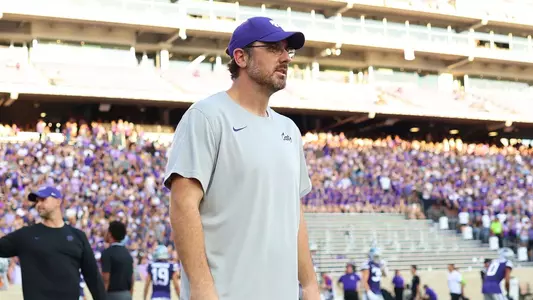
After serving the last three seasons as Kansas State's tight ends coach, Brian Lepak is returning to his roots. The former college offensive lineman, who helped coach the offensive line at two different football programs, has assumed duties as the Wildcats' offensive line coach, succeeding Conor Riley, who went to the Dallas Cowboys.
Before Lepak tutored the likes of tight ends Ben Sinnott (All-Big 12 First Team in 2022 and 2023), Garrett Oakley (2024 second team) and Will Swanson (2024 honorable mention), Lepak coached the offensive line at Southern in 2021, and prior to that spent the previous three seasons as a graduate assistant at Oklahoma, assisting an offensive line that in 2018 earned the Joe Moore Award as the nation's most outstanding offensive line unit.
A native of Claremore, Oklahoma, Lepak played offensive line for two seasons at Colorado State before transferring to Oklahoma for three seasons, including the 2010 Big 12 Championship campaign.
He admired K-State from afar.
"I know as a guy growing up in northeast Oklahoma, I was an OU fan, but watching K-State football the first thing I thought was, 'These guys are physical as hell. On offense, they're going to bloody your nose and on defense their linebackers are going to hit your quarterback about 15 times in the game,'" Lepak said. "So, it's always had that reputation to me that is still associated with the brand. When people see the Powercat, it's what they think about."
Lepak sat down with K-State Sports Extra's D. Scott Fritchen to discuss his passion for coaching offensive line and detail his duties since he assumed his new position on February 13:
D. Scott Fritchen: It's been a little over two weeks since you were elevated to offensive line coach. What was the first order of business upon accepting that role?
Brian Lepak: Very first thing, I met with every offensive lineman currently on the roster here on campus. I made a point to have a half-hour meeting with every single one of them to talk with them and the changes and how excited I was for the opportunity. For guys who were new, I wanted to get to know a little bit better. Most of the guys have been here for four years now going on their fifth, and they knew who I was just because of the overlap. That was priority number one, to meet with everybody both in a group setting and individually with each guy.
Fritchen: What is the most fun part about being on this coaching staff? What do you appreciate the most about this coaching staff?
Lepak: I think the first thing I appreciate the most is Coach Klieman has given me multiple opportunities to advance my career in a way that I don't think would've happened maybe at other places. That's mostly a byproduct of him and his ability to believe and have faith in people on the staff. If he sees people who are doing their job well, he rewards them for that, as opposed to feeling like he has to go make a splash hire, so to speak, but I think he has a great eye for people who have potential, and he empowers them to use their abilities to make the organization better. It's a place where if you commit to it, you're going to be rewarded one way or another.
Fritchen: Any change can take an adjustment. How would you describe the transition from tight ends coach to offensive line coach?
Lepak: The biggest thing for me personally is it's like riding a bike again. Once you know how to ride the bike, you know how to do it, and it may take a second or two to learn how to ride it, but my background is offensive line, so coming back from coaching tight ends to coaching the offensive line, it's been fun for how quickly I feel myself defaulting right back into things that I know and things that I taught in the past, and how much quicker that was than going to coach the tight ends. How you approach them and communicate with them needs to be different, the techniques you teach them need to be different, the game that they're playing is totally different. As a guy that was a box offensive line guy moving out to that, I had to spend a lot of time really thinking about what I wanted to do, how I was going to do it, I had to get a lot of "How do you want me to teach this?" and it's more black-and-white.
I understand better what we're trying to accomplish on offensive line, and I know what terms I want to use, and which ones I want to adopt. I know what I'm trying to accomplish, so you can better plan your teaching and your coaching to accomplish the end that you see in mind. You have more authority and control over that, whereas when you're the piece working in, the cog in the machine, you're still trying to figure out what the machine is, and that's where I feel happy to move back to offensive line. It's natural for me, and it's been fun for me, and that's what makes this exciting. Now it's a lot of work because you're going back and now, I'm making decisions on certain things, but it's been natural and a lot of fun.

Fritchen: From your perspective, what has made K-State offensive lines successful in recent years? Are there any specific traits?
Lepak: Well, first of all the program as a whole, regardless of who's sitting in the chairs running it, it has a reputation and demeanor that says we have to be great on the offensive line. There's a reputation of a physical team built up from that going back to Coach Snyder. I know as a guy growing up in northeast Oklahoma, I was an OU fan, but watching K-State football the first thing I thought was, "These guys are physical as hell. On offense, they're going to bloody your nose and on defense their linebackers are going to hit your quarterback about 15 times in the game." So, it's always had that reputation to me that is still associated with the brand. When people see the Powercat, it's what they think about. So, I think just as a starting point, any kid who comes into this program to play offensive line has this mentality that this is what it's going to be about.
Anybody sitting in the chair directing the program, we have to be dominant on the offensive line. There's no question about that. You go to other schools and maybe that's not their reputation. Maybe their reputation is having freaky-freak guys at wide receiver and run past everybody, or be Quarterback U. At Kansas State, we're dominant at the line of scrimmage and we beat the crap out of people. That's the first thing is the institution itself is bigger than anybody in the chair. Then I'd say in recent years since Coach Klieman has become the head coach, when Conor Riley came down from North Dakota State with Coach, the whole mentality was to take that up a notch and rediscover that edge. I think he has done a fantastic job of building that culture in the room that it makes my job where it's already established that this is what we're about. Conor brought a certain level of intensity and edge to that, which helped in that process. I attribute both of those things working together. It's a combination of what the program is known for, the kinds of kids we bring into the program because of that, and the kinds of kids we attract. And then it's the people pushing you and directing you. Conor is fantastic at doing that and Coach Klieman's leadership encourages that kind of environment.
Fritchen: What makes you so passionate about offensive line?
Lepak: I played the position. As a young kid, I wasn't big into sports. I played some basketball. I wasn't watching football all the time. I got into football probably in the seventh grade, and I really started playing attention to college football. I grew up an OU fan and we were all OU fans and OU won the national championship when I was in the seventh grade, and it was really inspiring for me. But in terms of my experience in sports, offensive line was my most natural fit, and it was both the role you played on the team of being a reliable rock, the first one up, the guy who can't make mistakes, you're the guy who because of knowing what to do, possessing the intensity of what you're doing, focusing on your technique, and just doing your job, you can be an impact player. That matched my personality, and it brought more out of me than maybe I was before that time playing football. That's what makes me passionate about offensive line, is that for the guys who are successful at that position, that's the mentality and approach that you have, and you have all kinds of personalities and mentalities to be successful.

The offensive lineman is a guy who has the mentality to do the dirty, grunt-work crap, so you can go score a touchdown and I'm holding my arms up afterward. That's the mentality you have. That's what I'm always passionate about with offensive linemen, we fit up our blocks and the ball ran past me. Not necessarily that I made some dominating pancake block, but I did my job to accomplish my goal. That's what makes me passionate about the position is you can't play the game without that. That's why people come to watch football, because they want to see the offensive linemen smash into dudes on the other side of the line and doing the dirty work. The other stuff is exciting, but that's what draws people to the game. So that's why I'm passionate about it.
Fritchen: You've been around great offensive lines before. In 2018, you were graduate assistant for an Oklahoma offensive line that earned the Joe Moore Award as the best offensive line in the nation. What made that offensive line special?
Lepak: Well first, you have a lot of talent. Those guys were all very talented, but they all embodied what we're talking about, what makes offensive linemen special. They all knew that they had to do their job at a high level, and they didn't ever have a compromising standard. They held a really high standard that they had to execute. You were going to get the job done, and we were going to prepare to get the job done. They were very well prepared and had a high level of talent and accepted that responsibility. That's what made them so good. They were all NFL Draft picks, so you can't deny the talent that was there. If you have talent that matches the mentality then, man, you're really, really special. We had great offensive lines. We had a great offensive line in 2017. When I was at Indiana, we had really good offensive lines with two All-Americans and a bunch of guys that weren't drafted but played and performed at a high level. There was a standard, a mentality that we had to get the job done. We had a 2,000-yard rusher. I think that's what makes a special offensive line.
Fritchen: What did you most learn about offensive line during your playing experience?
Lepak: What I learned the most is that your role is to get the job done and you do that by knowing exactly what your assignment is and then playing with relentless effort. That trumps everything. It's at the very top of the list. Yes, your fundamentals have to be good to execute, but your fundamentals can sometime be less than if you have those things. I think that it's about being relentless in the execution of my assignment is what I learned more than Xs and Os and speed. On the coaching side, you're exposed to so much more because you're thinking bigger picture, but I'd say as a player it was the level of intensity and effort that you give that impacted me the most as a player.

Fritchen: What kind of asset is Drew Liddle as assistant offensive line coach?
Lepak: Phenomenal asset. Drew is a perfect example of what I'm talking about with the program and the university as a brand and a reputation. It extends beyond the coaches. This is what the program is about. It's an offensive line, line of scrimmage-dominated program. Drew is one of those guys who has that cultural inheritance. You have a dude who played on multiple staffs and that coached underneath the staff that made this place what it is. But then he was also here when Coach Klieman took over. So, he has great perspective. He can pull up film going back to when Dana Dimel was the offensive coordinator to use as an example by analogy of maybe something that came from the offense when they came down from North Dakota State or maybe something when Collin Klein took over. Drew has that great consistency about him that he knows the bones of the program. He'll be a steadying force and know maybe something schematically that I didn't pick up on because I wasn't in those offensive line meetings, I was coaching the tight ends. He's a very valuable resource.
Fritchen: How would you describe last season for Brian Lepak?
Lepak: Lot of fun. Different challenges. I was used to being in the press box, and I went back at the end of the year for the final three games of the season essentially, the two regular-season games and the bowl game. Conor went down on the sideline and was in the fight with the guys a little bit more. So, that was kind of reverting back to things I'd done before. This year was a lot of fun because I got to be on the field with the tight ends to manage personnel throughout a game, so I could make substitutions. Getting the challenge of Ben Sinnott being a little bit of jack of all trades and being able to fix any problem, I didn't have a guy like that right now, and here's what Will Swanson's strengths are, and here's Garrett Oakley, Brayden Loftin and Will Anciaux or Andre Metzger, trying to work through all those variables and accepting the challenge that he might not be ready for this part, but he's ready for this. So how to utilize the strengths of each guy.
Then as the season went on, we had some injuries at times. We had to get it done. To see them all blossom throughout the year, they were all incredible assets by the end of the season. It was fun coaching them, and it was hard to figure out how to get these four dudes that played for us onto the field, but it was fun doing that, and it was a great group, and it was a new, unique challenge, but something that was enjoyable. Those guys in the tight end room are a great group of guys, and I enjoyed the hell out of coaching them. They make the job fun. Their personalities were great, and they were very coachable. So, it was fun challenges throughout the year. That was last season in a nutshell for me.

Fritchen: What makes you excited about this offensive line in 2025?
Lepak: We've got some challenges to figure out personnel wise, not because we have any deficient personnel but because we have some new faces. We have a few returners with serious playing time between Sam Hecht, Andrew Leingang and Taylor Poitier, but we've brought some new faces in as transfers, and we have some guys who've been here developing that need to step up, perform and play. This is their opportunity to compete and go out there and show us what they have. That's what makes this fun and exciting is you have some returning players but a lot of fresh faces both from new people and guys who this is really their time to make an impact. This is their time to show their development since they were freshmen. It's good to see those guys step up. In this age of college football, the emphasis is to get them up to speed as fast as possible.
Fritchen: Who are some of these fresh faces and what makes them unique?
Lepak: You have George Fitzpatrick from Ohio State, Amos Talalele from USC, and Brandon Sneh from Wagner College. Brandon and I actually connected pretty easily. His story is pretty unique. He's from Philadelphia, went to Fort Union Military Prep School in Virginia his first year out of high school, and then from there went to Elizabeth City State, which is a Division II HBCU. He and I connected about my experience at Southern. Then it went from there to Wagner for a year to us. You have a guy who's really tough and gritty and has worked his way up from Division II to FCS to a Power 4 school. It's going to be fun to watch and see how he picks things up and competes, but he's a tough dude, and I'm looking forward to getting him on the field and seeing what he can do.
Amos is a guy that, for me, is kind of fun in that we have some of these meetings and I tell him, "Tell me about this play." Well, Amos' head coach was Lincoln Riley. I'm asking questions of, "What were you taught here?" And I know exactly where he's going to go with it. It's fun to make that connection. I have a starting point with him because I have an idea what he was taught because Lincoln's offense is Lincoln's offense. I'm like, "I remember that."
Then George, you talk about a guy who it says a lot in the transfer portal that he decided to stay all the way through at Ohio State and play for a national championship as opposed to saying, "To hell with it, I'm getting in the portal right now." That speaks a lot about his competitive nature and commitment to play out the season. He was all in. I'm excited to see how that translates here in what kind of leadership he might have and how that translates to a competitive edge for us.

Fritchen: What excites you most about the 2025 season?
Lepak: I'm really excited to see this team as a whole respond from expectations from the 2024 season to go win a Big 12 Championship to take the sting of falling short of that goal and how we're going to apply it on offense, defense and special teams to go make that a reality. That's what I'm most excited to see, is how do we respond and how do we as coaches push to get that response. That's what I'm most excited to see.
Fritchen: What has Brian Lepak learned most about himself in the last year?
Lepak: What I've learned the most about myself in the last year is that the quality of time that you spend with your family and the impact it has on your children is the most important thing you can do. When I'm there with them, I need to be there present with them and not always preoccupied with my mind somewhere else and that I can solve those problems when I'm there to address them, but I don't need to carry those things into my home and make it where my sons and my daughter and my wife don't really get their guy who's their husband and dad. I've learned that the most about myself because my career has been, "GA, you're the support guy, do anything you can and be available all the time and demonstrate you're really committed to this." You've got to make an impression and put it above everything else, but you can't do that at the expense of your children knowing that you love them and care about them and that you're there to be their dad. It doesn't matter if you're an attorney, football coach, businessman or engineer, or whatever it is, if you want to be successful, you're going to commit a lot of time to it, but you're not going to be able to make up for your relationships and the quality of time you spend with your children. In the last year, realizing to make a conscious effort about that – not that I'm perfect – is where I've grown the most in the last year.
After serving the last three seasons as Kansas State's tight ends coach, Brian Lepak is returning to his roots. The former college offensive lineman, who helped coach the offensive line at two different football programs, has assumed duties as the Wildcats' offensive line coach, succeeding Conor Riley, who went to the Dallas Cowboys.
Before Lepak tutored the likes of tight ends Ben Sinnott (All-Big 12 First Team in 2022 and 2023), Garrett Oakley (2024 second team) and Will Swanson (2024 honorable mention), Lepak coached the offensive line at Southern in 2021, and prior to that spent the previous three seasons as a graduate assistant at Oklahoma, assisting an offensive line that in 2018 earned the Joe Moore Award as the nation's most outstanding offensive line unit.
A native of Claremore, Oklahoma, Lepak played offensive line for two seasons at Colorado State before transferring to Oklahoma for three seasons, including the 2010 Big 12 Championship campaign.
He admired K-State from afar.
"I know as a guy growing up in northeast Oklahoma, I was an OU fan, but watching K-State football the first thing I thought was, 'These guys are physical as hell. On offense, they're going to bloody your nose and on defense their linebackers are going to hit your quarterback about 15 times in the game,'" Lepak said. "So, it's always had that reputation to me that is still associated with the brand. When people see the Powercat, it's what they think about."
Lepak sat down with K-State Sports Extra's D. Scott Fritchen to discuss his passion for coaching offensive line and detail his duties since he assumed his new position on February 13:
D. Scott Fritchen: It's been a little over two weeks since you were elevated to offensive line coach. What was the first order of business upon accepting that role?
Brian Lepak: Very first thing, I met with every offensive lineman currently on the roster here on campus. I made a point to have a half-hour meeting with every single one of them to talk with them and the changes and how excited I was for the opportunity. For guys who were new, I wanted to get to know a little bit better. Most of the guys have been here for four years now going on their fifth, and they knew who I was just because of the overlap. That was priority number one, to meet with everybody both in a group setting and individually with each guy.
Fritchen: What is the most fun part about being on this coaching staff? What do you appreciate the most about this coaching staff?
Lepak: I think the first thing I appreciate the most is Coach Klieman has given me multiple opportunities to advance my career in a way that I don't think would've happened maybe at other places. That's mostly a byproduct of him and his ability to believe and have faith in people on the staff. If he sees people who are doing their job well, he rewards them for that, as opposed to feeling like he has to go make a splash hire, so to speak, but I think he has a great eye for people who have potential, and he empowers them to use their abilities to make the organization better. It's a place where if you commit to it, you're going to be rewarded one way or another.
Fritchen: Any change can take an adjustment. How would you describe the transition from tight ends coach to offensive line coach?
Lepak: The biggest thing for me personally is it's like riding a bike again. Once you know how to ride the bike, you know how to do it, and it may take a second or two to learn how to ride it, but my background is offensive line, so coming back from coaching tight ends to coaching the offensive line, it's been fun for how quickly I feel myself defaulting right back into things that I know and things that I taught in the past, and how much quicker that was than going to coach the tight ends. How you approach them and communicate with them needs to be different, the techniques you teach them need to be different, the game that they're playing is totally different. As a guy that was a box offensive line guy moving out to that, I had to spend a lot of time really thinking about what I wanted to do, how I was going to do it, I had to get a lot of "How do you want me to teach this?" and it's more black-and-white.
I understand better what we're trying to accomplish on offensive line, and I know what terms I want to use, and which ones I want to adopt. I know what I'm trying to accomplish, so you can better plan your teaching and your coaching to accomplish the end that you see in mind. You have more authority and control over that, whereas when you're the piece working in, the cog in the machine, you're still trying to figure out what the machine is, and that's where I feel happy to move back to offensive line. It's natural for me, and it's been fun for me, and that's what makes this exciting. Now it's a lot of work because you're going back and now, I'm making decisions on certain things, but it's been natural and a lot of fun.
Fritchen: From your perspective, what has made K-State offensive lines successful in recent years? Are there any specific traits?
Lepak: Well, first of all the program as a whole, regardless of who's sitting in the chairs running it, it has a reputation and demeanor that says we have to be great on the offensive line. There's a reputation of a physical team built up from that going back to Coach Snyder. I know as a guy growing up in northeast Oklahoma, I was an OU fan, but watching K-State football the first thing I thought was, "These guys are physical as hell. On offense, they're going to bloody your nose and on defense their linebackers are going to hit your quarterback about 15 times in the game." So, it's always had that reputation to me that is still associated with the brand. When people see the Powercat, it's what they think about. So, I think just as a starting point, any kid who comes into this program to play offensive line has this mentality that this is what it's going to be about.
Anybody sitting in the chair directing the program, we have to be dominant on the offensive line. There's no question about that. You go to other schools and maybe that's not their reputation. Maybe their reputation is having freaky-freak guys at wide receiver and run past everybody, or be Quarterback U. At Kansas State, we're dominant at the line of scrimmage and we beat the crap out of people. That's the first thing is the institution itself is bigger than anybody in the chair. Then I'd say in recent years since Coach Klieman has become the head coach, when Conor Riley came down from North Dakota State with Coach, the whole mentality was to take that up a notch and rediscover that edge. I think he has done a fantastic job of building that culture in the room that it makes my job where it's already established that this is what we're about. Conor brought a certain level of intensity and edge to that, which helped in that process. I attribute both of those things working together. It's a combination of what the program is known for, the kinds of kids we bring into the program because of that, and the kinds of kids we attract. And then it's the people pushing you and directing you. Conor is fantastic at doing that and Coach Klieman's leadership encourages that kind of environment.
Fritchen: What makes you so passionate about offensive line?
Lepak: I played the position. As a young kid, I wasn't big into sports. I played some basketball. I wasn't watching football all the time. I got into football probably in the seventh grade, and I really started playing attention to college football. I grew up an OU fan and we were all OU fans and OU won the national championship when I was in the seventh grade, and it was really inspiring for me. But in terms of my experience in sports, offensive line was my most natural fit, and it was both the role you played on the team of being a reliable rock, the first one up, the guy who can't make mistakes, you're the guy who because of knowing what to do, possessing the intensity of what you're doing, focusing on your technique, and just doing your job, you can be an impact player. That matched my personality, and it brought more out of me than maybe I was before that time playing football. That's what makes me passionate about offensive line, is that for the guys who are successful at that position, that's the mentality and approach that you have, and you have all kinds of personalities and mentalities to be successful.
The offensive lineman is a guy who has the mentality to do the dirty, grunt-work crap, so you can go score a touchdown and I'm holding my arms up afterward. That's the mentality you have. That's what I'm always passionate about with offensive linemen, we fit up our blocks and the ball ran past me. Not necessarily that I made some dominating pancake block, but I did my job to accomplish my goal. That's what makes me passionate about the position is you can't play the game without that. That's why people come to watch football, because they want to see the offensive linemen smash into dudes on the other side of the line and doing the dirty work. The other stuff is exciting, but that's what draws people to the game. So that's why I'm passionate about it.
Fritchen: You've been around great offensive lines before. In 2018, you were graduate assistant for an Oklahoma offensive line that earned the Joe Moore Award as the best offensive line in the nation. What made that offensive line special?
Lepak: Well first, you have a lot of talent. Those guys were all very talented, but they all embodied what we're talking about, what makes offensive linemen special. They all knew that they had to do their job at a high level, and they didn't ever have a compromising standard. They held a really high standard that they had to execute. You were going to get the job done, and we were going to prepare to get the job done. They were very well prepared and had a high level of talent and accepted that responsibility. That's what made them so good. They were all NFL Draft picks, so you can't deny the talent that was there. If you have talent that matches the mentality then, man, you're really, really special. We had great offensive lines. We had a great offensive line in 2017. When I was at Indiana, we had really good offensive lines with two All-Americans and a bunch of guys that weren't drafted but played and performed at a high level. There was a standard, a mentality that we had to get the job done. We had a 2,000-yard rusher. I think that's what makes a special offensive line.
Fritchen: What did you most learn about offensive line during your playing experience?
Lepak: What I learned the most is that your role is to get the job done and you do that by knowing exactly what your assignment is and then playing with relentless effort. That trumps everything. It's at the very top of the list. Yes, your fundamentals have to be good to execute, but your fundamentals can sometime be less than if you have those things. I think that it's about being relentless in the execution of my assignment is what I learned more than Xs and Os and speed. On the coaching side, you're exposed to so much more because you're thinking bigger picture, but I'd say as a player it was the level of intensity and effort that you give that impacted me the most as a player.
Fritchen: What kind of asset is Drew Liddle as assistant offensive line coach?
Lepak: Phenomenal asset. Drew is a perfect example of what I'm talking about with the program and the university as a brand and a reputation. It extends beyond the coaches. This is what the program is about. It's an offensive line, line of scrimmage-dominated program. Drew is one of those guys who has that cultural inheritance. You have a dude who played on multiple staffs and that coached underneath the staff that made this place what it is. But then he was also here when Coach Klieman took over. So, he has great perspective. He can pull up film going back to when Dana Dimel was the offensive coordinator to use as an example by analogy of maybe something that came from the offense when they came down from North Dakota State or maybe something when Collin Klein took over. Drew has that great consistency about him that he knows the bones of the program. He'll be a steadying force and know maybe something schematically that I didn't pick up on because I wasn't in those offensive line meetings, I was coaching the tight ends. He's a very valuable resource.
Fritchen: How would you describe last season for Brian Lepak?
Lepak: Lot of fun. Different challenges. I was used to being in the press box, and I went back at the end of the year for the final three games of the season essentially, the two regular-season games and the bowl game. Conor went down on the sideline and was in the fight with the guys a little bit more. So, that was kind of reverting back to things I'd done before. This year was a lot of fun because I got to be on the field with the tight ends to manage personnel throughout a game, so I could make substitutions. Getting the challenge of Ben Sinnott being a little bit of jack of all trades and being able to fix any problem, I didn't have a guy like that right now, and here's what Will Swanson's strengths are, and here's Garrett Oakley, Brayden Loftin and Will Anciaux or Andre Metzger, trying to work through all those variables and accepting the challenge that he might not be ready for this part, but he's ready for this. So how to utilize the strengths of each guy.
Then as the season went on, we had some injuries at times. We had to get it done. To see them all blossom throughout the year, they were all incredible assets by the end of the season. It was fun coaching them, and it was hard to figure out how to get these four dudes that played for us onto the field, but it was fun doing that, and it was a great group, and it was a new, unique challenge, but something that was enjoyable. Those guys in the tight end room are a great group of guys, and I enjoyed the hell out of coaching them. They make the job fun. Their personalities were great, and they were very coachable. So, it was fun challenges throughout the year. That was last season in a nutshell for me.
Fritchen: What makes you excited about this offensive line in 2025?
Lepak: We've got some challenges to figure out personnel wise, not because we have any deficient personnel but because we have some new faces. We have a few returners with serious playing time between Sam Hecht, Andrew Leingang and Taylor Poitier, but we've brought some new faces in as transfers, and we have some guys who've been here developing that need to step up, perform and play. This is their opportunity to compete and go out there and show us what they have. That's what makes this fun and exciting is you have some returning players but a lot of fresh faces both from new people and guys who this is really their time to make an impact. This is their time to show their development since they were freshmen. It's good to see those guys step up. In this age of college football, the emphasis is to get them up to speed as fast as possible.
Fritchen: Who are some of these fresh faces and what makes them unique?
Lepak: You have George Fitzpatrick from Ohio State, Amos Talalele from USC, and Brandon Sneh from Wagner College. Brandon and I actually connected pretty easily. His story is pretty unique. He's from Philadelphia, went to Fort Union Military Prep School in Virginia his first year out of high school, and then from there went to Elizabeth City State, which is a Division II HBCU. He and I connected about my experience at Southern. Then it went from there to Wagner for a year to us. You have a guy who's really tough and gritty and has worked his way up from Division II to FCS to a Power 4 school. It's going to be fun to watch and see how he picks things up and competes, but he's a tough dude, and I'm looking forward to getting him on the field and seeing what he can do.
Amos is a guy that, for me, is kind of fun in that we have some of these meetings and I tell him, "Tell me about this play." Well, Amos' head coach was Lincoln Riley. I'm asking questions of, "What were you taught here?" And I know exactly where he's going to go with it. It's fun to make that connection. I have a starting point with him because I have an idea what he was taught because Lincoln's offense is Lincoln's offense. I'm like, "I remember that."
Then George, you talk about a guy who it says a lot in the transfer portal that he decided to stay all the way through at Ohio State and play for a national championship as opposed to saying, "To hell with it, I'm getting in the portal right now." That speaks a lot about his competitive nature and commitment to play out the season. He was all in. I'm excited to see how that translates here in what kind of leadership he might have and how that translates to a competitive edge for us.
Fritchen: What excites you most about the 2025 season?
Lepak: I'm really excited to see this team as a whole respond from expectations from the 2024 season to go win a Big 12 Championship to take the sting of falling short of that goal and how we're going to apply it on offense, defense and special teams to go make that a reality. That's what I'm most excited to see, is how do we respond and how do we as coaches push to get that response. That's what I'm most excited to see.
Fritchen: What has Brian Lepak learned most about himself in the last year?
Lepak: What I've learned the most about myself in the last year is that the quality of time that you spend with your family and the impact it has on your children is the most important thing you can do. When I'm there with them, I need to be there present with them and not always preoccupied with my mind somewhere else and that I can solve those problems when I'm there to address them, but I don't need to carry those things into my home and make it where my sons and my daughter and my wife don't really get their guy who's their husband and dad. I've learned that the most about myself because my career has been, "GA, you're the support guy, do anything you can and be available all the time and demonstrate you're really committed to this." You've got to make an impression and put it above everything else, but you can't do that at the expense of your children knowing that you love them and care about them and that you're there to be their dad. It doesn't matter if you're an attorney, football coach, businessman or engineer, or whatever it is, if you want to be successful, you're going to commit a lot of time to it, but you're not going to be able to make up for your relationships and the quality of time you spend with your children. In the last year, realizing to make a conscious effort about that – not that I'm perfect – is where I've grown the most in the last year.
Players Mentioned

TE
/ Football
OL
/ Football
OL
/ Football
OL
/ Football
TE
/ Football
TE
/ Football
OL
/ Football
TE
/ Football
OL
/ FootballSunday, October 11
Friday, October 09
Friday, October 09
Friday, October 09