Nov 10, 2026 | Football, Sports Extra
By: D. Scott Fritchen
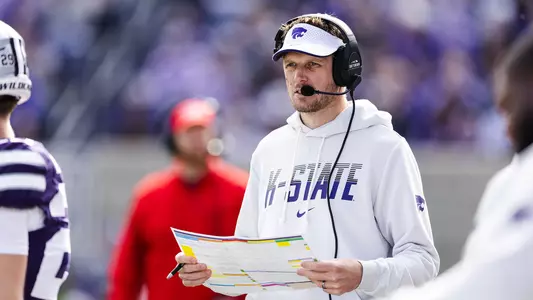
Marching through a season that features four different starting quarterbacks for the first time in Kansas State history and an ever-growing injury list as the Wildcats seek consistency across the board, first-year K-State head coach Collin Klein pulled an audible at Monday's team meeting.
Klein, the 2012 Heisman Trophy finalist and former K-State assistant coach, dusted off the K-State history book, and he recounted at his weekly news conference on Monday that he shared a story of perseverance with his current squad, which has lost three straight games and five of its last six contests overall.
"This morning," Klein said, "started with a little history lesson."
K-State comes off a 66-28 loss to Oklahoma State at Bill Snyder Family Stadium in which the Wildcats gave up at least 60 points for just the fourth time in the Big 12 era. The loss dropped the Wildcats to a 4-5 overall record, including a 1-5 mark in the Big 12 Conference, and it came after two narrow road defeats — a 28-17 loss at Arizona State and a 27-24 overtime loss at Colorado.
K-State joins Colorado and Kansas as the only Big 12 teams with one win in conference play and now prepares to visit TCU, 4-5 and 2-4, in Saturday's 1:00 p.m. kickoff in Fort Worth, Texas.
The Wildcats finish out their regular season at TCU, against Arizona, and at Iowa State, needing to win two of their final three games to reach the six victories necessary to secure bowl eligibility. K-State joins just 14 Power 4 teams — and the only Big 12 program — to be bowl eligible in 14 of the last 15 seasons.
Before this current K-State team embarks on this part of its journey, Klein shared the story of another K-State team that in some ways faced a similar path.
"None of us are in a situation we'd pick, and this is hard, and when you go on a string of three losses in a row and five of our last six, that's not a fun place to be, and none of us would pick that," Klein said. "I told our players about 2015 and the guts of that team, which started 3-0 and lost six in a row, and how we stayed together, kept getting better, kept focusing on the things within our control, and finished it right.
"We found a way to win our last three, and that's possible."

In 2015, K-State won its first three games, then lost six straight games, which marked the school's longest losing streak since 1989. Eight players on the two-deep depth chart missed a combined 24 games in what is considered to be one of the most injury-plagued seasons by K-State in decades. K-State went 63 days without a victory, but the players showed that grit, determination and that never-give-up approach that was so prevalent in the past successful K-State teams, and the Wildcats finished the regular season with a 6-6 record, becoming just the third Division I team since 1980 to endure a six-game losing streak and still become bowl eligible.
The message?
"Every single game where you have a chance to compete is a chance to improve, a chance to create momentum for this year, but then also beyond, and that decision is in front of all of us, staff, players and program wide, every single day," Klein said. "These circumstances are not fun or what anyone would pick, but this is where you really get to find out what you're made of, and that's for myself, for our staff, and definitely for our players.
"Their character and integrity show through."
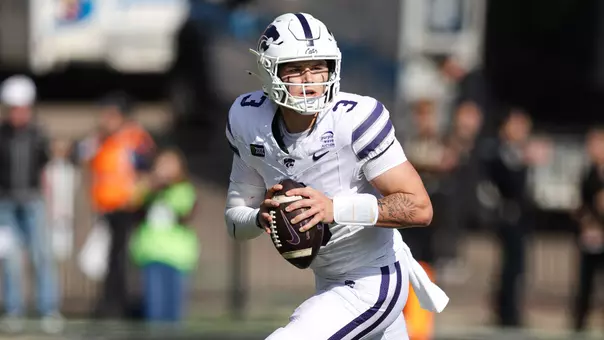
K-State has started four different quarterbacks, and it will have its second multiple-game starter at the position this season in either sophomore Dillon Duff or junior Blake Barnett. Barnett came off the sideline at Colorado and completed 18-of-28 passes for 224 yards and three touchdowns, then he went 7-of-17 for 106 yards and one touchdown and two interceptions in his first career start against Oklahoma State.
Duff started at Colorado and completed 1-of-1 passes for two yards in his first-career snaps against the Buffaloes, and then he came off the sideline to complete 10-of-17 passes for 94 yards and one touchdown and one interception against Oklahoma State.
"It felt really good for (Duff), and I was very happy for him," Klein said. "It's a different quarterback psychology that happens, especially as younger players, when you're starting a game, and it's not any different than when you go out at any point in a game, other than you're starting a game and you're feeling that you're carrying the load for your team.
"Both of those guys need to grow into that. To see Dillon not start the game and to come in and play well, which was the exact inverse of what happened (at Colorado) it's a part of the growth process and I was very happy for him to do so."

The starts by Duff and Barnett come after injuries to all-time total offensive yards senior Avery Johnson and fifth-year player Jacob Knuth.
As for when Klein might decide whether Duff or Barnett will start at quarterback for TCU?
"Man, that's a tough question, and it's not anything to do with those guys," Klein said. "They're both going to compete this week and both get a lot of reps. We'll see how it goes through the week. I was glad to see Dillon get out there and get to play and get into the flow of the game and make some plays and do some good things, so I'd see them both playing."
The injury bug struck the K-State defense even before the game against the Cowboys, as defensive tackle Eli Jackson was unavailable and De'Arieun Hicks went down during the game. Also, free safety Koy Beasley is working his way back to his starting spot.
"We've been battling on offense but losing Elijah Jackson and De'Arieun Hicks in the game are two big ones, and Koy Beasley is working his way back," Klein said. "(There could be) schematic adjustments (and you) say, 'Hey, these are some sets of unfortunate circumstances, but we have to adjust to solve those problems while getting better fundamentally.' That's the baseline of any scheme.
"But we're not playing fundamental football on either side of the ball right now, and how we need to play it."
The challenges facing K-State appeared to create the perfect storm as Oklahoma State scored its most points ever against K-State.
"That was one of the more frustrating, bad losses that I've been a part of," Klein said. "Not a whole lot of good in all three phases and a lot to improve upon. In a game like that against a team like that, even talking all week, the things that couldn't happen happened.
"We kept the fight going. I was proud of the team and the guys in how they competed throughout the game. Even as it got out of reach, from a mentality standpoint, there are things to be gained to improve yourself and your team as we continue to build this thing moving forward."
Marching through a season that features four different starting quarterbacks for the first time in Kansas State history and an ever-growing injury list as the Wildcats seek consistency across the board, first-year K-State head coach Collin Klein pulled an audible at Monday's team meeting.
Klein, the 2012 Heisman Trophy finalist and former K-State assistant coach, dusted off the K-State history book, and he recounted at his weekly news conference on Monday that he shared a story of perseverance with his current squad, which has lost three straight games and five of its last six contests overall.
"This morning," Klein said, "started with a little history lesson."
K-State comes off a 66-28 loss to Oklahoma State at Bill Snyder Family Stadium in which the Wildcats gave up at least 60 points for just the fourth time in the Big 12 era. The loss dropped the Wildcats to a 4-5 overall record, including a 1-5 mark in the Big 12 Conference, and it came after two narrow road defeats — a 28-17 loss at Arizona State and a 27-24 overtime loss at Colorado.
K-State joins Colorado and Kansas as the only Big 12 teams with one win in conference play and now prepares to visit TCU, 4-5 and 2-4, in Saturday's 1:00 p.m. kickoff in Fort Worth, Texas.
The Wildcats finish out their regular season at TCU, against Arizona, and at Iowa State, needing to win two of their final three games to reach the six victories necessary to secure bowl eligibility. K-State joins just 14 Power 4 teams — and the only Big 12 program — to be bowl eligible in 14 of the last 15 seasons.
Before this current K-State team embarks on this part of its journey, Klein shared the story of another K-State team that in some ways faced a similar path.
"None of us are in a situation we'd pick, and this is hard, and when you go on a string of three losses in a row and five of our last six, that's not a fun place to be, and none of us would pick that," Klein said. "I told our players about 2015 and the guts of that team, which started 3-0 and lost six in a row, and how we stayed together, kept getting better, kept focusing on the things within our control, and finished it right.
"We found a way to win our last three, and that's possible."
In 2015, K-State won its first three games, then lost six straight games, which marked the school's longest losing streak since 1989. Eight players on the two-deep depth chart missed a combined 24 games in what is considered to be one of the most injury-plagued seasons by K-State in decades. K-State went 63 days without a victory, but the players showed that grit, determination and that never-give-up approach that was so prevalent in the past successful K-State teams, and the Wildcats finished the regular season with a 6-6 record, becoming just the third Division I team since 1980 to endure a six-game losing streak and still become bowl eligible.
The message?
"Every single game where you have a chance to compete is a chance to improve, a chance to create momentum for this year, but then also beyond, and that decision is in front of all of us, staff, players and program wide, every single day," Klein said. "These circumstances are not fun or what anyone would pick, but this is where you really get to find out what you're made of, and that's for myself, for our staff, and definitely for our players.
"Their character and integrity show through."
K-State has started four different quarterbacks, and it will have its second multiple-game starter at the position this season in either sophomore Dillon Duff or junior Blake Barnett. Barnett came off the sideline at Colorado and completed 18-of-28 passes for 224 yards and three touchdowns, then he went 7-of-17 for 106 yards and one touchdown and two interceptions in his first career start against Oklahoma State.
Duff started at Colorado and completed 1-of-1 passes for two yards in his first-career snaps against the Buffaloes, and then he came off the sideline to complete 10-of-17 passes for 94 yards and one touchdown and one interception against Oklahoma State.
"It felt really good for (Duff), and I was very happy for him," Klein said. "It's a different quarterback psychology that happens, especially as younger players, when you're starting a game, and it's not any different than when you go out at any point in a game, other than you're starting a game and you're feeling that you're carrying the load for your team.
"Both of those guys need to grow into that. To see Dillon not start the game and to come in and play well, which was the exact inverse of what happened (at Colorado) it's a part of the growth process and I was very happy for him to do so."
The starts by Duff and Barnett come after injuries to all-time total offensive yards senior Avery Johnson and fifth-year player Jacob Knuth.
As for when Klein might decide whether Duff or Barnett will start at quarterback for TCU?
"Man, that's a tough question, and it's not anything to do with those guys," Klein said. "They're both going to compete this week and both get a lot of reps. We'll see how it goes through the week. I was glad to see Dillon get out there and get to play and get into the flow of the game and make some plays and do some good things, so I'd see them both playing."
The injury bug struck the K-State defense even before the game against the Cowboys, as defensive tackle Eli Jackson was unavailable and De'Arieun Hicks went down during the game. Also, free safety Koy Beasley is working his way back to his starting spot.
"We've been battling on offense but losing Elijah Jackson and De'Arieun Hicks in the game are two big ones, and Koy Beasley is working his way back," Klein said. "(There could be) schematic adjustments (and you) say, 'Hey, these are some sets of unfortunate circumstances, but we have to adjust to solve those problems while getting better fundamentally.' That's the baseline of any scheme.
"But we're not playing fundamental football on either side of the ball right now, and how we need to play it."
The challenges facing K-State appeared to create the perfect storm as Oklahoma State scored its most points ever against K-State.
"That was one of the more frustrating, bad losses that I've been a part of," Klein said. "Not a whole lot of good in all three phases and a lot to improve upon. In a game like that against a team like that, even talking all week, the things that couldn't happen happened.
"We kept the fight going. I was proud of the team and the guys in how they competed throughout the game. Even as it got out of reach, from a mentality standpoint, there are things to be gained to improve yourself and your team as we continue to build this thing moving forward."
Players Mentioned

QB
/ Football
S
/ Football
QB
/ Football
DT
/ Football
DT
/ Football
QB
/ Football
QB
/ FootballMonday, November 09
Monday, November 09
Monday, November 09
Monday, November 09


