Using the Numbers to Gain an Advantage
Apr 16, 2026 | Men's Basketball, Sports Extra
By: D. Scott Fritchen
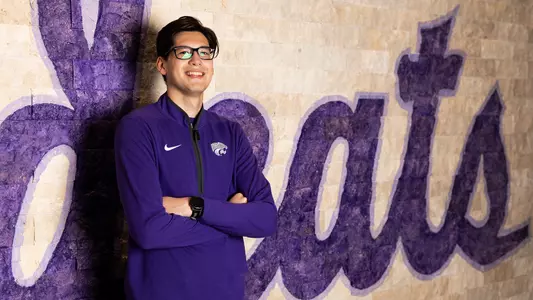
Basketball is basketball, but Bryce Haase has never been at this level before, on the men's basketball staff of a Power 4 program, and 24-year-old Bryce Haase sits inside the Shamrock Zone at Bramlage Coliseum in a purple Powercat quarter-zip and looks all around the spacious room.
Here he is, Haase, a native of Vienna, Virginia, who just completed his master's degree in sports administration at Belmont last May, and who was on the Belmont staff the past three seasons, including the first two as a graduate assistant, getting his first look at Kansas State and grateful for the opportunity under new K-State head coach Casey Alexander.
Haase's eyes are wide. He's ready.
"To know I was coming to Kansas State with Casey, I was like, 'Oh my gosh. I'm going to be in the Big 12 at Kansas State,'" Haase says. "I still haven't fully processed what's happened and where I am and what's going on. I mean, look at this place. The town is super nice, the facilities and all the people — crazy. I love Belmont and it's an awesome place, but the amount of stuff here is crazy.
"Man, this place is sick. I didn't realize the football stadium was right here and it was connected to the basketball arena and connected to the practice facility. K-State has all the stuff. There's an area for snacks in the facility that's just for us, and we have our own conference room, and everything about it is so — I can't describe it. It's hard to describe what it feels like to be here after always being at the mid-major level. I've been to nice facilities, but this place is next level for sure."
Haase, named K-State men's basketball director of analytics, will focus on data analytics, advanced stats, video breakdown through Synergy Sports, player development, and game preparation. He has ample resources around him, a basketball court, and an insatiable passion for numbers.
And numbers can make a difference.
Even in recruiting. Especially in recruiting.
"For us, it's going to be more different than it's ever been because it's such a jump up in going from a mid-major to the Big 12, but that's an area where numbers are going to help us because we have a few years now of historic data of what transfers have worked in the Big 12 and what transfers haven't worked in the Big 12," Haase. "So, we'll utilize that and identify what players are at our level and then condensing the list down to a smaller number of players to watch, so we can really watch and see if this is a guy who will fit in Casey Alexander's system.
"We'll do all the numbers on the guys and how they'll fit and how they won't fit. It's not just how good they are, but if they're up to our level."
Bryce Haase spoke with K-State Sports Extra's D. Scott Fritchen about his passion for numbers and his excitement to be a part of K-State.

D. Scott Fritchen: What was your immediate reaction when you heard Casey accepted the K-State job?
Bryce Haase: I was excited. I knew he'd been in conversation and was a candidate, for sure, but for him to accept the job was super exciting, because I knew he'd worked really hard for it, and he'd been climbing the ranks. We were so good last year that I knew he was on the fringe of getting a job at this level, and so to see it happen was really exciting.
Fritchen: What was your reaction when Casey asked you to join him in Manhattan?
Haase: To know I was coming to Kansas State with Casey, I was like, "Oh my gosh. I'm going to be in the Big 12 at Kansas State." I still haven't fully processed what's happened and where I am and what's going on. I mean, look at this place. The town is super nice, the facilities and all the people — crazy. I love Belmont and it's an awesome place, but the amount of stuff here is crazy.
Fritchen: What do you admire most about Casey as a person and then what do you admire most about Casey as a coach?
Haase: I think they go hand in hand. I was a graduate assistant for two years, then stayed with Casey for one more year, and obviously followed him here. He just cares so much about the people he brings in, whether it's players or staff. He used to say at Belmont, "Be Belmont." Everybody understood what that meant. It meant to be nice to the waiters and hold doors open, and all that kind of stuff. Now he's going to bring that here and say, "Be K-State." I think that's the stuff that made us really good as a team. That's what made us a team at Belmont. That's what he's bringing to K-State.
Fritchen: Describe your chemistry with Casey and what makes you both tick?
Haase: Casey has always been into numbers. I was hired as a graduate assistant at Belmont because he had never had a person who was into analytics and a numbers guy. I was hired because I had a different skillset than graduate assistants in the past. That's part of why I was retained and brought here. Casey is super smart and wants to learn. He wants the numbers. It helps him think and make decisions and understand what he's seeing. That's why we get along well, because he wants the numbers, and I can always provide that.
Fritchen: You were to begin your fourth year at Belmont this next season and your first year as director of strategy and analytics after spending the previous two seasons as a graduate assistant. Now you're a first-year assistant on a Power 4 team that competes in arguably the toughest conference in the nation. What are the emotions that go along with making that jump?
Haase: Man, it's super exciting. I'm probably one of the biggest college basketball fans you'll ever meet. I'll watch more basketball than anyone you'll see. Obviously, I've watched tons of Big 12 basketball. To jump from the Missouri Valley, which is a really, really good mid-major conference, to the Big 12, it's always kind of what I wanted and where I wanted to work. To get the chance to do it at such a young age at 24 is incredible.
Fritchen: What kinds of thoughts were running through your head as you opened the front door and entered the K-State basketball facility for the first time?
Haase: Man, this place is sick. I didn't realize the football stadium was right here and it was connected to the basketball arena and connected to the practice facility. K-State has all the stuff. There's an area for snacks in the facility that's just for us, and we have our own conference room, and everything about it is so — I can't describe it. It's hard to describe what it feels like to be here after always being at the mid-major level. I've been to nice facilities, but this place is next level for sure.

Fritchen: How did this passion for analytics begin for you?
Haase: When I was a kid, I'd always go to my driveway and pretend to be dudes and write down their stats. I had a hockey game and would create my own leagues and keep stats. I've always been into it. When I got to college, I didn't start out as a manager my freshman year. I didn't become a manager for UMass until my senior year. The reason I got the job is because I really got into computer science and coding so I could do more stuff. Just learning that, it's like a whole new language, and it's something I was really into. That's how I got my break at UMass and then at Belmont. Just learning that side of things was big for me, and then learning there are whole different levels to the game of basketball. I could provide insight in just a totally different way and in a way I was very fascinated by.
Fritchen: There are so many numbers and so many categories. Which categories to do watch the most?
Haase: At its most basic level, shot selection is the biggest thing we'll care about. That's one of the most-controlled things that you have — "Are you taking good shots?" Something we'll talk to our team about is how thin the margin for success is in college basketball. We spoke to the team prior to last year and how the difference between where we were projected in the conference and where the best team was projected in the conference was only a couple points, so if we cut out two bad shots, we were literally at the top of the conference. That's something we've really emphasized. Analytics sometimes gets a bad rap, and I think a lot of that is because people come in thinking they're going to totally change everything, and they know so much better than people who've been around forever. I don't think that's true at all. I think it's finding really small advantages just to put yourself a little bit ahead of the other guy, that little 1% or 2% difference. That's where the shot selection is the easiest. It's the easiest to be found.
Casey, over the summer, we'd have segments where the points only counted if you took a good shot. If you took a bad shot, the points didn't count. Casey's buy-in and the emphasis of shot selection – obviously we recruited players who could shoot 3s and that helped us a lot – but that emphasis is what helped us to lead the entire nation in effective field goal percentage this past year. That was because of Casey's buy in. He's really smart and analytics have really helped us out.
Fritchen: At Belmont, you focused on data analytics, advanced stats, video breakdown through Synergy Sports, player development, game preparation. What's thumbnail sketch of the duties you'll undertake on this K-State staff?
Haase: It'll be a lot of similar stuff, for sure. I also did all the operations at Belmont like the flights and travel. I won't be doing any of that here thankfully. So, I'll just be able to focus on basketball. Right now, it's roster construction, and identifying which guys we want, how much they're worth, and seeing how they fit with us. Once we get into the season, it'll be game preparation and analyzing what happened in the games, halftime stuff, and then we'll be back to portal season.
Fritchen: Recruiting and signing guys out of the transfer portal is more crucial today than at any other time in the history of college basketball. It's a whole new world. What are your thoughts on the recruiting process from an analytics standpoint?
Haase: For us, it's going to be more different than it's ever been because it's such a jump up in going from a mid-major to the Big 12, but that's an area where numbers are going to help us because we have a few years now of historic data of what transfers have worked in the Big 12 and what transfers haven't worked in the Big 12. So, we'll utilize that and identify what players are at our level and then condensing the list down to a smaller number of players to watch, so we can really watch and see if this is a guy who will fit in Casey Alexander's system. We'll do all the numbers on the guys and how they'll fit and how they won't fit. It's not just how good they are, but if they're up to our level. There are so many kids that having some sort of system — if I had a number 0-100 how good was a player, I would solve basketball, and that's not what it is. But maybe using that as a better way to filter or identify guys helps, so instead of watching 100 guys, we maybe watch 20. That's really where it's most helpful for the portal stuff.

Fritchen: The NCAA Tournament is wrapped up. What kind of hunger do you feel this time of year in just imagining making a trip with K-State to compete in a NCAA Tournament?
Haase: Like I said, I'm the biggest college basketball fan you'll ever meet. Playing in March Madness is all I've ever dreamed of, and being at this level I'm going to have the best opportunity I've ever had to qualify for March Madness next season. Casey is thinking the same way. He's been to March Madness but coming to Kansas State with all the resources and with how good the program gives him the best chance not only to make the tournament next year but year after year and not have to fight for it every single year to win the conference tournament.
Fritchen: From that young boy growing up in Vienna, Virginia, to the man you are today, what has Bruce Haase learned most about himself during his journey?
Haase: To treat people the right way. I think that's what's given me the opportunity. The more likable and the better you treat people, the better opportunity you'll get to learn. That's how I've learned a ton and how I've been retained by Casey. The other thing is to always stay curious, open minded and ready to learn. I'm the numbers guy. I promise I don't know everything. I'm always trying to learn from these guys and Casey and anything I can find online. That's the most important thing for sure, especially with how much everything is evolving in basketball and analytics and the world in general.
Basketball is basketball, but Bryce Haase has never been at this level before, on the men's basketball staff of a Power 4 program, and 24-year-old Bryce Haase sits inside the Shamrock Zone at Bramlage Coliseum in a purple Powercat quarter-zip and looks all around the spacious room.
Here he is, Haase, a native of Vienna, Virginia, who just completed his master's degree in sports administration at Belmont last May, and who was on the Belmont staff the past three seasons, including the first two as a graduate assistant, getting his first look at Kansas State and grateful for the opportunity under new K-State head coach Casey Alexander.
Haase's eyes are wide. He's ready.
"To know I was coming to Kansas State with Casey, I was like, 'Oh my gosh. I'm going to be in the Big 12 at Kansas State,'" Haase says. "I still haven't fully processed what's happened and where I am and what's going on. I mean, look at this place. The town is super nice, the facilities and all the people — crazy. I love Belmont and it's an awesome place, but the amount of stuff here is crazy.
"Man, this place is sick. I didn't realize the football stadium was right here and it was connected to the basketball arena and connected to the practice facility. K-State has all the stuff. There's an area for snacks in the facility that's just for us, and we have our own conference room, and everything about it is so — I can't describe it. It's hard to describe what it feels like to be here after always being at the mid-major level. I've been to nice facilities, but this place is next level for sure."
Haase, named K-State men's basketball director of analytics, will focus on data analytics, advanced stats, video breakdown through Synergy Sports, player development, and game preparation. He has ample resources around him, a basketball court, and an insatiable passion for numbers.
And numbers can make a difference.
Even in recruiting. Especially in recruiting.
"For us, it's going to be more different than it's ever been because it's such a jump up in going from a mid-major to the Big 12, but that's an area where numbers are going to help us because we have a few years now of historic data of what transfers have worked in the Big 12 and what transfers haven't worked in the Big 12," Haase. "So, we'll utilize that and identify what players are at our level and then condensing the list down to a smaller number of players to watch, so we can really watch and see if this is a guy who will fit in Casey Alexander's system.
"We'll do all the numbers on the guys and how they'll fit and how they won't fit. It's not just how good they are, but if they're up to our level."
Bryce Haase spoke with K-State Sports Extra's D. Scott Fritchen about his passion for numbers and his excitement to be a part of K-State.
D. Scott Fritchen: What was your immediate reaction when you heard Casey accepted the K-State job?
Bryce Haase: I was excited. I knew he'd been in conversation and was a candidate, for sure, but for him to accept the job was super exciting, because I knew he'd worked really hard for it, and he'd been climbing the ranks. We were so good last year that I knew he was on the fringe of getting a job at this level, and so to see it happen was really exciting.
Fritchen: What was your reaction when Casey asked you to join him in Manhattan?
Haase: To know I was coming to Kansas State with Casey, I was like, "Oh my gosh. I'm going to be in the Big 12 at Kansas State." I still haven't fully processed what's happened and where I am and what's going on. I mean, look at this place. The town is super nice, the facilities and all the people — crazy. I love Belmont and it's an awesome place, but the amount of stuff here is crazy.
Fritchen: What do you admire most about Casey as a person and then what do you admire most about Casey as a coach?
Haase: I think they go hand in hand. I was a graduate assistant for two years, then stayed with Casey for one more year, and obviously followed him here. He just cares so much about the people he brings in, whether it's players or staff. He used to say at Belmont, "Be Belmont." Everybody understood what that meant. It meant to be nice to the waiters and hold doors open, and all that kind of stuff. Now he's going to bring that here and say, "Be K-State." I think that's the stuff that made us really good as a team. That's what made us a team at Belmont. That's what he's bringing to K-State.
Fritchen: Describe your chemistry with Casey and what makes you both tick?
Haase: Casey has always been into numbers. I was hired as a graduate assistant at Belmont because he had never had a person who was into analytics and a numbers guy. I was hired because I had a different skillset than graduate assistants in the past. That's part of why I was retained and brought here. Casey is super smart and wants to learn. He wants the numbers. It helps him think and make decisions and understand what he's seeing. That's why we get along well, because he wants the numbers, and I can always provide that.
Fritchen: You were to begin your fourth year at Belmont this next season and your first year as director of strategy and analytics after spending the previous two seasons as a graduate assistant. Now you're a first-year assistant on a Power 4 team that competes in arguably the toughest conference in the nation. What are the emotions that go along with making that jump?
Haase: Man, it's super exciting. I'm probably one of the biggest college basketball fans you'll ever meet. I'll watch more basketball than anyone you'll see. Obviously, I've watched tons of Big 12 basketball. To jump from the Missouri Valley, which is a really, really good mid-major conference, to the Big 12, it's always kind of what I wanted and where I wanted to work. To get the chance to do it at such a young age at 24 is incredible.
Fritchen: What kinds of thoughts were running through your head as you opened the front door and entered the K-State basketball facility for the first time?
Haase: Man, this place is sick. I didn't realize the football stadium was right here and it was connected to the basketball arena and connected to the practice facility. K-State has all the stuff. There's an area for snacks in the facility that's just for us, and we have our own conference room, and everything about it is so — I can't describe it. It's hard to describe what it feels like to be here after always being at the mid-major level. I've been to nice facilities, but this place is next level for sure.
Fritchen: How did this passion for analytics begin for you?
Haase: When I was a kid, I'd always go to my driveway and pretend to be dudes and write down their stats. I had a hockey game and would create my own leagues and keep stats. I've always been into it. When I got to college, I didn't start out as a manager my freshman year. I didn't become a manager for UMass until my senior year. The reason I got the job is because I really got into computer science and coding so I could do more stuff. Just learning that, it's like a whole new language, and it's something I was really into. That's how I got my break at UMass and then at Belmont. Just learning that side of things was big for me, and then learning there are whole different levels to the game of basketball. I could provide insight in just a totally different way and in a way I was very fascinated by.
Fritchen: There are so many numbers and so many categories. Which categories to do watch the most?
Haase: At its most basic level, shot selection is the biggest thing we'll care about. That's one of the most-controlled things that you have — "Are you taking good shots?" Something we'll talk to our team about is how thin the margin for success is in college basketball. We spoke to the team prior to last year and how the difference between where we were projected in the conference and where the best team was projected in the conference was only a couple points, so if we cut out two bad shots, we were literally at the top of the conference. That's something we've really emphasized. Analytics sometimes gets a bad rap, and I think a lot of that is because people come in thinking they're going to totally change everything, and they know so much better than people who've been around forever. I don't think that's true at all. I think it's finding really small advantages just to put yourself a little bit ahead of the other guy, that little 1% or 2% difference. That's where the shot selection is the easiest. It's the easiest to be found.
Casey, over the summer, we'd have segments where the points only counted if you took a good shot. If you took a bad shot, the points didn't count. Casey's buy-in and the emphasis of shot selection – obviously we recruited players who could shoot 3s and that helped us a lot – but that emphasis is what helped us to lead the entire nation in effective field goal percentage this past year. That was because of Casey's buy in. He's really smart and analytics have really helped us out.
Fritchen: At Belmont, you focused on data analytics, advanced stats, video breakdown through Synergy Sports, player development, game preparation. What's thumbnail sketch of the duties you'll undertake on this K-State staff?
Haase: It'll be a lot of similar stuff, for sure. I also did all the operations at Belmont like the flights and travel. I won't be doing any of that here thankfully. So, I'll just be able to focus on basketball. Right now, it's roster construction, and identifying which guys we want, how much they're worth, and seeing how they fit with us. Once we get into the season, it'll be game preparation and analyzing what happened in the games, halftime stuff, and then we'll be back to portal season.
Fritchen: Recruiting and signing guys out of the transfer portal is more crucial today than at any other time in the history of college basketball. It's a whole new world. What are your thoughts on the recruiting process from an analytics standpoint?
Haase: For us, it's going to be more different than it's ever been because it's such a jump up in going from a mid-major to the Big 12, but that's an area where numbers are going to help us because we have a few years now of historic data of what transfers have worked in the Big 12 and what transfers haven't worked in the Big 12. So, we'll utilize that and identify what players are at our level and then condensing the list down to a smaller number of players to watch, so we can really watch and see if this is a guy who will fit in Casey Alexander's system. We'll do all the numbers on the guys and how they'll fit and how they won't fit. It's not just how good they are, but if they're up to our level. There are so many kids that having some sort of system — if I had a number 0-100 how good was a player, I would solve basketball, and that's not what it is. But maybe using that as a better way to filter or identify guys helps, so instead of watching 100 guys, we maybe watch 20. That's really where it's most helpful for the portal stuff.
Fritchen: The NCAA Tournament is wrapped up. What kind of hunger do you feel this time of year in just imagining making a trip with K-State to compete in a NCAA Tournament?
Haase: Like I said, I'm the biggest college basketball fan you'll ever meet. Playing in March Madness is all I've ever dreamed of, and being at this level I'm going to have the best opportunity I've ever had to qualify for March Madness next season. Casey is thinking the same way. He's been to March Madness but coming to Kansas State with all the resources and with how good the program gives him the best chance not only to make the tournament next year but year after year and not have to fight for it every single year to win the conference tournament.
Fritchen: From that young boy growing up in Vienna, Virginia, to the man you are today, what has Bruce Haase learned most about himself during his journey?
Haase: To treat people the right way. I think that's what's given me the opportunity. The more likable and the better you treat people, the better opportunity you'll get to learn. That's how I've learned a ton and how I've been retained by Casey. The other thing is to always stay curious, open minded and ready to learn. I'm the numbers guy. I promise I don't know everything. I'm always trying to learn from these guys and Casey and anything I can find online. That's the most important thing for sure, especially with how much everything is evolving in basketball and analytics and the world in general.

Wednesday, September 16
Tuesday, September 15
Monday, September 14
Monday, September 14