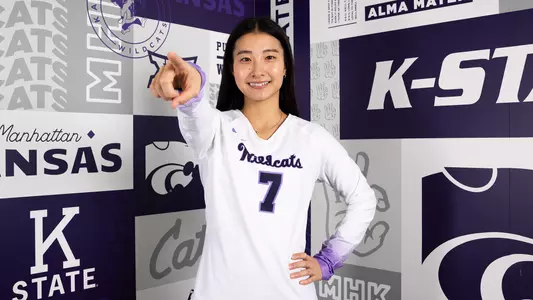
Sekita Found Her True Calling
May 05, 2026 | Volleyball, Sports Extra
By: D. Scott Fritchen
She chose to attend a high school two hours from home. Each day, there was the train, the bus, and finally the walk to Mukogawa Women's Senior High School, which had the best volleyball program around. It harbored an arena of hope for young Fuka Sekita, a native of Hyogo, Japan, who began her athletic endeavors as a hesitant 9-year-old going to soccer practice at the request of her parents, but who later that year found her true calling — volleyball — and the flow that she credits to her present success.
"My best friend invited me to her volleyball team," Sekita says. "I was nine. She wanted me to come to practice. I found out they gave you snacks. I found out I could hit the ball, so I started playing volleyball. Years later, I went to a good high school. There's no club volleyball in Japan, so if you want to play good volleyball, you have to go to a good high school.
"Getting to school was not fun, but I had a really good experience over there."
She realized in the sixth grade that she was perhaps more talented than her peers on the volleyball court. At 5-foot-1, she was actually taller than the other kids at the time. Her parents lived athletic lives. Her father's activities included skiing, ping-pong, soccer, baseball, Japanese Judo and kayaking. Her mother liked handball. Her parents taught Fuka sports, but she thrived on the volleyball court.
"In elementary school, almost all the kids weren't serious about volleyball," Sekita says. "But I was."
Japan only has three years of high school. Sekita wanted to play professional volleyball and be a teacher as well. By her final year of high school, she knew what she wanted. She wanted volleyball to take her places in life. She began researching college volleyball programs in the United States. Through her agent, she connected with some college coaches.
Her first stop? New Mexico Military Institute.
"I didn't understand how hard a military school was," she says. "I spoke with a Japanese player who was there before me. I got there and didn't understand an English word. I was a cadet, and had a uniform, woke up early, went to bed at 10:00 p.m., and performed rifle drills. I just wanted to play volleyball. It was a hard time my first year."
Playing libero in two seasons at New Mexico Military Institute, she earned NJCAA First Team All-America and AVCA Second Team All-America honors with 1,297 digs, 191 assists and 65 service aces. She earned conference Defensive Player of the Year and Most Valuable Player honors. She was named conference Player of the Week 13 times and was a four-time NJCAA Defensive Player of the Week.
"I was just trying to show everything," she says. "When I played in Japan, we didn't show emotion and celebrate, so I was kind of shy. So, I tried to be like American volleyball players. As far as my skills, I noticed that I could compete with these tall girls. I could compete with them. My teammate earned conference MVP the year before, and I saw her trophy. I said, 'I'm going to get that next year.' I had a goal and went out and got it."
Sekita yearned for more.
"UTEP had a good season before I committed there and they needed a libero," she says. "My New Mexico head coach and the UTEP head coach were really close with each other, and UTEP is close to New Mexico Military Institute, so I decided to go to UTEP."
Last season, she helped UTEP to a 25-5 record and the NCAA Tournament while anchoring the defense with a team-high 364 digs and 3.64 digs per set, which ranked seventh in Conference USA, and also had 99 assists and 19 service aces. She had double-digit digs in 23 matches.
"I visited K-State, and I loved the purple, and I felt that K-State needed me at libero," Sekita says.

Sekita has played libero for four years now.
"Honestly, if I was a tall player I'd be an outside hitter, but it's important to stay disciplined, and me personally, as a libero, I care about other players more than myself," Sekita says. "The setter is so busy and has to check everything, and the middle blockers move around and everything, but the libero, we stay grounded and get the ball. I really like that I can care about other players.
"I just have to get more range for the digs. My passing is consistent but other liberos are taller and can reach way farther than me, and they're so fast, and I'm 5-foot-1 with shorter arms, so I have to be more creative. I always think I have to dig, set and pass perfect, but I've learned I just need to touch the ball and create as a libero. I'm going to work on that for next season."
Today, Sekita sits inside the Morgan Family Arena wearing a gray t-shirt with a purple Powercat in the middle. She smiles as she discusses her journey to this point. She visited K-State in December and signed her scholarship papers on January 7 and arrived at K-State on January 18 before spring practice began weeks later.
"K-State has a lot of fans, and I was talking to some Japanese friends playing sports in the U.S., and they said, 'Fuka, you're going to K-State? Oh my gosh, that's a big school. I wish I was there, too.' This Powercat logo is really heavy for me. I have to keep telling myself that I'm not playing volleyball only for me. I have to play for my family and friends back home, and for this city and the school, and with next season being my last to play volleyball in the U.S., I want to play volleyball for others, not for me."

K-State head coach Jason Mansfield is pumped that Sekita will be a Wildcat for her final collegiate season.
"We are so excited to welcome Fuka to our K-State volleyball family," Mansfield says. "She's a quick, fearless defender who's incredibly skilled as a passer, server and setter. Fuka is driven to be the best she can be, has a deep love for the game of volleyball, and will bring a great deal of experience and passion to our team."
From that little girl who took the train, the bus and walked two hours from Hyogo, Japan to Mukogawa Women's Senior High School each day to chase this passion for volleyball, to the young woman eager to embark upon her final season in the United States, what has Sekita learned most about herself during her journey?
"It's really simple, but I've learned a smile is the most important thing," she says. "When I first came to the United States, I didn't know English and didn't talk to people because I was scared, so I'd just smile. I just smiled all the time. Sometimes, it was hard, especially if a season isn't going well, but I just tried to be positive. And I challenged myself. Challenging myself is very important, also.
"Coming to the United States was the biggest challenge for myself. If I hadn't challenged myself when I was in the third grade, I wouldn't be sitting here in this K-State t-shirt, and maybe I would've already stopped playing volleyball. I'm really glad I challenged myself and came to the United States.
"Volleyball is my life."
What makes Sekita smile these days?
"These days," she says, "volleyball makes me smile so much."
She chose to attend a high school two hours from home. Each day, there was the train, the bus, and finally the walk to Mukogawa Women's Senior High School, which had the best volleyball program around. It harbored an arena of hope for young Fuka Sekita, a native of Hyogo, Japan, who began her athletic endeavors as a hesitant 9-year-old going to soccer practice at the request of her parents, but who later that year found her true calling — volleyball — and the flow that she credits to her present success.
"My best friend invited me to her volleyball team," Sekita says. "I was nine. She wanted me to come to practice. I found out they gave you snacks. I found out I could hit the ball, so I started playing volleyball. Years later, I went to a good high school. There's no club volleyball in Japan, so if you want to play good volleyball, you have to go to a good high school.
"Getting to school was not fun, but I had a really good experience over there."
She realized in the sixth grade that she was perhaps more talented than her peers on the volleyball court. At 5-foot-1, she was actually taller than the other kids at the time. Her parents lived athletic lives. Her father's activities included skiing, ping-pong, soccer, baseball, Japanese Judo and kayaking. Her mother liked handball. Her parents taught Fuka sports, but she thrived on the volleyball court.
"In elementary school, almost all the kids weren't serious about volleyball," Sekita says. "But I was."
Japan only has three years of high school. Sekita wanted to play professional volleyball and be a teacher as well. By her final year of high school, she knew what she wanted. She wanted volleyball to take her places in life. She began researching college volleyball programs in the United States. Through her agent, she connected with some college coaches.
Her first stop? New Mexico Military Institute.
"I didn't understand how hard a military school was," she says. "I spoke with a Japanese player who was there before me. I got there and didn't understand an English word. I was a cadet, and had a uniform, woke up early, went to bed at 10:00 p.m., and performed rifle drills. I just wanted to play volleyball. It was a hard time my first year."
Playing libero in two seasons at New Mexico Military Institute, she earned NJCAA First Team All-America and AVCA Second Team All-America honors with 1,297 digs, 191 assists and 65 service aces. She earned conference Defensive Player of the Year and Most Valuable Player honors. She was named conference Player of the Week 13 times and was a four-time NJCAA Defensive Player of the Week.
"I was just trying to show everything," she says. "When I played in Japan, we didn't show emotion and celebrate, so I was kind of shy. So, I tried to be like American volleyball players. As far as my skills, I noticed that I could compete with these tall girls. I could compete with them. My teammate earned conference MVP the year before, and I saw her trophy. I said, 'I'm going to get that next year.' I had a goal and went out and got it."
Sekita yearned for more.
"UTEP had a good season before I committed there and they needed a libero," she says. "My New Mexico head coach and the UTEP head coach were really close with each other, and UTEP is close to New Mexico Military Institute, so I decided to go to UTEP."
Last season, she helped UTEP to a 25-5 record and the NCAA Tournament while anchoring the defense with a team-high 364 digs and 3.64 digs per set, which ranked seventh in Conference USA, and also had 99 assists and 19 service aces. She had double-digit digs in 23 matches.
"I visited K-State, and I loved the purple, and I felt that K-State needed me at libero," Sekita says.
Sekita has played libero for four years now.
"Honestly, if I was a tall player I'd be an outside hitter, but it's important to stay disciplined, and me personally, as a libero, I care about other players more than myself," Sekita says. "The setter is so busy and has to check everything, and the middle blockers move around and everything, but the libero, we stay grounded and get the ball. I really like that I can care about other players.
"I just have to get more range for the digs. My passing is consistent but other liberos are taller and can reach way farther than me, and they're so fast, and I'm 5-foot-1 with shorter arms, so I have to be more creative. I always think I have to dig, set and pass perfect, but I've learned I just need to touch the ball and create as a libero. I'm going to work on that for next season."
Today, Sekita sits inside the Morgan Family Arena wearing a gray t-shirt with a purple Powercat in the middle. She smiles as she discusses her journey to this point. She visited K-State in December and signed her scholarship papers on January 7 and arrived at K-State on January 18 before spring practice began weeks later.
"K-State has a lot of fans, and I was talking to some Japanese friends playing sports in the U.S., and they said, 'Fuka, you're going to K-State? Oh my gosh, that's a big school. I wish I was there, too.' This Powercat logo is really heavy for me. I have to keep telling myself that I'm not playing volleyball only for me. I have to play for my family and friends back home, and for this city and the school, and with next season being my last to play volleyball in the U.S., I want to play volleyball for others, not for me."
K-State head coach Jason Mansfield is pumped that Sekita will be a Wildcat for her final collegiate season.
"We are so excited to welcome Fuka to our K-State volleyball family," Mansfield says. "She's a quick, fearless defender who's incredibly skilled as a passer, server and setter. Fuka is driven to be the best she can be, has a deep love for the game of volleyball, and will bring a great deal of experience and passion to our team."
From that little girl who took the train, the bus and walked two hours from Hyogo, Japan to Mukogawa Women's Senior High School each day to chase this passion for volleyball, to the young woman eager to embark upon her final season in the United States, what has Sekita learned most about herself during her journey?
"It's really simple, but I've learned a smile is the most important thing," she says. "When I first came to the United States, I didn't know English and didn't talk to people because I was scared, so I'd just smile. I just smiled all the time. Sometimes, it was hard, especially if a season isn't going well, but I just tried to be positive. And I challenged myself. Challenging myself is very important, also.
"Coming to the United States was the biggest challenge for myself. If I hadn't challenged myself when I was in the third grade, I wouldn't be sitting here in this K-State t-shirt, and maybe I would've already stopped playing volleyball. I'm really glad I challenged myself and came to the United States.
"Volleyball is my life."
What makes Sekita smile these days?
"These days," she says, "volleyball makes me smile so much."
Players Mentioned

L
/ VolleyballK-State Volleyball | Alumni Game Mic'd Up
Monday, May 04
K State Men's Basketball | Head Coach Casey Alexander Media Availability - April 30, 2026
Thursday, April 30
K-State Rowing | March Rower of the Month
Thursday, April 30
Women's Golf | NCAA Tournament Selection Show Reaction
Wednesday, April 29