Trausch Fueled to Develop Optimal Performance
Jun 05, 2026 | Football, Sports Extra
Scott Trausch, who came to Kansas State to fill its newly-developed Director of Sports Nutrition position in October 2013, oversees the development of all nutritional protocols, including performance-fueling strategies, team and individual nutrition education, hydration, and body composition testing. He sits wearing a big smile in his office with big windows inside the Vanier Family Football Complex. It's 9:03 a.m. on Tuesday, and the 37-year-old husband and father of three points at a piece of typing paper taped to the top edge of his desk.
Upon the paper are a series of slash marks in black marker like you'd use to keep track of the score in a mean game of horseshoes. These slash marks? They're reserved for a different game. The slash marks have aged more than a decade, serving proof that competition knows no age, and that the men who roam the sideline on Saturdays in the fall aren't exempt from suffering a loss a time or two — particularly off the football field.
"Since 2013, Collin Klein and I have played Spikeball in the weight room, and it got very intense," Trausch begins, pointing at the scoresheet with all the slash marks. "A long time ago, I started keeping this record. When Collin left, I kept the scoresheet because I knew he'd be coming back someday, and when he arrived as head coach, I told him, 'I still got it.'
"It was always a great competition. We even talked about playing Spikeball yesterday."
The Spikeball scoresheet hasn't yellowed and the memories of 13 years at K-State haven't faded for Trausch, a native of Lincoln, Nebraska, who began his journey as a student intern with the Nebraska football team from 2008-11 before assuming the full-time role in Sports Nutrition where he managed all sports nutrition services for the Nebraska football team from 2011-13. Trausch knew Nebraska was well established, as the always-hungry Huskers gobbled up opponents for decades and were always near the top of the food pyramid in college football, but he yearned for something more.
"At 24 years old, you're really hungry and want to put your skillset to the test," Trausch says. "What I'd known from Nebraska, and knowing sports nutrition was in its infancy in athletics, I knew I'd have to leave to test myself. K-State was that leap I needed to take."
Back then, Trausch was single with no children, and he put in absurd hours to prove to head coach Bill Snyder and Matt Thomason, the senior associate AD for student-athlete health, wellness & performance who hired him, that he wasn't just a "food guy," but an integral piece for what was quickly evolving into an ever-growing and competitive realm of college athletics — the sports nutrition game. In the beginning, at 24 years old, Trausch pulled up to Vanier at 3:00 a.m. to begin his day. In the beginning, K-State football had no office for Trausch, so he took an office located between the offices of Coach Snyder, and his son, Sean Snyder, who at the time was the longstanding special teams coordinator.
"It was a whirlwind, but within a day it was clear this was going to be something special," Trausch says. "Matt Thomason, who hired me in that process, he's been my supervisor for 13 years, but the first day was me wondering what they were going to expect from me. I came from a Nebraska football program where nutrition had been there since the 1990s. I knew what I wanted to do and that was to not bring Nebraska to K-State. I just wanted to bring my skillset in and understand what K-State needed and build off that.
"I was an early riser, and I had work to do and wanted to be the best at what I was going to do. Every morning at 5:00 a.m., Coach Snyder walked by my office and said, 'Good morning, Scott.' What started as minimal talking grew into hand-written notes and then Coach asking me in meetings, 'What are your thoughts, Scott?' Coach Snyder became open to ideas. I wanted to take things really slow. The fact that they took a chance on me to come in and build a program, that was my dream."
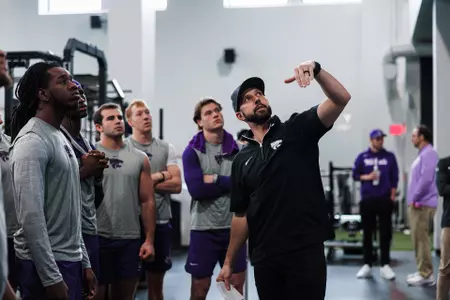
Today, Trausch occupies a central office whose windows peer into the K-State Football Fueling Station, the primary on-site nutritional hub, which is adjacent to the weight room and provides players with performance snacks, shakes and rapid recovery supplements to ensure players meet their optimal macronutrient and calorie goals. Small typewritten labels upon one glass fridge read, "Turkey Sandwich" and "Chicken Sandwich" and "Hard Boiled Eggs" and "Ham Sandwich" and "String Cheese" and "Strawberries" and "Pineapple" and "Carrots" and "Collagen Jell-O" with nutritional information also typewritten upon the bottom of each label. About two dozen UnCrustables fill a bin in another fridge. Another fridge reads "Post-Lift Shakes" and features Chocolate Hulk (750 calories), Vanilla Hulk (740 calories), PB&J (765 calories), Strawberry Banana (510 calories), Snickerdoodle (430 calories), and Mint Chocolate Chip (530 calories). Oh, there's plenty more good stuff around here, like a Chobani yogurt creation stand, whole milk, chocolate milk, eight large stainless-steel bowls that house fresh fruits and that sit atop long steel tables, standing coolers filled with Gatorade bottles and other recovery beverages. One sign upon a wall reads, "THE DAILY EDGE. POWER. RECOVERY. AVAILABILITY. BUILT DAILY." Underneath reads, "Vitamin D3 — Supported Muscle Produces Force," and "Magnesium — Recovered Muscle Can Train Again," and "Omega-3 — Healthy Joints Stay Available." Underneath reads, "Training creates the stimulus, support determines adaptation."
If you've read this far and it seems like a lot — it is a lot. There is simply so much that goes into building a body for success in college football.
Trausch, who typically gets to his office at 4:15 a.m. to start the day, brings a visitor into his office at 9:03 a.m. to discuss his passion and his life. Trausch just came from an Optimal Performance Team meeting, which features Klein along with Trey Scott (football general manager), Matt Thomason (Sports Medicine), Lance Yancy (Director of Sports Science), Jeremy Jacobs (Director of Strength and Conditioning) and Kacey Feldcamp (Director of Football Operations).
"It was a meeting about the status of the team where we talk about the week and our collective thoughts as a performance team, and Coach offers his thoughts, and Lance talks about the Catapults and the results from the latest run, and I talk about guys from a weight perspective and their trajectory for the end of the training phase," Trausch says. "Jeremy talks about the lifts and team runs. It's just a very honed-in meeting about where the team is at and if we need to change anything. We also talked about practices, camp schedule, so we're prepared for that meeting.
"The rest of the day, we're doing body-composition testing. We'll do it at the beginning of the phase and then at the end of the phase we'll help project where our guys need to be by the start of camp from a body-composition standpoint."
Then Trausch, sitting at his desk, turns on a flatscreen upon a nearby wall, and scrolls through menus with a remote.
He is showing off his baby — a website that he built over a two-month period, and that seemingly tabulates endless rows of data — data that we mere mortals would never think about, but that's crucial to the overall development of football players.
"I wanted to do this, and I took some numbers and put them in and it just kept snowballing to where it became this," he says, pointing at the flatscreen in his office. "It's evolved since January and I keep adding things because players ask, 'What about this?' At the touch of a button, they have access to their data, their ability to hydrate, to fuel, to know every day, and for me, that's what allowed us on here to really have our best winter ever."
Best winter ever?
"Best winter ever," Trausch says.
Think Trausch's one-of-a-kind technology is appealing to recruits who seek to maximize their body composition, their strength, endurance and overall on-field performance throughout a 12, 13 or 14-game schedule in the fall?
Darned right.
In short, with this technology developed by Trausch, K-State football is Star Trek and a majority of the rest of college football are the Flintstones.
"Recruits say, 'We've never seen this.' I say, 'You're right, because there's not an app, there's not a company, because I spent two months building this myself,'" Trausch says. "Some schools have a nutrition budget five times the size of ours with three or four full-time directors of nutrition, and they aren't doing this. It's been great. Having Lance in sports science and working with him for seven years and now Jeremy in the weight room and the training staff, just our ability down here as a performance team, we're not silent in any way. The meetings we have, the information we share is very, very important to the success of our players because it all plays a part.
"If I didn't have his data, I couldn't be more specific to these guys about how we're going to fuel. If I didn't know what Jeremy was doing in the weight room, we're not going to see these types of results. When you take the silo effect out and all four areas from strength to science to nutrition to medicine are on the same page, that's why we achieved what we achieved in the winter of 2026."
Exactly what did K-State football achieve in the winter of 2026?
K-State players gained an average of 6.9 pounds of muscle — the all-time best in K-State history for a winter strength and conditioning period.
K-State players lost an average of 2.6 pounds of fat — also the all-time best in K-State history for a winter strength and conditioning period.
In a span of seven weeks of winter training, 27 players gained at least 10 pounds of muscle — again, the all-time best in K-State history for a winter strength and conditioning period.
"The amount of muscle gained per guy to the amount of fat loss per guy, for it to outweigh and to bring back the old-school mentality of going back to stations and how hard we pushed the players' bodies, we knew we could push them because we had the data to back up that their bodies were ready for this," Trausch says. "The player loads, the yards, everything they accumulated allowed us to say, 'Yes, push the envelope,' instead of the eye test of, 'I think they look good to go.' We know every day where a player is at and we can say, 'This guy needs to go harder' or 'This guy needs to pull back a tiny back.' We have the data to show that we have a reason to do that, which is great."
One K-State player instantly comes to mind — sophomore tight end Linkon Cure — after Klein in a news conference applauded Cure for gaining the most muscle and losing the most fat of any player on the team.
Cure credited Trausch and Jacobs and his recovery following workouts for his development in winter conditioning.
"Linkon said, 'I'm going to do exactly what they're telling me,'" Trausch says. "A lot of guys find success on the scale. Talking to him, I said, 'If your body weight is the same every day and you're training the way you're training you might not see that scale moving at all, because that means you're gaining muscle and losing fat. You have to trust that. You are doing everything you're doing and see the same number everyday — trust that.'
"Linkon trusted that and saw his progress and he was like, 'Woah.' He gained 12 pounds of muscle and lost 11.6 pounds of fat. To do that in really 49 days at the most is pretty phenomenal. It wasn't even a true seven weeks. His most current weight is 244 pounds. He'll be in the best shape of his life at the end of the summer."
Trausch points out another player — Josiah Vilmael, a freshman who was the 83rd-rated cornerback in the Class of 2026 by ESPN and who had four interceptions his senior season at Fort Bend Travis (Texas) High School. Vilmael also earned six USATF All-America honors with sizzling times in the 100-meter dash (10.66 seconds), and the 200-meter dash (21.29).
"Josiah stepped into Vanier at 174 pounds and in 51 days he gained 19 pounds of muscle and put on two pounds of fat, but for putting on that much muscle, and for the scale to go from 173 to 197 in 51 days, is incredible. His goal was scale weight. He wanted to gain weight. You're not going to be a great defensive back at 173 pounds.
"We have every piece of information about every guy, so when they go into the weight room and step on the scale there's an iPad and the second that scale registers that number, it's put into our online database so every day we can see bodyweights."
Trausch cleans up one popular misconception when it comes to preparing players for battle on the gridiron. Just as Klein loaded up the spring in having players wear shoulder pads in 12 of 15 practices, notably irritated by the NCAA rule that allows just eight helmeted practices in fall camp — "The only way you can get better playing football is by playing football," Klein says — Trausch, Jacobs, Yancy and everybody else involved with advising and preparing players face bumps of their own.
"People think, 'We have eight months to get these guys prepared,'" Trausch says. "Well, we do, but we really only have two training phases in those eight months where football isn't the priority. You get seven weeks in the winter, usually a spring break, then it's football spring practice, then dead week, then finals week where we can't do a lot with the rules, and then they're off for three weeks. The summer training phase is seven weeks.
"For us to actually have our hands on them and do training phases, yes, we have eight months, but really call it three months, or 14 weeks of true program training in the weightroom versus here's a take-home for spring break or for three weeks in May. When they're away, they're away from resources and their fuel station and meals already prepared and there are ebbs and flows throughout that. We try to educate them as much as we can and they get handouts and workouts and meal plans during those breaks, but also, some guys might be taking a vacation."
There are no days off when it comes to Trausch's passion.
On Tuesday, Trausch arrived at Vanier at 4:15 a.m. and returned home at 6:45 p.m. Monday, Tuesday and Thursday are typically 12- to 14-hour workdays. Wednesday is usually around an eight-hour workday because players are off. This Friday, with the parade of official visits, will likely turn into a 13-hour workday. When the season hits, Trausch and his staff will arrive at 4:00 a.m. to prepare for morning practice.
"It's busy all day, which is great," Trausch says. "A day like Tuesday didn't feel like 12 or 13 hours. Coming in at 4:00 a.m., guys are going to be rolling in at 5:00 or 5:30 a.m. so it's getting hydration ready, and getting everything prepared, so I can be in the fuel station to talk to guys. 'Remember, you're cramping prone. It's humid this morning, you're going to sweat a lot more.' In the runs, I'm taking notes of which guy is toward the back of the pack and is he there because he's out of shape or because his body isn't letting him push the envelope? Why is it not letting him? Is it food? The carbs? Hydration? His body composition? So, I collect my notes during conditioning. Then we have our meeting with Coach."
It's less than 100 days until the September 5 season opener against Nicholls at Bill Snyder Family Stadium. No matter the amount of success K-State achieves in its first year under Klein, or in its second year, or in its third, Trausch, in his domain, believes there's plenty room to continue to grow.
"We're above and beyond a lot of programs," he says. "We definitely haven't reached our ceiling. Being here 13 years and building something like this, we still have a long ways to go because it seems like every year we found a way to get better in terms of our education and buy-in. Our 2026 numbers, that's what keeps me hungry, knowing we keep clawing toward the top of that mountain, but the great part is everyone down here will say there's no top of the mountain, because we just know where our eyes are at, which is straight ahead.
"For us to see the record results we saw in the winter just tells us that in 2027 we have to do better. We've surpassed a lot of schools, and a lot of schools could beat us in the resource game, but they couldn't beat us in the relationship game of how strength and nutrition, science and medicine collectively work with a head coach and the buy-in we have with players.
"For what we have, we are one of the best in the country, hands down."
It's 10:10 a.m. Trausch's meeting with his visitor has run over. There are players to meet with individually. They patiently wait outside his office. Nearby, other players survey the food sprawled across the stainless-steel table.
This is Trausch's element. Smiling, he waves a player into his office. They will talk about life. They will talk about football, and they will talk about being a part of this K-State family, which seemingly continues to build and build and build, for now behind the scenes, before coaches and players race out of the tunnel and onto the field for the first game.
Somewhere on Trausch's to-do list is a reminder to text Klein.
They still have a score to settle in Spikeball.
Upon the paper are a series of slash marks in black marker like you'd use to keep track of the score in a mean game of horseshoes. These slash marks? They're reserved for a different game. The slash marks have aged more than a decade, serving proof that competition knows no age, and that the men who roam the sideline on Saturdays in the fall aren't exempt from suffering a loss a time or two — particularly off the football field.
"Since 2013, Collin Klein and I have played Spikeball in the weight room, and it got very intense," Trausch begins, pointing at the scoresheet with all the slash marks. "A long time ago, I started keeping this record. When Collin left, I kept the scoresheet because I knew he'd be coming back someday, and when he arrived as head coach, I told him, 'I still got it.'
"It was always a great competition. We even talked about playing Spikeball yesterday."
The Spikeball scoresheet hasn't yellowed and the memories of 13 years at K-State haven't faded for Trausch, a native of Lincoln, Nebraska, who began his journey as a student intern with the Nebraska football team from 2008-11 before assuming the full-time role in Sports Nutrition where he managed all sports nutrition services for the Nebraska football team from 2011-13. Trausch knew Nebraska was well established, as the always-hungry Huskers gobbled up opponents for decades and were always near the top of the food pyramid in college football, but he yearned for something more.
"At 24 years old, you're really hungry and want to put your skillset to the test," Trausch says. "What I'd known from Nebraska, and knowing sports nutrition was in its infancy in athletics, I knew I'd have to leave to test myself. K-State was that leap I needed to take."
Back then, Trausch was single with no children, and he put in absurd hours to prove to head coach Bill Snyder and Matt Thomason, the senior associate AD for student-athlete health, wellness & performance who hired him, that he wasn't just a "food guy," but an integral piece for what was quickly evolving into an ever-growing and competitive realm of college athletics — the sports nutrition game. In the beginning, at 24 years old, Trausch pulled up to Vanier at 3:00 a.m. to begin his day. In the beginning, K-State football had no office for Trausch, so he took an office located between the offices of Coach Snyder, and his son, Sean Snyder, who at the time was the longstanding special teams coordinator.
"It was a whirlwind, but within a day it was clear this was going to be something special," Trausch says. "Matt Thomason, who hired me in that process, he's been my supervisor for 13 years, but the first day was me wondering what they were going to expect from me. I came from a Nebraska football program where nutrition had been there since the 1990s. I knew what I wanted to do and that was to not bring Nebraska to K-State. I just wanted to bring my skillset in and understand what K-State needed and build off that.
"I was an early riser, and I had work to do and wanted to be the best at what I was going to do. Every morning at 5:00 a.m., Coach Snyder walked by my office and said, 'Good morning, Scott.' What started as minimal talking grew into hand-written notes and then Coach asking me in meetings, 'What are your thoughts, Scott?' Coach Snyder became open to ideas. I wanted to take things really slow. The fact that they took a chance on me to come in and build a program, that was my dream."
Today, Trausch occupies a central office whose windows peer into the K-State Football Fueling Station, the primary on-site nutritional hub, which is adjacent to the weight room and provides players with performance snacks, shakes and rapid recovery supplements to ensure players meet their optimal macronutrient and calorie goals. Small typewritten labels upon one glass fridge read, "Turkey Sandwich" and "Chicken Sandwich" and "Hard Boiled Eggs" and "Ham Sandwich" and "String Cheese" and "Strawberries" and "Pineapple" and "Carrots" and "Collagen Jell-O" with nutritional information also typewritten upon the bottom of each label. About two dozen UnCrustables fill a bin in another fridge. Another fridge reads "Post-Lift Shakes" and features Chocolate Hulk (750 calories), Vanilla Hulk (740 calories), PB&J (765 calories), Strawberry Banana (510 calories), Snickerdoodle (430 calories), and Mint Chocolate Chip (530 calories). Oh, there's plenty more good stuff around here, like a Chobani yogurt creation stand, whole milk, chocolate milk, eight large stainless-steel bowls that house fresh fruits and that sit atop long steel tables, standing coolers filled with Gatorade bottles and other recovery beverages. One sign upon a wall reads, "THE DAILY EDGE. POWER. RECOVERY. AVAILABILITY. BUILT DAILY." Underneath reads, "Vitamin D3 — Supported Muscle Produces Force," and "Magnesium — Recovered Muscle Can Train Again," and "Omega-3 — Healthy Joints Stay Available." Underneath reads, "Training creates the stimulus, support determines adaptation."
If you've read this far and it seems like a lot — it is a lot. There is simply so much that goes into building a body for success in college football.
Trausch, who typically gets to his office at 4:15 a.m. to start the day, brings a visitor into his office at 9:03 a.m. to discuss his passion and his life. Trausch just came from an Optimal Performance Team meeting, which features Klein along with Trey Scott (football general manager), Matt Thomason (Sports Medicine), Lance Yancy (Director of Sports Science), Jeremy Jacobs (Director of Strength and Conditioning) and Kacey Feldcamp (Director of Football Operations).
"It was a meeting about the status of the team where we talk about the week and our collective thoughts as a performance team, and Coach offers his thoughts, and Lance talks about the Catapults and the results from the latest run, and I talk about guys from a weight perspective and their trajectory for the end of the training phase," Trausch says. "Jeremy talks about the lifts and team runs. It's just a very honed-in meeting about where the team is at and if we need to change anything. We also talked about practices, camp schedule, so we're prepared for that meeting.
"The rest of the day, we're doing body-composition testing. We'll do it at the beginning of the phase and then at the end of the phase we'll help project where our guys need to be by the start of camp from a body-composition standpoint."
Then Trausch, sitting at his desk, turns on a flatscreen upon a nearby wall, and scrolls through menus with a remote.
He is showing off his baby — a website that he built over a two-month period, and that seemingly tabulates endless rows of data — data that we mere mortals would never think about, but that's crucial to the overall development of football players.
"I wanted to do this, and I took some numbers and put them in and it just kept snowballing to where it became this," he says, pointing at the flatscreen in his office. "It's evolved since January and I keep adding things because players ask, 'What about this?' At the touch of a button, they have access to their data, their ability to hydrate, to fuel, to know every day, and for me, that's what allowed us on here to really have our best winter ever."
Best winter ever?
"Best winter ever," Trausch says.
Think Trausch's one-of-a-kind technology is appealing to recruits who seek to maximize their body composition, their strength, endurance and overall on-field performance throughout a 12, 13 or 14-game schedule in the fall?
Darned right.
In short, with this technology developed by Trausch, K-State football is Star Trek and a majority of the rest of college football are the Flintstones.
"Recruits say, 'We've never seen this.' I say, 'You're right, because there's not an app, there's not a company, because I spent two months building this myself,'" Trausch says. "Some schools have a nutrition budget five times the size of ours with three or four full-time directors of nutrition, and they aren't doing this. It's been great. Having Lance in sports science and working with him for seven years and now Jeremy in the weight room and the training staff, just our ability down here as a performance team, we're not silent in any way. The meetings we have, the information we share is very, very important to the success of our players because it all plays a part.
"If I didn't have his data, I couldn't be more specific to these guys about how we're going to fuel. If I didn't know what Jeremy was doing in the weight room, we're not going to see these types of results. When you take the silo effect out and all four areas from strength to science to nutrition to medicine are on the same page, that's why we achieved what we achieved in the winter of 2026."
Exactly what did K-State football achieve in the winter of 2026?
K-State players gained an average of 6.9 pounds of muscle — the all-time best in K-State history for a winter strength and conditioning period.
K-State players lost an average of 2.6 pounds of fat — also the all-time best in K-State history for a winter strength and conditioning period.
In a span of seven weeks of winter training, 27 players gained at least 10 pounds of muscle — again, the all-time best in K-State history for a winter strength and conditioning period.
"The amount of muscle gained per guy to the amount of fat loss per guy, for it to outweigh and to bring back the old-school mentality of going back to stations and how hard we pushed the players' bodies, we knew we could push them because we had the data to back up that their bodies were ready for this," Trausch says. "The player loads, the yards, everything they accumulated allowed us to say, 'Yes, push the envelope,' instead of the eye test of, 'I think they look good to go.' We know every day where a player is at and we can say, 'This guy needs to go harder' or 'This guy needs to pull back a tiny back.' We have the data to show that we have a reason to do that, which is great."
One K-State player instantly comes to mind — sophomore tight end Linkon Cure — after Klein in a news conference applauded Cure for gaining the most muscle and losing the most fat of any player on the team.
Cure credited Trausch and Jacobs and his recovery following workouts for his development in winter conditioning.
"Linkon said, 'I'm going to do exactly what they're telling me,'" Trausch says. "A lot of guys find success on the scale. Talking to him, I said, 'If your body weight is the same every day and you're training the way you're training you might not see that scale moving at all, because that means you're gaining muscle and losing fat. You have to trust that. You are doing everything you're doing and see the same number everyday — trust that.'
"Linkon trusted that and saw his progress and he was like, 'Woah.' He gained 12 pounds of muscle and lost 11.6 pounds of fat. To do that in really 49 days at the most is pretty phenomenal. It wasn't even a true seven weeks. His most current weight is 244 pounds. He'll be in the best shape of his life at the end of the summer."
Trausch points out another player — Josiah Vilmael, a freshman who was the 83rd-rated cornerback in the Class of 2026 by ESPN and who had four interceptions his senior season at Fort Bend Travis (Texas) High School. Vilmael also earned six USATF All-America honors with sizzling times in the 100-meter dash (10.66 seconds), and the 200-meter dash (21.29).
"Josiah stepped into Vanier at 174 pounds and in 51 days he gained 19 pounds of muscle and put on two pounds of fat, but for putting on that much muscle, and for the scale to go from 173 to 197 in 51 days, is incredible. His goal was scale weight. He wanted to gain weight. You're not going to be a great defensive back at 173 pounds.
"We have every piece of information about every guy, so when they go into the weight room and step on the scale there's an iPad and the second that scale registers that number, it's put into our online database so every day we can see bodyweights."
Trausch cleans up one popular misconception when it comes to preparing players for battle on the gridiron. Just as Klein loaded up the spring in having players wear shoulder pads in 12 of 15 practices, notably irritated by the NCAA rule that allows just eight helmeted practices in fall camp — "The only way you can get better playing football is by playing football," Klein says — Trausch, Jacobs, Yancy and everybody else involved with advising and preparing players face bumps of their own.
"People think, 'We have eight months to get these guys prepared,'" Trausch says. "Well, we do, but we really only have two training phases in those eight months where football isn't the priority. You get seven weeks in the winter, usually a spring break, then it's football spring practice, then dead week, then finals week where we can't do a lot with the rules, and then they're off for three weeks. The summer training phase is seven weeks.
"For us to actually have our hands on them and do training phases, yes, we have eight months, but really call it three months, or 14 weeks of true program training in the weightroom versus here's a take-home for spring break or for three weeks in May. When they're away, they're away from resources and their fuel station and meals already prepared and there are ebbs and flows throughout that. We try to educate them as much as we can and they get handouts and workouts and meal plans during those breaks, but also, some guys might be taking a vacation."
There are no days off when it comes to Trausch's passion.
On Tuesday, Trausch arrived at Vanier at 4:15 a.m. and returned home at 6:45 p.m. Monday, Tuesday and Thursday are typically 12- to 14-hour workdays. Wednesday is usually around an eight-hour workday because players are off. This Friday, with the parade of official visits, will likely turn into a 13-hour workday. When the season hits, Trausch and his staff will arrive at 4:00 a.m. to prepare for morning practice.
"It's busy all day, which is great," Trausch says. "A day like Tuesday didn't feel like 12 or 13 hours. Coming in at 4:00 a.m., guys are going to be rolling in at 5:00 or 5:30 a.m. so it's getting hydration ready, and getting everything prepared, so I can be in the fuel station to talk to guys. 'Remember, you're cramping prone. It's humid this morning, you're going to sweat a lot more.' In the runs, I'm taking notes of which guy is toward the back of the pack and is he there because he's out of shape or because his body isn't letting him push the envelope? Why is it not letting him? Is it food? The carbs? Hydration? His body composition? So, I collect my notes during conditioning. Then we have our meeting with Coach."
It's less than 100 days until the September 5 season opener against Nicholls at Bill Snyder Family Stadium. No matter the amount of success K-State achieves in its first year under Klein, or in its second year, or in its third, Trausch, in his domain, believes there's plenty room to continue to grow.
"We're above and beyond a lot of programs," he says. "We definitely haven't reached our ceiling. Being here 13 years and building something like this, we still have a long ways to go because it seems like every year we found a way to get better in terms of our education and buy-in. Our 2026 numbers, that's what keeps me hungry, knowing we keep clawing toward the top of that mountain, but the great part is everyone down here will say there's no top of the mountain, because we just know where our eyes are at, which is straight ahead.
"For us to see the record results we saw in the winter just tells us that in 2027 we have to do better. We've surpassed a lot of schools, and a lot of schools could beat us in the resource game, but they couldn't beat us in the relationship game of how strength and nutrition, science and medicine collectively work with a head coach and the buy-in we have with players.
"For what we have, we are one of the best in the country, hands down."
It's 10:10 a.m. Trausch's meeting with his visitor has run over. There are players to meet with individually. They patiently wait outside his office. Nearby, other players survey the food sprawled across the stainless-steel table.
This is Trausch's element. Smiling, he waves a player into his office. They will talk about life. They will talk about football, and they will talk about being a part of this K-State family, which seemingly continues to build and build and build, for now behind the scenes, before coaches and players race out of the tunnel and onto the field for the first game.
Somewhere on Trausch's to-do list is a reminder to text Klein.
They still have a score to settle in Spikeball.

Players Mentioned

TE
/ Football
CB
/ FootballMonday, September 14
Saturday, September 12
Saturday, September 12
Wednesday, September 09