SE: Home Grown — K-State Rowing Continues to Find, Build In-State Athletes into Successes
Sep 27, 2017 | Rowing, Sports Extra
Pat Sweeney was looking for four things: A departure from international rowing. A program that was in desperate need of repair. An athletic department that was willing to let him design his own program. And finally, a community fit to raise his family.
Back in 2003 when he first visited Manhattan, the water was flat, but he knew that would be rare. He was intrigued about the thought of coaching rowing in a different way, and doing so in a community he felt would be good for him and his wife to raise their daughter, Toula.
"Manhattan fit that beautifully," Sweeney, entering his 15th season at K-State, said. "I wanted a challenge, and this program fit that well, too."
Prior to K-State, Sweeney's coaching resume included four World Championship medals, two Olympic medals and four NCAA national titles. Those accomplishments came on the backs of rowers from all over the world who were plopped in a boat at a young age.
Coaching was not coaching, at least how Sweeney knows it now. It was, as he puts it, "easy." He did not want easy. So he came to K-State, where rowing became a varsity sport in the 1996-97 season; where winds and temperature can limit the team's time on the water to only three months of the year; where recruiting means hardly ever leaving the state of Kansas.
"This is hard work. It's a challenge," said Sweeney, a native of England, "and it's fun."
Rowing's 'Cool Runnings'
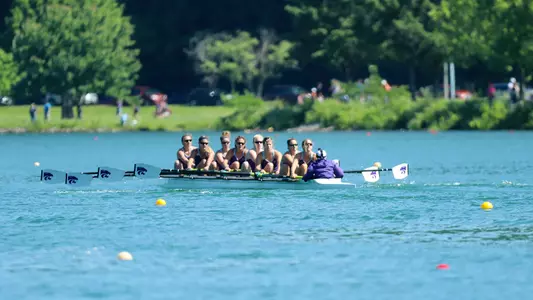
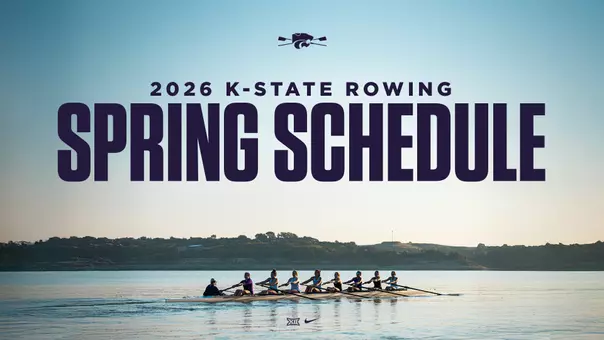
Last season, when K-State's First Varsity Eight idled up to the start line of a race and looked to either side, the Wildcats would see boats filled with out-of-state or international talent. They might even eye an athlete or two that has competed for her national team.
When opponents looked at the Wildcats' top boat, they saw eight Kansans whose first experience in the sport was at a K-State practice. The same could be said for K-State's other four racing boats last season, as all 32 Wildcats who competed were recruited from Kansas without any experience in the sport.
Of the six other schools to compete with a full five-boat arsenal in the Big 12 Championship, only Kansas and Oklahoma broke double-digits in terms of in-state student-athletes.
The rest of the conference's racing squads last season broke down as such:
Unlike its competitors, K-State has leaned on a model of solely recruiting athletes that fit the mold of a rower, from height to mental makeup, and turning them into rowers.
Better yet, the Wildcats make it work.
In the last nine seasons, K-State has placed third or higher in the conference meet six times, highlighted by second-place finishes in 2008-09 and 2013-14.
"There's just something special about this state. There's something about the Midwest," said K-State junior Kennedy Felice. "Homegrown talent, it's out there."
Assistant coach Hanna Wiltfong relates K-State's program to the movie, "Cool Runnings," in which four Jamaicans who never saw snow before compete in the bobsled competition at the Winter Olympics.
"We're playing an international game with local talent," she said. "We're the Jamaica of rowing and we just grabbed some people that seemed kind of athletic and said, 'Let's try hard.' It's our version of 'Cool Runnings.'"
Homegrown Hires
Wiltfong used to be a "skeptic of the system." When she was hired as a graduate assistant coach back in 2012, she was hesitant with the way K-State's program was set up from a coaching standpoint.
"Is this really what's best? Shouldn't you bring in some Olympic rower?" Wiltfong, a product of the program from 2007-12, recalled thinking. Now, the Wildcats' lead recruiter understands. Most high-caliber coaches are not comfortable teaching the sport from the ground up, nor do they relate well to athletes learning the basics of rowing.
Wiltfong, hired as a full-time coach in 2015, can relate. So can K-State's other assistants, Beth DeMars and Noelle Dykmann, as well as graduate assistant Kayla Brock. All three rowed for K-State, as did the assistants before them.
"They've been through it and the frustrations of it, but they know it can be successful," Sweeney said of his assistants. "They know what it's like and they know how to turn kids around. They're Kansas kids, so they know how it works."
K-State's assistants can also identify the intangible traits needed to overcome the obvious obstacles of taking on a completely new sport. Fortunately, they are able to find plenty of those traits in high school gyms without ever hopping on a plane or crossing state lines.
"Nothing stops a Kansas kid. Nothing," Wiltfong said. "The work ethic that comes by nature to these local, regional kids, I think it really opens a door for us to have a fighting chance."
'We All Want to Prove Something'
Each year, the majority of K-State rowing's signees bring an abundance of athletic accolades in sports they were not recruited to play at the Division I level. Whether they were a few inches too short, a couple steps too slow, or simply overlooked, they all share traits that opened their minds to trying a new sport.
Humble, courageous and driven is a starting place when trying to describe the average K-State rower. This only scratches the surface, however.
"These girls are probably some of the hardest workers I've ever worked with," said K-State strength and conditioning coach Christa Ryan.
"It's a bunch of girls who are very much overachievers. Everyone wants to be the best," K-State junior Elaina Grantham added. "Sweeney calls us masochistic because we kill ourselves to be the best, but it really is a common trait among us. We're all extremely hard-working perfectionists."
With their high standards, each accomplishment along the way fuels excitement and an eagerness to take another step forward for K-State's rowers. It can be as small as a technical fix or as big as making one of the five racing boats, but there's always a hunger for more.
"You don't let yourself plateau in one spot because you know that there's always more that can be done," Felice said. "We all want to prove something."
Because K-State's rowers come in without any actual experience, they all start on a level playing field. The ones who make past the first few years, through bloodied hands and aching muscles, grow in ways they never imagined and accomplish feats they never thought possible.
"It's taught me how to push myself beyond where I ever knew that I could," Grantham said. "I really think it's changed my life. I don't know where I'd be without it. It's taught me how to be really tough, strong-minded."
"I figured out how to push hard physically and mentally," K-State junior Grace Reilly added. "To see where I've come from, from where I was, it blows my mind, really."
Between the friends gained and lessons learned, K-State rowing is more than a five-year experience. It's an adventure that will linger for a lifetime.
"There's been a lot of commitment, a lot of sacrifice and a lot that has gone into it, but I think everything I've lost, I've gained so much more because of it. And I don't think you can totally explain that to someone until they become a part of it and they're in it," Felice said. "This team, it's just something that you know is going to be part of you for the rest of your life."
Continuing the Cycle
At a certain point in a K-State rower's journey, everything comes together. The light bulb turns on. Wiltfong lives for these instances.
"I can go a week on one of those moments," she said. "That's going to gas me up for a long time."
Sweeney said helping build a rower from nothing into an All-Big 12 performer or an All-Region selection is as rewarding as the Olympic medals and national championships.
"That's as much fun to see a kid in those four or five years getting to that level as it is to see the professionals win at the Olympics or a World Championship," said Sweeney, who has produced 14 All-Big 12 honorees and 10 Collegiate Rowing Coaches Association All-Region picks at K-State. "That, to me, is as much fun because you've taken something and you've made it."
As K-State's rowers progress through the program, they appreciate the people who came before them more and more. They eventually go from being molded to helping mold the next generation of racers.
"We talk about how we stand on the shoulders of giants because it's kind of this cycle of we all have no idea what's going on and then we come in, we work hard and figure things out. Then you turn around and you teach somebody else how to do that," Felice said. "It's this ongoing cycle of you get broken down and you get built back up but then you get to put your hand in the pot and help build it back up as well."
To think, this style of building all started 15 years ago, when a perfect Manhattan day welcomed an Olympic coach who came in with a plan to construct a program by building rowers en masse. It's a plan Sweeney has stuck to despite the alternatives.
"I think that is incredibly honorable because he's chosen to do more work," Wiltfong said, as K-State prepares to open the 2017-18 season on October 7 at the Head of the Oklahoma in Oklahoma City. "He's coached Olympians. He's coached men, he's coached women, he's coached absolute machines, and yet and still, this is what he thinks is fun, coaching us, a ragtag, thrown together, grassroots program.
"All we need now is more kids who want to work hard."
Back in 2003 when he first visited Manhattan, the water was flat, but he knew that would be rare. He was intrigued about the thought of coaching rowing in a different way, and doing so in a community he felt would be good for him and his wife to raise their daughter, Toula.
"Manhattan fit that beautifully," Sweeney, entering his 15th season at K-State, said. "I wanted a challenge, and this program fit that well, too."
Prior to K-State, Sweeney's coaching resume included four World Championship medals, two Olympic medals and four NCAA national titles. Those accomplishments came on the backs of rowers from all over the world who were plopped in a boat at a young age.
Coaching was not coaching, at least how Sweeney knows it now. It was, as he puts it, "easy." He did not want easy. So he came to K-State, where rowing became a varsity sport in the 1996-97 season; where winds and temperature can limit the team's time on the water to only three months of the year; where recruiting means hardly ever leaving the state of Kansas.
"This is hard work. It's a challenge," said Sweeney, a native of England, "and it's fun."
Rowing's 'Cool Runnings'
Last season, when K-State's First Varsity Eight idled up to the start line of a race and looked to either side, the Wildcats would see boats filled with out-of-state or international talent. They might even eye an athlete or two that has competed for her national team.
When opponents looked at the Wildcats' top boat, they saw eight Kansans whose first experience in the sport was at a K-State practice. The same could be said for K-State's other four racing boats last season, as all 32 Wildcats who competed were recruited from Kansas without any experience in the sport.
Of the six other schools to compete with a full five-boat arsenal in the Big 12 Championship, only Kansas and Oklahoma broke double-digits in terms of in-state student-athletes.
The rest of the conference's racing squads last season broke down as such:
- Texas: Eight in-state rowers, eight international and 16 out-of-state.
- Oklahoma: 12 in-state, three international and 17 out-of-state.
- Tennessee: Four in-state, six international and 22 out-of-state.
- Alabama: Two in-state, one international and 29 out-of-state.
- Kansas: 17 in-state, zero international and 15 out-of-state.
- West Virginia: Four in-state, one international and 15 out-of-state.
Unlike its competitors, K-State has leaned on a model of solely recruiting athletes that fit the mold of a rower, from height to mental makeup, and turning them into rowers.
Better yet, the Wildcats make it work.
In the last nine seasons, K-State has placed third or higher in the conference meet six times, highlighted by second-place finishes in 2008-09 and 2013-14.
"There's just something special about this state. There's something about the Midwest," said K-State junior Kennedy Felice. "Homegrown talent, it's out there."
Assistant coach Hanna Wiltfong relates K-State's program to the movie, "Cool Runnings," in which four Jamaicans who never saw snow before compete in the bobsled competition at the Winter Olympics.
"We're playing an international game with local talent," she said. "We're the Jamaica of rowing and we just grabbed some people that seemed kind of athletic and said, 'Let's try hard.' It's our version of 'Cool Runnings.'"
Homegrown Hires
Wiltfong used to be a "skeptic of the system." When she was hired as a graduate assistant coach back in 2012, she was hesitant with the way K-State's program was set up from a coaching standpoint.
"Is this really what's best? Shouldn't you bring in some Olympic rower?" Wiltfong, a product of the program from 2007-12, recalled thinking. Now, the Wildcats' lead recruiter understands. Most high-caliber coaches are not comfortable teaching the sport from the ground up, nor do they relate well to athletes learning the basics of rowing.
Wiltfong, hired as a full-time coach in 2015, can relate. So can K-State's other assistants, Beth DeMars and Noelle Dykmann, as well as graduate assistant Kayla Brock. All three rowed for K-State, as did the assistants before them.
"They've been through it and the frustrations of it, but they know it can be successful," Sweeney said of his assistants. "They know what it's like and they know how to turn kids around. They're Kansas kids, so they know how it works."
K-State's assistants can also identify the intangible traits needed to overcome the obvious obstacles of taking on a completely new sport. Fortunately, they are able to find plenty of those traits in high school gyms without ever hopping on a plane or crossing state lines.
"Nothing stops a Kansas kid. Nothing," Wiltfong said. "The work ethic that comes by nature to these local, regional kids, I think it really opens a door for us to have a fighting chance."
'We All Want to Prove Something'
Each year, the majority of K-State rowing's signees bring an abundance of athletic accolades in sports they were not recruited to play at the Division I level. Whether they were a few inches too short, a couple steps too slow, or simply overlooked, they all share traits that opened their minds to trying a new sport.
Humble, courageous and driven is a starting place when trying to describe the average K-State rower. This only scratches the surface, however.
"These girls are probably some of the hardest workers I've ever worked with," said K-State strength and conditioning coach Christa Ryan.
"It's a bunch of girls who are very much overachievers. Everyone wants to be the best," K-State junior Elaina Grantham added. "Sweeney calls us masochistic because we kill ourselves to be the best, but it really is a common trait among us. We're all extremely hard-working perfectionists."
With their high standards, each accomplishment along the way fuels excitement and an eagerness to take another step forward for K-State's rowers. It can be as small as a technical fix or as big as making one of the five racing boats, but there's always a hunger for more.
"You don't let yourself plateau in one spot because you know that there's always more that can be done," Felice said. "We all want to prove something."
Because K-State's rowers come in without any actual experience, they all start on a level playing field. The ones who make past the first few years, through bloodied hands and aching muscles, grow in ways they never imagined and accomplish feats they never thought possible.
"It's taught me how to push myself beyond where I ever knew that I could," Grantham said. "I really think it's changed my life. I don't know where I'd be without it. It's taught me how to be really tough, strong-minded."
"I figured out how to push hard physically and mentally," K-State junior Grace Reilly added. "To see where I've come from, from where I was, it blows my mind, really."
Between the friends gained and lessons learned, K-State rowing is more than a five-year experience. It's an adventure that will linger for a lifetime.
"There's been a lot of commitment, a lot of sacrifice and a lot that has gone into it, but I think everything I've lost, I've gained so much more because of it. And I don't think you can totally explain that to someone until they become a part of it and they're in it," Felice said. "This team, it's just something that you know is going to be part of you for the rest of your life."
Continuing the Cycle
At a certain point in a K-State rower's journey, everything comes together. The light bulb turns on. Wiltfong lives for these instances.
"I can go a week on one of those moments," she said. "That's going to gas me up for a long time."
Sweeney said helping build a rower from nothing into an All-Big 12 performer or an All-Region selection is as rewarding as the Olympic medals and national championships.
"That's as much fun to see a kid in those four or five years getting to that level as it is to see the professionals win at the Olympics or a World Championship," said Sweeney, who has produced 14 All-Big 12 honorees and 10 Collegiate Rowing Coaches Association All-Region picks at K-State. "That, to me, is as much fun because you've taken something and you've made it."
As K-State's rowers progress through the program, they appreciate the people who came before them more and more. They eventually go from being molded to helping mold the next generation of racers.
"We talk about how we stand on the shoulders of giants because it's kind of this cycle of we all have no idea what's going on and then we come in, we work hard and figure things out. Then you turn around and you teach somebody else how to do that," Felice said. "It's this ongoing cycle of you get broken down and you get built back up but then you get to put your hand in the pot and help build it back up as well."
To think, this style of building all started 15 years ago, when a perfect Manhattan day welcomed an Olympic coach who came in with a plan to construct a program by building rowers en masse. It's a plan Sweeney has stuck to despite the alternatives.
"I think that is incredibly honorable because he's chosen to do more work," Wiltfong said, as K-State prepares to open the 2017-18 season on October 7 at the Head of the Oklahoma in Oklahoma City. "He's coached Olympians. He's coached men, he's coached women, he's coached absolute machines, and yet and still, this is what he thinks is fun, coaching us, a ragtag, thrown together, grassroots program.
"All we need now is more kids who want to work hard."
Players Mentioned
/ Rowing
/ Rowing
/ Rowing
/ Rowing
/ Rowing
K-State Rowing | Dec. 4 Pre-Season Hype
Thursday, December 04
K-State Rowing | Happy Thanksgiving
Friday, November 28
K-State Rowing | Practice and Preparation
Tuesday, November 11
K-State Rowing | Head of the Kansas Race Recap
Tuesday, November 11