SE: ‘Little Things’ Propel Terrell Smith to Record-Breaking Career for K-State T&F
Feb 01, 2018 | Track & Field, Sports Extra
By Corbin McGuire
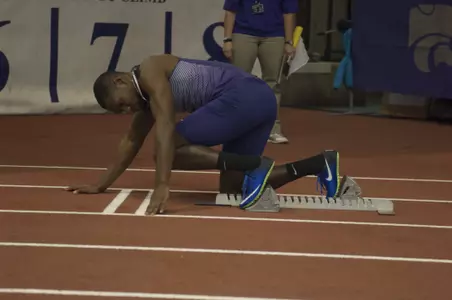
Without understanding the small-but-severely-important details of sprinting, K-State track and field senior Terrell Smith would not have broken a school record more than once.
Without the same mindset off the track, Smith's college experience would look completely different, void of the life-changing experiences he's taken in as a Wildcat.
Smith said the smallest detail that has taken him a long way, as a sprinter and a person, has been communication.
"I understand now that communication is key coming from any area of track and field, and life," he said. "If you talk to people, the more you'll learn and the more you can give other people. So I also pass down information to my teammates in order to make sure they are able to do the same things after I graduate."
On the track, Smith knows every minor detail matters immensely. Sprinters, unlike jumpers or throwers, only get one shot at performing at their highest level. A deficiency in one area could be the difference between a personal best time and a season-worst performance.
"As a sprinter, one small thing can set you back a great deal. So if you sit in the block too long or if you stumble, anything like that could alter your time greatly because every millisecond counts for us," Smith said. "The details are extremely important when you're talking about angles because track is nothing but physics and math. There's just a lot of details that come into sprinting that a lot people aren't aware of."
Smith was not aware of a lot of these details until he got to K-State and started learning under Director of Track and Field/Cross Country Cliff Rovelto. Curiosity caused Smith to not follow Rovelto's program with blind faith, but to question each segment to figure out its purpose.
"Talking to Coach (Rovelto) has allowed me to understand what I was doing. For example, for the warm-ups, understanding that these particular warm-ups help extend my stride and these particular warm-ups help me put power into the ground," Smith said. "That way I can have the ability and the mindset to understand what these things do, what I need to do in my warm-up to better prepare me for each individual race."
Smith questioned more than just Rovelto, too. He talked to just about anyone he could to find ways to improve, whether it was gathering random tips from Body First CEO Doug Sellers or learning from former standout Wildcat sprinters like Carlos Rodriguez and Jeffrey Julmis.
"Each year, I could feel that I understand a lot more," Smith said, as K-State hosts the DeLoss Dodds Invitational on Friday and Saturday in Ahearn Field House. "I feel like I actually know what I'm supposed to be doing, how things are supposed to feel."
Most recently, Smith felt great walking off the track. His 200-meter time of 20.90 seconds at last weekend's Razorback Invitational in Arkansas broke his previous school record of 20.93, which he set as a sophomore. His new record time places him third in the Big 12 and eighth in the country, positioning him well for a chance to go to the NCAA Indoor Championships in March.
"It felt good to come back and break my record my senior year. Every meet I feel like I'm getting faster, so that's a positive," said Smith, who also matched his personal-best 60-meter time in Arkansas, running a 6.70 that ranks fourth in K-State history and fourth in the Big 12 this season. "I feel like I'm moving in the right direction and I'm enjoying my last year completely. Everything, I feel like, is going well."
When Smith says "everything," he means more than just running. In his last year at K-State, Smith wants to get one message across to other student-athletes: Treat academic opportunities as seriously as athletic ones.
"I want people to not just be a student-athlete, but be more of a student," he said. "Being an All-American is good and great, but if you get out into the real world and put that on your application, it looks good to a certain extent, but what did you do outside of sports?"
Smith has been part of plenty off the track while at K-State.
He's been a member of K-State Student-Athlete Advisory Committee (SAAC), represented K-State and the Big 12 at the 2016 NCAA Student-Athlete Leadership Forum in Baltimore, Maryland, and took part in numerous community-service events. Last July, he traveled to Nicaragua as part of K-State's annual Cats Across Continents service trip to build courts for communities in need.
He's also a member of Phi Beta Sigma, which has opened up more opportunities for him to get involved with the Manhattan community in ways such as visiting local elementary schools. Additionally, Smith volunteers for a local track and field team to help with its sprinters.
Smith said all of these experiences helped him develop personally, and they all started with one small thing.
"In my opinion, the little things off the track are what allow me to grow in my career. To connect with people Cori Pinkett, Arin Dunn, Jill Shields and the whole athletic department, to understand my resources, communicate with them and have them on my side, whether I want to change something on campus or the way we do something in the program, was very beneficial to me," he said. "The little things are very important in expanding who you are as a person."
Without understanding the small-but-severely-important details of sprinting, K-State track and field senior Terrell Smith would not have broken a school record more than once.
Without the same mindset off the track, Smith's college experience would look completely different, void of the life-changing experiences he's taken in as a Wildcat.
Smith said the smallest detail that has taken him a long way, as a sprinter and a person, has been communication.
"I understand now that communication is key coming from any area of track and field, and life," he said. "If you talk to people, the more you'll learn and the more you can give other people. So I also pass down information to my teammates in order to make sure they are able to do the same things after I graduate."
On the track, Smith knows every minor detail matters immensely. Sprinters, unlike jumpers or throwers, only get one shot at performing at their highest level. A deficiency in one area could be the difference between a personal best time and a season-worst performance.
"As a sprinter, one small thing can set you back a great deal. So if you sit in the block too long or if you stumble, anything like that could alter your time greatly because every millisecond counts for us," Smith said. "The details are extremely important when you're talking about angles because track is nothing but physics and math. There's just a lot of details that come into sprinting that a lot people aren't aware of."
Smith was not aware of a lot of these details until he got to K-State and started learning under Director of Track and Field/Cross Country Cliff Rovelto. Curiosity caused Smith to not follow Rovelto's program with blind faith, but to question each segment to figure out its purpose.
"Talking to Coach (Rovelto) has allowed me to understand what I was doing. For example, for the warm-ups, understanding that these particular warm-ups help extend my stride and these particular warm-ups help me put power into the ground," Smith said. "That way I can have the ability and the mindset to understand what these things do, what I need to do in my warm-up to better prepare me for each individual race."
Smith questioned more than just Rovelto, too. He talked to just about anyone he could to find ways to improve, whether it was gathering random tips from Body First CEO Doug Sellers or learning from former standout Wildcat sprinters like Carlos Rodriguez and Jeffrey Julmis.
"Each year, I could feel that I understand a lot more," Smith said, as K-State hosts the DeLoss Dodds Invitational on Friday and Saturday in Ahearn Field House. "I feel like I actually know what I'm supposed to be doing, how things are supposed to feel."
Most recently, Smith felt great walking off the track. His 200-meter time of 20.90 seconds at last weekend's Razorback Invitational in Arkansas broke his previous school record of 20.93, which he set as a sophomore. His new record time places him third in the Big 12 and eighth in the country, positioning him well for a chance to go to the NCAA Indoor Championships in March.
"It felt good to come back and break my record my senior year. Every meet I feel like I'm getting faster, so that's a positive," said Smith, who also matched his personal-best 60-meter time in Arkansas, running a 6.70 that ranks fourth in K-State history and fourth in the Big 12 this season. "I feel like I'm moving in the right direction and I'm enjoying my last year completely. Everything, I feel like, is going well."
When Smith says "everything," he means more than just running. In his last year at K-State, Smith wants to get one message across to other student-athletes: Treat academic opportunities as seriously as athletic ones.
"I want people to not just be a student-athlete, but be more of a student," he said. "Being an All-American is good and great, but if you get out into the real world and put that on your application, it looks good to a certain extent, but what did you do outside of sports?"
Smith has been part of plenty off the track while at K-State.
He's been a member of K-State Student-Athlete Advisory Committee (SAAC), represented K-State and the Big 12 at the 2016 NCAA Student-Athlete Leadership Forum in Baltimore, Maryland, and took part in numerous community-service events. Last July, he traveled to Nicaragua as part of K-State's annual Cats Across Continents service trip to build courts for communities in need.
He's also a member of Phi Beta Sigma, which has opened up more opportunities for him to get involved with the Manhattan community in ways such as visiting local elementary schools. Additionally, Smith volunteers for a local track and field team to help with its sprinters.
Smith said all of these experiences helped him develop personally, and they all started with one small thing.
"In my opinion, the little things off the track are what allow me to grow in my career. To connect with people Cori Pinkett, Arin Dunn, Jill Shields and the whole athletic department, to understand my resources, communicate with them and have them on my side, whether I want to change something on campus or the way we do something in the program, was very beneficial to me," he said. "The little things are very important in expanding who you are as a person."

Players Mentioned
/ Track & Field
K-State Track and Field | Tyson Invitational Recap
Wednesday, February 18
K-State Track & Field | DeLoss Dodds Invitational Recap
Wednesday, February 04
K-State Track & Field | Thane Baker Invitational Recap
Monday, January 19
K-State Track & Field | Uniform Reveal
Tuesday, November 11