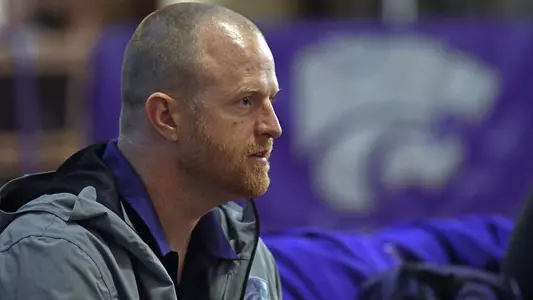
SE: Nathan Ott Looks to Keep K-State’s National Success in Throws Events Rolling
Jan 03, 2019 | Track & Field, Sports Extra
By Corbin McGuire
Hanging a few feet above Nathan Ott's desk are six pictures — five in black and white, one in color. Ott pointed to them when asked what he's learned about K-State since he was hired as the track and field team's throws coach in August.
"Learning the history and tradition and how many good track athletes have come out of here," he said, "I just kind of looked back on the last couple of years, not necessarily the wealth of it."
Ott knew of the recent history of successful K-State throwers. He was familiar with names like Sara Savatovic, Janee' Kassanavoid and Dani Winters. Between the three of them, they racked up 10 All-America honors, 11 Big 12 Championships and a national championship for K-State from 2013-18.
What Ott did not know was how far back K-State has been nationally prominent in the throwing events. Thankfully, he has six reminders in his office.
From left to right, he has pictures of two-time NCAA shot put champion (1938, 1939) Elmer Hackney, three-time All-American Susie Norton (1974-76), five-time All-American Angie Miller (1990-91), six-time All-American Renetta Seiler (1996-99) and four-time All-American (2007-08) Loren Groves, the only picture in color.
"It's just crazy how good it's been for such a long time," he said. "We're standing on the shoulders of giants. I'm just trying to do my part and keep it rolling."
Ott's plan to continue the success stands on three pillars.
Two of them are education and dedication. These, he said, have always been his niche as a coach. The key aspect is finding a balance between them.
"Throwing is not something you can just pick up do a few times and be good at it. You have to take a lot of reps doing it," he said. "You just don't want to just take a bunch of unfocused junk reps. You have to know what it is you're trying to work toward — education and dedication."
The other benchmark Ott looks to hit as a coach is a healthy relationship with his student-athletes. Too often, he said, the opposite occurs and stymies progress. Unlike other sports, there's no such thing as earning playing time as a thrower. Every athlete gets equal amounts of throws in practice and competitions, so it's important, Ott said, that the coach and athlete work together.
"I always look at it as a partnership between me and the athlete against gravity because we're trying to overcome a force of nature," he said. "We're trying to overcome gravity."
Ott's method has worked wherever he's been.
He coached 19 conference champions at Southern Utah, his alma mater. His throwers broke 13 school records in his six seasons there. In one season at Texas State, he led a group that included eight conference champions.
At his most recent stop, Northern Arizona, Ott cultivated yet another successful throws unit. This group was highlighted by three-time All-American Brooke Andersen, who twice finished second in the hammer throw at the NCAA Outdoor Championships. Adam Keenan, who earned two All-America honors in the hammer throw, and Julia Viberg, an All-American discus thrower, also learned under Ott at NAU.
Ironically, Ott never really had a coach to model his style after. In his 10 years of throwing competitively, he only had a coach for two of them.
In hindsight, he said his situation as an athlete has paid dividends for him as a coach. Ott was able to experiment with technique often, finding what works for him. He went on to set the Southern Utah school record in the hammer throw and win a conference title in 2007. He also went to a lot of clinics, including one held by the world record holder in the hammer, Yuriy Sedykh. Additionally, he had to create his own discipline outside of practice, an aspect he said may be more vital to success than practice itself.
"We try to control the three hours of training when they're here, and that's vital, but almost more vital is the 21 other hours the rest of the day," he said. "For me, that's the one thing I learned myself. I decided to make the right choices and I think that kind of permeates how I coach and handle people and treat them. 'Do you want to be at your best or do you want to be mediocre? Do you want to sell yourself short? Do you want to sacrifice the gift you've been given, or do you want to maximize it and make it your very best, your best form, your best self, your best whatever?'
"I just try to make them realize that's a choice they can make, to choose to be better and be their best. I remember that moment when I had it. I'm just showing that to people I coach, trying to show them that route that I had."
Ultimately, Ott said he wants to further the success he walked into. He's focused first on maintaining the momentum of improvement from Wildcats like Helene Ingvaldsen and Brett Neelly — the latter of whom broke K-State's shot put record in December and ranks first in the country — and then on recruiting and coaching up the next group of K-State throwers. Hopefully someday their picture will hang in his office.
"I'm trying to keep that national image of K-State in a positive light," Ott said, as his throwers compete again at the Wildcat Invitational in Ahearn Field House on January 12. "I want to keep that tradition rolling."
Hanging a few feet above Nathan Ott's desk are six pictures — five in black and white, one in color. Ott pointed to them when asked what he's learned about K-State since he was hired as the track and field team's throws coach in August.
"Learning the history and tradition and how many good track athletes have come out of here," he said, "I just kind of looked back on the last couple of years, not necessarily the wealth of it."
Ott knew of the recent history of successful K-State throwers. He was familiar with names like Sara Savatovic, Janee' Kassanavoid and Dani Winters. Between the three of them, they racked up 10 All-America honors, 11 Big 12 Championships and a national championship for K-State from 2013-18.
What Ott did not know was how far back K-State has been nationally prominent in the throwing events. Thankfully, he has six reminders in his office.
From left to right, he has pictures of two-time NCAA shot put champion (1938, 1939) Elmer Hackney, three-time All-American Susie Norton (1974-76), five-time All-American Angie Miller (1990-91), six-time All-American Renetta Seiler (1996-99) and four-time All-American (2007-08) Loren Groves, the only picture in color.
"It's just crazy how good it's been for such a long time," he said. "We're standing on the shoulders of giants. I'm just trying to do my part and keep it rolling."
Ott's plan to continue the success stands on three pillars.
Two of them are education and dedication. These, he said, have always been his niche as a coach. The key aspect is finding a balance between them.
"Throwing is not something you can just pick up do a few times and be good at it. You have to take a lot of reps doing it," he said. "You just don't want to just take a bunch of unfocused junk reps. You have to know what it is you're trying to work toward — education and dedication."
The other benchmark Ott looks to hit as a coach is a healthy relationship with his student-athletes. Too often, he said, the opposite occurs and stymies progress. Unlike other sports, there's no such thing as earning playing time as a thrower. Every athlete gets equal amounts of throws in practice and competitions, so it's important, Ott said, that the coach and athlete work together.
"I always look at it as a partnership between me and the athlete against gravity because we're trying to overcome a force of nature," he said. "We're trying to overcome gravity."
Ott's method has worked wherever he's been.
He coached 19 conference champions at Southern Utah, his alma mater. His throwers broke 13 school records in his six seasons there. In one season at Texas State, he led a group that included eight conference champions.
At his most recent stop, Northern Arizona, Ott cultivated yet another successful throws unit. This group was highlighted by three-time All-American Brooke Andersen, who twice finished second in the hammer throw at the NCAA Outdoor Championships. Adam Keenan, who earned two All-America honors in the hammer throw, and Julia Viberg, an All-American discus thrower, also learned under Ott at NAU.
Ironically, Ott never really had a coach to model his style after. In his 10 years of throwing competitively, he only had a coach for two of them.
In hindsight, he said his situation as an athlete has paid dividends for him as a coach. Ott was able to experiment with technique often, finding what works for him. He went on to set the Southern Utah school record in the hammer throw and win a conference title in 2007. He also went to a lot of clinics, including one held by the world record holder in the hammer, Yuriy Sedykh. Additionally, he had to create his own discipline outside of practice, an aspect he said may be more vital to success than practice itself.
"We try to control the three hours of training when they're here, and that's vital, but almost more vital is the 21 other hours the rest of the day," he said. "For me, that's the one thing I learned myself. I decided to make the right choices and I think that kind of permeates how I coach and handle people and treat them. 'Do you want to be at your best or do you want to be mediocre? Do you want to sell yourself short? Do you want to sacrifice the gift you've been given, or do you want to maximize it and make it your very best, your best form, your best self, your best whatever?'
"I just try to make them realize that's a choice they can make, to choose to be better and be their best. I remember that moment when I had it. I'm just showing that to people I coach, trying to show them that route that I had."
Ultimately, Ott said he wants to further the success he walked into. He's focused first on maintaining the momentum of improvement from Wildcats like Helene Ingvaldsen and Brett Neelly — the latter of whom broke K-State's shot put record in December and ranks first in the country — and then on recruiting and coaching up the next group of K-State throwers. Hopefully someday their picture will hang in his office.
"I'm trying to keep that national image of K-State in a positive light," Ott said, as his throwers compete again at the Wildcat Invitational in Ahearn Field House on January 12. "I want to keep that tradition rolling."

Players Mentioned

K-State Track and Field | Director of T&F Travis Geopfert Post Indoor NCAA Championships Interview
Tuesday, March 17
K-State Track and Field | Tyson Invitational Recap
Wednesday, February 18
K-State Track & Field | DeLoss Dodds Invitational Recap
Wednesday, February 04
K-State Track & Field | Thane Baker Invitational Recap
Monday, January 19