SE: All-American High Jumper Shankar Joins K-State Accounting Team, Advances to National Competition
Nov 26, 2019 | Track & Field, Sports Extra
By Corbin McGuire
K-State track and field's Tejaswin Shankar has always gravitated toward the best in what he wanted to become.
It's part of why the talented high jumper from New Delhi, India ended up at K-State. Shankar grew up watching former Wildcat and Olympic medalist Erik Kynard Jr. on YouTube. So, he wanted to learn from the man Kynard did, K-State director of track and field/cross country Cliff Rovelto.
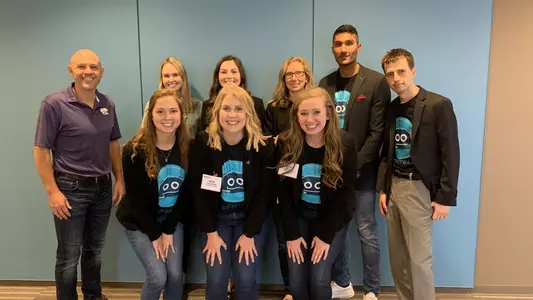
More recently, it's why Shankar agreed to join a six-student team within the K-State College of Business to compete in the Deloitte Audit Innovation Campus Challenge (AICC). Last Friday in Dallas, Texas, that team placed in the top two at a regional competition to qualify for the national competition at Deloitte University in April in Westlake, Texas.
Shankar, who described the experience as "really exciting," added that he's thankful he trusted his instinct to join the team when one of his professors asked a while back.
"I knew it was something I'm interested in, one, and then, two, the people that would be involved in this, they would be really smart. I'd get to interact with all these smart kids from the business school," Shankar, a junior majoring in accounting and finance, said. "I think it's like a magnet. Anyone who is doing well or anyone who is smart enough and anyone who aspires to be smart or aspires to be good is always drawn toward that (type of) person. If I inspire to be a good high jumper, I'll definitely be drawn to good high jumpers. If I want to be good in accounting, I'll be drawn toward people who come up with new ideas that interests me.
"I wouldn't deny the fact that they did draw me toward them. I think the want to learn is something that always draws you toward such people. The fact that I really want to explore the field and learn, and it interests me, is probably why I did it."
The AICC, as defined by Deloitte University's website, "is a nationally-driven program hosted by Deloitte's Audit Innovation group and the Deloitte Foundation, which accelerates innovation in education by helping institutions of higher learning keep pace with the rapidly changing marketplace and evolving technologies. The program will engage students and faculty from campuses across the country, providing an educational experience designed to help students develop skills for success in professional services and sharing the culture of Innovation at Deloitte with academia and potential future employees."
In a nutshell, Shankar said the competition centered around "finding new methods of auditing and new revenue streams."
Each team presented for 15 minutes on its idea in front of a panel of judges in Dallas. Shankar compared it to the TV show, "Shark Tank," where entrepreneurs present ideas to investors. In this instance, it was 10 college teams presenting creative ways to expand auditing revenue outside of the traditional model.
K-State's team came up with an idea that involved Esports, competitive videogaming. The industry has rapidly grown in recent years, especially its viewership numbers.
Shankar and his team, however, discovered through some research that those numbers can be skewed dramatically by bots, non-human users. When it comes to companies advertising on platforms like Twitch or Mixer, another site that streams Esports, along with social media companies like Instagram and Twitter, those numbers matter a great deal.
So, K-State's idea was to create a way to verify a platform's userbase to, in turn, give advertisers a clearer picture of the impact their dollars could have. Shankar likened it to concept behind Informed-Sport, which tests supplements for banned substances. Anything approved by Informed-Sport has its label on it, so athletes know if it's safe to consume.
"Say, for example, you go on Twitch, the Amazon platform, and then on the bottom of Twitch it would probably say verified or certified by Deloitte for viewer commentary. That was the idea," Shankar said. "Advertisers would see that and go, 'OK, that's actually a certified, validated platform. We know for a fact that, if the other platform doesn't have that certification, then the money we put into this platform will actually be helpful and we'll get the returns we expect.' That was pitch, and they liked our idea. So, now we move on to the finals."
The finals, on April 3-4, will include 12 teams from the six regional sites. Shankar, a three-time All-American who will be in the midst of his third outdoor season and preparing for his country's Olympic trials, hopes his schedule lines up to make the event.
He's enjoyed every second of the academic team setting so far. From K-State's team name of "E-Ferret," to the T-shirts he and his teammates wore to Dallas with their nicknames on the back — "MajorHopps," for Shankar — to the experience of building an idea from scratch and seeing it grow into something worthy of national merit.
"It was just fun," Shankar said. "It was something new, something different than track. I came here just because of my track abilities, not because of how good my grades were, but the fact that I came here and I was able to get myself involved in such a thing, I think, gives me more confidence, in terms of knowing I can do good in school and interact with people and express myself outside of (athletics) and not only be limited to track. That just helps me with my development."
K-State track and field's Tejaswin Shankar has always gravitated toward the best in what he wanted to become.
It's part of why the talented high jumper from New Delhi, India ended up at K-State. Shankar grew up watching former Wildcat and Olympic medalist Erik Kynard Jr. on YouTube. So, he wanted to learn from the man Kynard did, K-State director of track and field/cross country Cliff Rovelto.
More recently, it's why Shankar agreed to join a six-student team within the K-State College of Business to compete in the Deloitte Audit Innovation Campus Challenge (AICC). Last Friday in Dallas, Texas, that team placed in the top two at a regional competition to qualify for the national competition at Deloitte University in April in Westlake, Texas.
Shankar, who described the experience as "really exciting," added that he's thankful he trusted his instinct to join the team when one of his professors asked a while back.
"I knew it was something I'm interested in, one, and then, two, the people that would be involved in this, they would be really smart. I'd get to interact with all these smart kids from the business school," Shankar, a junior majoring in accounting and finance, said. "I think it's like a magnet. Anyone who is doing well or anyone who is smart enough and anyone who aspires to be smart or aspires to be good is always drawn toward that (type of) person. If I inspire to be a good high jumper, I'll definitely be drawn to good high jumpers. If I want to be good in accounting, I'll be drawn toward people who come up with new ideas that interests me.
"I wouldn't deny the fact that they did draw me toward them. I think the want to learn is something that always draws you toward such people. The fact that I really want to explore the field and learn, and it interests me, is probably why I did it."
The AICC, as defined by Deloitte University's website, "is a nationally-driven program hosted by Deloitte's Audit Innovation group and the Deloitte Foundation, which accelerates innovation in education by helping institutions of higher learning keep pace with the rapidly changing marketplace and evolving technologies. The program will engage students and faculty from campuses across the country, providing an educational experience designed to help students develop skills for success in professional services and sharing the culture of Innovation at Deloitte with academia and potential future employees."
In a nutshell, Shankar said the competition centered around "finding new methods of auditing and new revenue streams."
Each team presented for 15 minutes on its idea in front of a panel of judges in Dallas. Shankar compared it to the TV show, "Shark Tank," where entrepreneurs present ideas to investors. In this instance, it was 10 college teams presenting creative ways to expand auditing revenue outside of the traditional model.
K-State's team came up with an idea that involved Esports, competitive videogaming. The industry has rapidly grown in recent years, especially its viewership numbers.
Shankar and his team, however, discovered through some research that those numbers can be skewed dramatically by bots, non-human users. When it comes to companies advertising on platforms like Twitch or Mixer, another site that streams Esports, along with social media companies like Instagram and Twitter, those numbers matter a great deal.
So, K-State's idea was to create a way to verify a platform's userbase to, in turn, give advertisers a clearer picture of the impact their dollars could have. Shankar likened it to concept behind Informed-Sport, which tests supplements for banned substances. Anything approved by Informed-Sport has its label on it, so athletes know if it's safe to consume.
"Say, for example, you go on Twitch, the Amazon platform, and then on the bottom of Twitch it would probably say verified or certified by Deloitte for viewer commentary. That was the idea," Shankar said. "Advertisers would see that and go, 'OK, that's actually a certified, validated platform. We know for a fact that, if the other platform doesn't have that certification, then the money we put into this platform will actually be helpful and we'll get the returns we expect.' That was pitch, and they liked our idea. So, now we move on to the finals."
The finals, on April 3-4, will include 12 teams from the six regional sites. Shankar, a three-time All-American who will be in the midst of his third outdoor season and preparing for his country's Olympic trials, hopes his schedule lines up to make the event.
He's enjoyed every second of the academic team setting so far. From K-State's team name of "E-Ferret," to the T-shirts he and his teammates wore to Dallas with their nicknames on the back — "MajorHopps," for Shankar — to the experience of building an idea from scratch and seeing it grow into something worthy of national merit.
"It was just fun," Shankar said. "It was something new, something different than track. I came here just because of my track abilities, not because of how good my grades were, but the fact that I came here and I was able to get myself involved in such a thing, I think, gives me more confidence, in terms of knowing I can do good in school and interact with people and express myself outside of (athletics) and not only be limited to track. That just helps me with my development."


Players Mentioned
/ Track & Field
K-State Track and Field | Tyson Invitational Recap
Wednesday, February 18
K-State Track & Field | DeLoss Dodds Invitational Recap
Wednesday, February 04
K-State Track & Field | Thane Baker Invitational Recap
Monday, January 19
K-State Track & Field | Uniform Reveal
Tuesday, November 11