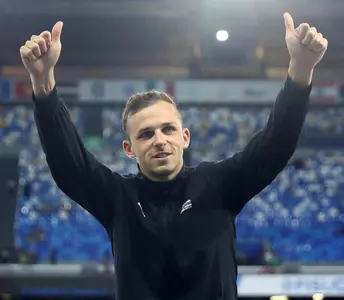
SE: Aaron Booth Comes Full Circle with Gold Medal at World University Games
Jul 15, 2019 | Track & Field, Sports Extra
By Corbin McGuire
Aaron Booth's gold medal performance at the 2019 World University Games last week in Naples, Italy, was a full-circle achievement of sorts.
Two years before, the New Zealand native earned his first World University Games medal in Taipei, Taiwan, where he finished third. There, he was also first introduced to K-State. Reinis Kregers, a former Wildcat decathlete and All-American in 2014, competed at the 2017 Games and put Booth, now a rising junior for the Wildcats, in contact with K-State Director of Cross Country/Track and Field Cliff Rovelto.
"Going into the (2017) Games, I didn't expect to get a scholarship offer to K-State," Booth, a three-time All-American now for K-State, said in a phone interview while still in Italy. "Then, this time around, who knows what could happen from this."
This was a personal-best decathlon score of 7,827 points, nearly 150 points better than his previous top total. It capped a 24-month drive to reach the top of the podium for his country.
"I wanted to come back this time and win it," he said. "That was my goal the past two years. Having two years of such big changes in my life coming to K-State — new coach, new country, new friends, everything — and to still be able to improve on the athletics side was really good."
Booth's performance also provided further internal proof that he's capable of more.
His junior campaign took a hit after he sustained a foot injury at the end of the indoor season, which included him placing eighth in the heptathlon at the NCAA Indoor Championships.
For three weeks, Booth did nothing. Then, he trained mostly in a pool. He eventually eased himself back into running on K-State's Alter-G treadmill. Before the Big 12 Outdoor Championships, he had not even worked on some of the field events in months. He trained one week on an actual track.
"My biggest running session was six 100s (100-meter runs) at 80 percent," he said. "Then, I did two 150s at 90 percent, but they still weren't fast."
Booth finished second in the decathlon at the conference meet. He said his personal-best score of 7,602 points left him "really shocked."
"That kind of showed the level I was at," he said. "I think that showed my baseline performance has improved a lot."
Booth credited his decision to come to K-State as a big reason why. He said his strength under Rovelto's training program has made a huge difference in the throwing and jumping events. Booth pointed to the depth of multi-events talent at K-State — four Wildcat decathletes medaled at the 2019 Big 12 Outdoor Championships — as another key factor in his development.
"Having a proper competitive environment all the time with the four or five guys we've got in the decathlon, and even other events as well, it just makes you want to keep pushing to improve when you see other guys doing well," he said. "You just build off each other and thrive off of what each other is doing to keep improving. I think that's really helped, especially with motivation the past few years."
After a few weeks of feeling fully healthy and training normally late this spring, Booth entered the NCAA Outdoor Championships confident. He had 7,800 in mind. But the day K-State arrived in Austin, Texas, he got sick and was "throwing up all night."
"That whole competition I just felt super weak. I wanted to pull out (of the competition) during the shot put, but Coach (Rovelto) made me keep going, and I PB'd again (with 7,680 points)," he said. "Those past two comps made me realize I'd gone through two months of no training, came out and PB'd, and then went into a competition losing, like, all the liquid in me, basically, and still PB'd.
"It just showed me what I think I'm capable of."
Which started with winning the World University Games, where his K-State career, in a way, really began. This time, Booth had 8,000 in his sights. While the two-month stretch with limited training this spring may have kept him from hitting that number in Italy, Booth said he was proud of his score.
"I definitely thought there was more there, but I honestly can't complain with 7,800," he said. "That's definitely a big step in the right direction."
The next big step? Booth isn't shying away from it: The Olympics.
The decathlon standard for the 2020 Olympics is 8,350 points, which would require a lot of improvement from Booth in the next year. But, while he admitted 2024 is a more reasonable goal, he's not one to back away from a lofty challenge.
"I don't see any harm of setting a goal of trying to make 2020 Olympics. I think that's what I like to (fuel) off of," he said. "Having big, ambitious goals makes me want to work hard and chase it."
Aaron Booth's gold medal performance at the 2019 World University Games last week in Naples, Italy, was a full-circle achievement of sorts.
Two years before, the New Zealand native earned his first World University Games medal in Taipei, Taiwan, where he finished third. There, he was also first introduced to K-State. Reinis Kregers, a former Wildcat decathlete and All-American in 2014, competed at the 2017 Games and put Booth, now a rising junior for the Wildcats, in contact with K-State Director of Cross Country/Track and Field Cliff Rovelto.
"Going into the (2017) Games, I didn't expect to get a scholarship offer to K-State," Booth, a three-time All-American now for K-State, said in a phone interview while still in Italy. "Then, this time around, who knows what could happen from this."
This was a personal-best decathlon score of 7,827 points, nearly 150 points better than his previous top total. It capped a 24-month drive to reach the top of the podium for his country.
"I wanted to come back this time and win it," he said. "That was my goal the past two years. Having two years of such big changes in my life coming to K-State — new coach, new country, new friends, everything — and to still be able to improve on the athletics side was really good."
Booth's performance also provided further internal proof that he's capable of more.
His junior campaign took a hit after he sustained a foot injury at the end of the indoor season, which included him placing eighth in the heptathlon at the NCAA Indoor Championships.
For three weeks, Booth did nothing. Then, he trained mostly in a pool. He eventually eased himself back into running on K-State's Alter-G treadmill. Before the Big 12 Outdoor Championships, he had not even worked on some of the field events in months. He trained one week on an actual track.
"My biggest running session was six 100s (100-meter runs) at 80 percent," he said. "Then, I did two 150s at 90 percent, but they still weren't fast."
Booth finished second in the decathlon at the conference meet. He said his personal-best score of 7,602 points left him "really shocked."
"That kind of showed the level I was at," he said. "I think that showed my baseline performance has improved a lot."
Booth credited his decision to come to K-State as a big reason why. He said his strength under Rovelto's training program has made a huge difference in the throwing and jumping events. Booth pointed to the depth of multi-events talent at K-State — four Wildcat decathletes medaled at the 2019 Big 12 Outdoor Championships — as another key factor in his development.
"Having a proper competitive environment all the time with the four or five guys we've got in the decathlon, and even other events as well, it just makes you want to keep pushing to improve when you see other guys doing well," he said. "You just build off each other and thrive off of what each other is doing to keep improving. I think that's really helped, especially with motivation the past few years."
After a few weeks of feeling fully healthy and training normally late this spring, Booth entered the NCAA Outdoor Championships confident. He had 7,800 in mind. But the day K-State arrived in Austin, Texas, he got sick and was "throwing up all night."
"That whole competition I just felt super weak. I wanted to pull out (of the competition) during the shot put, but Coach (Rovelto) made me keep going, and I PB'd again (with 7,680 points)," he said. "Those past two comps made me realize I'd gone through two months of no training, came out and PB'd, and then went into a competition losing, like, all the liquid in me, basically, and still PB'd.
"It just showed me what I think I'm capable of."
Which started with winning the World University Games, where his K-State career, in a way, really began. This time, Booth had 8,000 in his sights. While the two-month stretch with limited training this spring may have kept him from hitting that number in Italy, Booth said he was proud of his score.
"I definitely thought there was more there, but I honestly can't complain with 7,800," he said. "That's definitely a big step in the right direction."
The next big step? Booth isn't shying away from it: The Olympics.
The decathlon standard for the 2020 Olympics is 8,350 points, which would require a lot of improvement from Booth in the next year. But, while he admitted 2024 is a more reasonable goal, he's not one to back away from a lofty challenge.
"I don't see any harm of setting a goal of trying to make 2020 Olympics. I think that's what I like to (fuel) off of," he said. "Having big, ambitious goals makes me want to work hard and chase it."

Players Mentioned

/ Track & Field
K-State Track and Field | Director of T&F Travis Geopfert Post Indoor NCAA Championships Interview
Tuesday, March 17
K-State Track and Field | Tyson Invitational Recap
Wednesday, February 18
K-State Track & Field | DeLoss Dodds Invitational Recap
Wednesday, February 04
K-State Track & Field | Thane Baker Invitational Recap
Monday, January 19