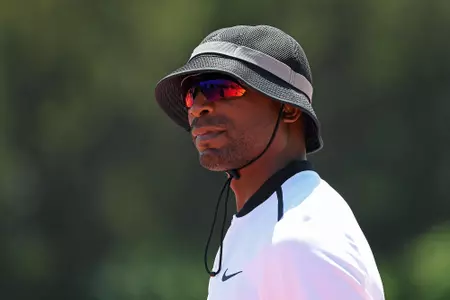
SE: Catching up with Vincent Johnson of K-State Track & Field
Mar 03, 2021 | Track & Field, Sports Extra
By: Austin Siegel
K-State wrapped up an impressive weekend at the Big 12 Indoor Track and Field Championships on Saturday, including Tejaswin Shankar's third-straight Big 12 title in the high jump and podium finishes throughout the weekend.
No event saw the Wildcats dominate quite like the women's jumps, where Chantoba Bright, Taishia Pryce and Rhianna Phipps put themselves in contention for the NCAA Indoor Track and Field Championships.
The list of Wildcats invited to the NCAAs in Arkansas will be finalized this weekend.
Before Indoor Nationals, assistant coach Vincent Johnson spoke with Austin Siegel of K-State Sports Extra about a big weekend from his jumpers and what makes this the closest group of student-athletes he's ever coached in Manhattan.
This interview has been condensed and edited for clarity.
AS: Indoor Nationals might be one of the toughest meets to qualify for in the country. What about this group of women has put them in a position to make it to Arkansas?
VJ: The thing I'm most proud of is their ability to work together. They're very selfless and do a great job supporting each other and holding each other accountable. They're already talented. Those other things, supporting each other and holding each other accountable, helps us make sure everything in training gets done. Those small things are very important, those are the nuts and bolts that bring their performance to fruition.
AS: Something you said there, accountability, I'm not sure that's ever been more important than during a COVID season. How much have you relied on your athletes when you have such limited contact with them as a coach?
VJ: Three of our five jumpers are new to Kansas State, so I had to rely on Taishia Pryce and Wurrie Njadoe. They really embraced the new people and kind of helped them with the flow of how we do things and discovering the joy of competing. They led by example. With Taishia as the leader of this group, she's done a really good job. She's one of our top athletes and when other people see what she's doing, it's easy to fall in line. I just have to manage it, because they're all so talented.
AS: You've got a very international contingent of jumpers this year, I know that's not unusual, but how are you or someone like Taishia able to help with that adjustment?
VJ: In the recruiting process, one thing I kind of hang my hat on is the relationship that I've built with them. When they come in, I try and foster that same relationship. Hopefully when they come in and see my relationship with Taishia and Wurrie, the younger people see that the one-on-one relationship we've built throughout the recruiting process is going to continue. When they get here, I don't just turn into a different person. I try and embrace them as part of my family. I want them to feel like I've got their back when they're doing well and even when they're not doing well. Even if you pray for rain, you've still got to deal with the mud.
AS: How do you build that connection when student-athletes get here, especially with so many of the challenges due to COVID?
VJ: I believe in strong relationships, period. This track and field stuff will fade away, but those strong relationships will last forever. I'm really more focused on building a strong relationship because I think when you know a coach is pulling for you and has your best interests at heart, then you can give your best on a day-to-day basis. That's how I felt when I was an athlete.
I was a pretty good athlete at a big school, but I didn't feel a connection with my coaches. I ended up going to another school that was nowhere near the caliber of the first one, but the relationship I had with my coach was solid. Throughout my career, I did way better at that university because I had a strong connection with my coach. That doesn't mean I didn't have bad performances, but the good outweighed the bad. And whatever we did, I knew it was geared towards my success. That's my philosophy as well.
We're going to build a strong relationship so that when you're standing behind the sand pit and looking down that runway, there's not a doubt in your mind that you can get it done.
AS: Is there anything else that makes this group of women stand out?
VJ: I've been coaching for 20 years and this is the most cohesive group I've been around. The competition has been the easy part because they do a lot of grinding together. But the journey isn't easy for anyone. Stay consistent when you're up and stay consistent when you're down.
My thought process has always been, if you trust me and your parents trust me to be an influence on your career, then I owe it to you to give all that I have. One of the things I always talk about is an athlete is responsible for 80 percent of their success. A coach is only 20 percent. One of the things they've done well as a group is to take care of their 80 percent to make it 100.
I have a strong faith as well and I believe in doing all things as if I was doing them unto the Lord. We're enjoying track and field while we're here, but eventually that's going to fade away. If I've only prepared you for track, then I've failed you. By the same token, if I'm only preparing you for life after track, then I've failed you as an athlete. I try and control the balance. But every day, I'm going to make sure my 20 percent is available.
K-State wrapped up an impressive weekend at the Big 12 Indoor Track and Field Championships on Saturday, including Tejaswin Shankar's third-straight Big 12 title in the high jump and podium finishes throughout the weekend.
No event saw the Wildcats dominate quite like the women's jumps, where Chantoba Bright, Taishia Pryce and Rhianna Phipps put themselves in contention for the NCAA Indoor Track and Field Championships.
The list of Wildcats invited to the NCAAs in Arkansas will be finalized this weekend.
Before Indoor Nationals, assistant coach Vincent Johnson spoke with Austin Siegel of K-State Sports Extra about a big weekend from his jumpers and what makes this the closest group of student-athletes he's ever coached in Manhattan.
This interview has been condensed and edited for clarity.
AS: Indoor Nationals might be one of the toughest meets to qualify for in the country. What about this group of women has put them in a position to make it to Arkansas?
VJ: The thing I'm most proud of is their ability to work together. They're very selfless and do a great job supporting each other and holding each other accountable. They're already talented. Those other things, supporting each other and holding each other accountable, helps us make sure everything in training gets done. Those small things are very important, those are the nuts and bolts that bring their performance to fruition.
AS: Something you said there, accountability, I'm not sure that's ever been more important than during a COVID season. How much have you relied on your athletes when you have such limited contact with them as a coach?
VJ: Three of our five jumpers are new to Kansas State, so I had to rely on Taishia Pryce and Wurrie Njadoe. They really embraced the new people and kind of helped them with the flow of how we do things and discovering the joy of competing. They led by example. With Taishia as the leader of this group, she's done a really good job. She's one of our top athletes and when other people see what she's doing, it's easy to fall in line. I just have to manage it, because they're all so talented.
AS: You've got a very international contingent of jumpers this year, I know that's not unusual, but how are you or someone like Taishia able to help with that adjustment?
VJ: In the recruiting process, one thing I kind of hang my hat on is the relationship that I've built with them. When they come in, I try and foster that same relationship. Hopefully when they come in and see my relationship with Taishia and Wurrie, the younger people see that the one-on-one relationship we've built throughout the recruiting process is going to continue. When they get here, I don't just turn into a different person. I try and embrace them as part of my family. I want them to feel like I've got their back when they're doing well and even when they're not doing well. Even if you pray for rain, you've still got to deal with the mud.
Put our best on display #KStateTF x #Big12TF pic.twitter.com/Xr52QtcQkI
— K-State Track (@KStateTFXC) March 2, 2021
AS: How do you build that connection when student-athletes get here, especially with so many of the challenges due to COVID?
VJ: I believe in strong relationships, period. This track and field stuff will fade away, but those strong relationships will last forever. I'm really more focused on building a strong relationship because I think when you know a coach is pulling for you and has your best interests at heart, then you can give your best on a day-to-day basis. That's how I felt when I was an athlete.
I was a pretty good athlete at a big school, but I didn't feel a connection with my coaches. I ended up going to another school that was nowhere near the caliber of the first one, but the relationship I had with my coach was solid. Throughout my career, I did way better at that university because I had a strong connection with my coach. That doesn't mean I didn't have bad performances, but the good outweighed the bad. And whatever we did, I knew it was geared towards my success. That's my philosophy as well.
We're going to build a strong relationship so that when you're standing behind the sand pit and looking down that runway, there's not a doubt in your mind that you can get it done.
AS: Is there anything else that makes this group of women stand out?
VJ: I've been coaching for 20 years and this is the most cohesive group I've been around. The competition has been the easy part because they do a lot of grinding together. But the journey isn't easy for anyone. Stay consistent when you're up and stay consistent when you're down.
My thought process has always been, if you trust me and your parents trust me to be an influence on your career, then I owe it to you to give all that I have. One of the things I always talk about is an athlete is responsible for 80 percent of their success. A coach is only 20 percent. One of the things they've done well as a group is to take care of their 80 percent to make it 100.
I have a strong faith as well and I believe in doing all things as if I was doing them unto the Lord. We're enjoying track and field while we're here, but eventually that's going to fade away. If I've only prepared you for track, then I've failed you. By the same token, if I'm only preparing you for life after track, then I've failed you as an athlete. I try and control the balance. But every day, I'm going to make sure my 20 percent is available.

Players Mentioned

/ Track & Field
/ Track & Field

/ Track & Field

/ Track & Field

/ Track & Field
K-State Track and Field | Sights & Sounds Steve Miller Invitational
Monday, February 23
K-State Baseball | Highlights vs Michigan - Feb. 22, 2026
Monday, February 23
K-State Men's Basketball | Postgame Press Conference at Texas Tech
Sunday, February 22
K-State Women's Basketball | Tess Heal Senior Video
Sunday, February 22