SE: Q&A with Legendary Track and Field Coach Cliff Rovelto
Jan 26, 2022 | Track & Field, Sports Extra
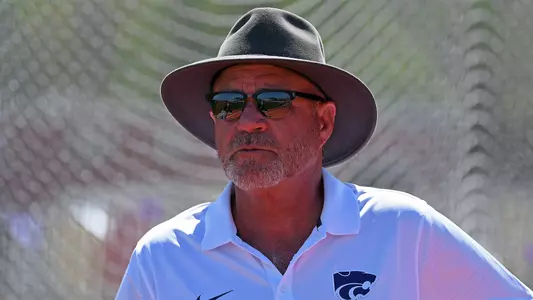
Cliff Rovelto, an icon in United States track and field, is in his 30th season leading the Kansas State track and field program and his 34th season as a coach in Manhattan. The Director of Track and Field and Cross Country, Rovelto carries a legendary resume.
Rovelto has personally coached 17 Olympians, who have made a combined 22 Olympic appearances. He served as USA Assistant Coach at the 2016 Rio De Janeiro Olympics. He has coached nine individuals to compete at World Indoor Championships, combining for 14 Championships. He has coached 23 individuals to compete at the World Outdoor Championships, combining for 34 total Championships. He has coached 42 USA National Champions, including 27 in the high jump. He has coached 16 athletes to NCAA Championships, athletes who have received 207 All-American Certificates, including 134 First-Team All-Americans, and he has coached athletes to 109 individual conference championships.
Most recently, he coached Tejaswin Shankar (2018), Christoff Bryan (2017), Kim Williamson (2016) and Akela Jones (2016) to NCAA titles.
K-State Sports Extra's D. Scott Fritchen spoke with Rovelto in this Q&A about his beginnings, his successes, and the Mount Rushmore of K-State Track and Field in his tenure:
D. SCOTT FRITCHEN: For all your many decades of success, a lot of people might be curious to know that you started your career as a track and field coach at McLouth High School in Kansas in 1979. Can you walk me through your early experiences as a coach and how that ignited this undying passion to teach athletes?
CLIFF ROVELTO: I never had a plan to go into coaching. I went to the University of Kansas as a political science major thinking I'd go to law school and took the LSAT, but I ended up with a degree in education. I taught history and civics. My favorite sport to this day is basketball. If there was any thought of going into coaching, at that time I thought it'd end up being in basketball. I was an assistant basketball coach and they needed someone to coach track and never had a cross country program. I thought we should start a cross country program, so we started one at McLouth High School.
As an undergrad I was a part of the Kansas Relays student committee. I helped Coach Timmons because he was alone putting that together for years. I interviewed for a position on that committee and got to know Coach Timmons and the program though that. I did my practicum in coaching with the track and field team, which at that time was very rare. Previously, the education majors always did their practicums with junior highs and high schools. I taught history at a junior high at Ft. Leavenworth. While I was there, I helped out with cross country. It just so happened they started girls cross country that year. It was an unbelievable experience. Toward the end of the season, Coach got ill and was in the hospital, so I was literally coaching the entire team. The boys placed high in the state, the women placed second in state in the very first year of the program. Even though I never had plans to do the sport, things happened and with the people were around, I understood why it happened, if that makes sense.

DSF: What's your philosophy from a structural, organizational, and instructional standpoint as it pertains to your duties as Director of Track and Field and Cross Country?
CR: In a lot of ways, our sport is unique. There are lots of measures. You can measure a team by how complete they are as a dual-meet team, or from a conference perspective, or from a national perspective. They're really completely different measures. From a national perspective, power ratings come out, which measures the national championship. Then there's one single conference championship each season, which comes down to one weekend. Then there's the dual-meet. We've never been tasked with "this is your focus and what we want you to do" so we try to do all things at a high level, which is almost impossible. What you try to do from a national perspective is completely different from how you build a team from a dual-meet perspective. We always wanted to have a complete team and we wanted to have good athletes in every event. If we were having a dual meet with whoever we wanted to be competitive. At the same time, we wanted to do what the conference needs and be a top 20 national team. It's difficult to do all those things.
We're an equivalency sport. On the men's side we have 12.6 scholarships for cross country, indoor track and outdoor track, which is almost impossible to field a complete team. That's a reason you've seen coaches basically emphasize one or two areas of their program, which is something we haven't done. Another thing is we're in a smaller populated state. When you look per capita, Kansas isn't a bad track state. When you look at the number of Division I athletes per capita, it's pretty decent, but we have millions of fewer people than some other states. In terms of how we have to recruit, we have to recruit the world.
The reality of our sport is men have 12.6 scholarships and women have 18. A high jumper that jumps a certain height or a triple jumper who jumps a certain distance, there's value based on what they can do as far as scoring points, and that dictates the aid that you give out.
If we're recruiting a kid from Texas, their value in the Big 12 is the same for us as it is for Texas in terms of their ability to score, but what we may have to give them is significantly more than what Texas has to give them. A lot of those kids will end up at Texas. Where we're not as much at a disadvantage is if we're recruiting internationally. In the early 1990s we started recruiting the world and recruiting countries that nobody else recruited. There were few if any eastern European athletes competing in the NCAA back then. It was an untapped area. When we first started, we recruited the California junior college system pretty heavily because a lot of the schools in California weren't recruiting those kids and a lot of other people were looking at the junior college system, but not the California junior college system. We were looking at areas that were somewhat untapped to get things going.
The size of our rosters are smaller than a lot of people we compete against. Our roster historically has been capped at 40 per gender. We've recruited people who can do multiple things. That has led to how we've structured our staff. Personally, I don't think it's good to have kids bounce around from practice area to practice area and from coach to coach. When you look at the best combined athletes in the would they have a coach, one person that's in charge. That keeps everything moving smoothly. Those are some factual realities we've worked with that have led to how we've developed things.
We were one of the first programs in the country to have a director of operations for track and field. Karol has been in that role for a long time. The reason I asked for permission to do that was because we'd never had the full complement of six coaches. We've had six people named but maybe one of two of those positions were glorified graduate assistant people. We've never really had the full complement.

DSF: How will the Olympic Training Center assist your program?
CR: There are a couple ways that it'll help. We've never had a dedicated weight room. At times we were lifting in a little room in Ahearn Field House, then we've had times where some people were in Vanier. We've used the weight room that's attached to the indoor football facility. We created something of a weight room in our building at RV Christian. Today we have basically four different places where we lift. Obviously, there are size limitations as far as how many people can be there at one time.
A lot of times when people lift are when the facilities are available and not always when we want to lift. The weight room in the Olympic Center will certainly make it easier for our athletes. Probably more important will be Olympic Training Room. Our trainers now are based out of two different facilities – the indoor at Ahearn and then RVC. The RVC was not meant to be a training room. We'll have a room that's nicer and cleaner and better equipped, which will benefit our athletes. Those are two areas it'll benefit us compared to what we have right now.
DSF: You've been described as one of the top authorities on high jump in the world. What led you to fall in love with the high jump, in particular, and what are your thoughts when you hear people refer to Kansas State as High Jump U?
CR: First of all, I love coaching everything. If I had to pick one event, and most people don't think I'm being honest when I say this, but the truth is it's decathlon and heptathlon. The reason is because it's everything and I love to coach everything. Having said that, we've had a lot of success in the high jump. I don't think the event itself is the by any means the most difficult event that we deal with, but it might be the most difficult event to coach. In our sport, having people at their best when it matters most, that's our sport and what it's all about. If you do that well, you're going to have success, and if you don't do that well, then you're not going to have much success. The high jump is an extremely difficult event to do. For me, putting that puzzle together has always been an enjoyable process. Just the nature of high jump — I don't know if you've ever stood under a bar at 7 foot, but it's pretty intimidating knowing that a human can jump over that without aid of a pole. It's amazing.
As far as High Jump U, what it says to me is just that we've had a lot of good people. I think about all the kids that have been a part of the program and have contributed to that perception. Obviously, there's been some who have been very, very successful, but the start was pretty cool. My first year at Kansas State was 1988-89 and Brad Speer was a fifth-year senior and won the Big Eight. R.D. Cogswell was a high jump recruit. Then Connie Teaberry and Gwen Wentland were early one and two gals who had great careers. They were the ones that helped to get it all going. What allowed us to keep it going was we always had somebody good here. Whenever we were recruiting, one of the things that was probably attractive to those recruits is there was always somebody here who was good. It gave them confidence in the program. It was very good for me because no matter how good the kid was coming in, there was somebody here who was better.
We've had a lot of NCAA Champions. We've had a lot of people make the World Championship teams. We've had a bunch of All-Americans and conference champions. We're first in the country or top two or three in the country in all those measures. There's two measures that to me are really impressive. One is that over the last 33 years we've scored more points at the NCAA Championships high jump than any other school in the country. So, it's not just individuals who've done well, the number of points is mind-boggling over that time. We've had wonderful kids who've done all of that.
Something else that boggles my mind is that in the last 33 years that I've been here, we're averaging over one athlete in the top three at the NCAA Championship for 33 years. There are schools in the country that over the last 33 years haven't had two or three kids in the top two or three in any event over that time. To think this group of athletes has averaged that each year over a 33-year period of mind-boggling. That's amazing.
DSF: How do you recruit student-athletes to Kansas State University? What are the key selling points?
CR: I say this to every kid that we talk to. First and foremost, education is very important to me. I don't think I'd be where I am if not for the education I'd received and more specifically in track and field education. The coaching education program when it started in the U.S. in the mid-1980s kind of coincided with my early years, so I went to the very first level-three school, and the very first level-two school, and was involved in writing curriculum for the first level-two combined school. Those experiences had a pretty huge impact on me.
For me, education is a big deal. When I became head coach, we had a lot of good athletes on our team. Some didn't value education. That was something I really wanted to change. When I came on as head coach our men's GPA was 2.2 cumulative. Now our men are at a 3.2. Our women are above a 3.5 cumulative. Our kids do good things on the track but they're outstanding students too for the most part. That's a big deal with me. Having a university with Kansas State with a lot of strong programs and all the academic assistance available and the assistance by professors and their folks give kids, and the assistance our athletic department gives, it's phenomenal. We've got a lot of things that can help a kid be successful. Education is the first thing I talk about. I talk about education before anything athletically.
When Steve Miller was athletic director, I asked him about using a massage therapist. At the time that wasn't a common thing at all, but he gave me permission to do it dependent upon my budget. That was a win. Massage therapy is really important, and we were one of the first programs to travel with a massage therapist. Facilities, a competitive schedule, all of that contribute to it. The things that you need to have to be successful, we have that. The final thing, which is probably most important, we can have the best academic institution and athletic program in the country, but if the kids aren't comfortable here, it isn't going to work. Environment is a big deal and having the right kids that fit in is a big deal. There are many times we've seen kids who were unbelievably gifted athletically, but we didn't think they'd fit in here, so we didn't recruit them. They need to fit in at the university. Every university and athletic program and every team has a different personality. Oftentimes it's a reflection of your coaching staff. We bring in kids who we think will fit in, because we're better off having somebody who isn't maybe as gifted athletically, but they want to be here, so at the end of the day they'll probably have more success. That's my spiel to recruits.
DSF: How many countries have you visited over your career? Have you kept a map?
CR: We've stuck pins in countries and states, but we've done it off the top of our heads and not really sat down and really given a huge amount of thought. I know I've been to over 50 countries. It's probably mid to upper 50s.
DSF: What has one of your athletes done in track and field that has absolutely left you in awe?
CR: One of the things about being old and having done something for a long time is if you've had an opportunity to be around a lot of great athletes, it's hard to narrow it down to one. I have different eras. It's impossible for me to say one. There are so many different ones on different era. For example, at the University of Kansas, I was a graduate assistant, and I had the opportunity to work with Jeff Buckingham, who set the collegiate record indoors and the American record outdoors in pole vault. He did things nobody had ever done before. I worked with a decathlete post collegiately, Tom Pappas, who was a world champion in 2003 in Paris. I didn't start working with Tom until later in his career. He had been a collegiate record holder. Tom had three labrum surgeries and literally was being held together with tape. Seeing him score over 8,500 points — 300 points higher than had ever been scored in the Thorpe Cup, the dual-meet with Germany every year, what he'd gone through and done to be able to do that was pretty amazing.
In 2004, at the Athens Games we had Jamie Nieto finish second and Matt Hemingway finish fourth in the high jump on the men's side, and Austra Skujyte and Shelia Burrell finish second and fourth in the women's heptathlon — to have four athletes finish top 4 in the same games, for them to perform at that level, those are all things that kind of stick out to me. That was, "Wow."
Seeing Erik Kynard and Jesse Williams jump 7-9 ¾ (2.37m), to have two different athletes do that is unbelievable. One of them was a world champion and the other was a gold medalist. Jesse won the Jesse Owens Award as the outstanding U.S. track and field athlete of 2011 — high jumpers don't get that award, and he earned that. That gives you an idea how amazing that feat is.
Ryann Krais transferred here from UCLA and was a pretty darned good athlete coming out of high school. She was literally like 24th in the heptathlon her sophomore year at UCLA and wasn't even close to qualifying for the NCAA meet in the 400 hurdles, and then she transferred here, and the first year here she won at Drake in the heptathlon and got third place in the 400 hurdles. That is unbelievable, but the whole story is unbelievable. She had to qualify just to run the semifinal round of the 400 meter hurdles the night before the heptathlon starts. The next day is the first day of the heptathlon and the next day is the finals of the 400 hurdles. She threw the javelin, and literally had to run inside the stadium, and ran directly to the call area, and directly to the track, and it started pouring rain, and she finished third in the 400 hurdles, a school record, and then 50 minutes later ran the 800 meters to win the heptathlon. I mean, it's unbelievable.

DSF: Which athletes have the biggest case to be on the Mount Rushmore of K-State track and field in your tenure?
CR: First off, I don't think people have an appreciation for how great Thane Baker was before my time. K-State has had some great athletes in all sports, but I don't think there's any athlete in the history of Kansas State whose athletic resume is anything that compares with Thane Baker — four Olympic medals in two Games is pretty amazing.
On the men's side, it's tough but I'd say Steve Fritz is on that list. He's a guy who was not recruited by a single Division I school, who went to a community college because he had to for his opportunity to compete, and played basketball, and was successful in the decathlon — fourth in the 1996 Games and fourth in the 1997 World Championships. Still to this day, Steve has the highest fourth-place score in history of a world-class decathlon. Any other world championship or Olympic Games he would've been a medalist. He missed it by 20 points. The guy that was third eventually became the world record holder. The things that contributed to how that happened – I'd love to tell you that story sometime – but it's unbelievable. Steve overcame so much to do what he did in that meet and it's pretty amazing.
Obviously, Erik, now with the gold medal, and what he did collegiately and what he's done throughout his career, he'd have to be on the list. Attila Zsiovczky in the K-State Athletics Hall of Fame, the summer before he came to K-State he won the world juniors for his age group and for the next four years he had the highest score for his age group. Christian Smith belongs in that discussion. He doesn't have the resume the other guys do in terms of longevity but setting the collegiate record in the 1,000 meters and making the Olympic team and his school records, he belongs.

On the gal's side, Austra Skujyte, for her to compete in as many Olympic Games as she did, obviously she performed at an unbelievably high level for a long time, that record is pretty amazing, and to have two Olympic medals, and her collegiate records. She's the world record holder in the heptathlon shotput. That was pretty amazing, all of the things she did in her career and here. Akela Jones has to be there as well. Austra and Akela were only here two years. Austra transferred from Lithuania and Akela from a Division II school. And they did what they did. Akela, and probably hardly anybody knows this, but in the history of the world in the heptathlon, she's the only female that's ever scored 6,000 points in her first one. That's something Jackie Joyner Kersee didn't do.
Rovelto has personally coached 17 Olympians, who have made a combined 22 Olympic appearances. He served as USA Assistant Coach at the 2016 Rio De Janeiro Olympics. He has coached nine individuals to compete at World Indoor Championships, combining for 14 Championships. He has coached 23 individuals to compete at the World Outdoor Championships, combining for 34 total Championships. He has coached 42 USA National Champions, including 27 in the high jump. He has coached 16 athletes to NCAA Championships, athletes who have received 207 All-American Certificates, including 134 First-Team All-Americans, and he has coached athletes to 109 individual conference championships.
Most recently, he coached Tejaswin Shankar (2018), Christoff Bryan (2017), Kim Williamson (2016) and Akela Jones (2016) to NCAA titles.
K-State Sports Extra's D. Scott Fritchen spoke with Rovelto in this Q&A about his beginnings, his successes, and the Mount Rushmore of K-State Track and Field in his tenure:
D. SCOTT FRITCHEN: For all your many decades of success, a lot of people might be curious to know that you started your career as a track and field coach at McLouth High School in Kansas in 1979. Can you walk me through your early experiences as a coach and how that ignited this undying passion to teach athletes?
CLIFF ROVELTO: I never had a plan to go into coaching. I went to the University of Kansas as a political science major thinking I'd go to law school and took the LSAT, but I ended up with a degree in education. I taught history and civics. My favorite sport to this day is basketball. If there was any thought of going into coaching, at that time I thought it'd end up being in basketball. I was an assistant basketball coach and they needed someone to coach track and never had a cross country program. I thought we should start a cross country program, so we started one at McLouth High School.
As an undergrad I was a part of the Kansas Relays student committee. I helped Coach Timmons because he was alone putting that together for years. I interviewed for a position on that committee and got to know Coach Timmons and the program though that. I did my practicum in coaching with the track and field team, which at that time was very rare. Previously, the education majors always did their practicums with junior highs and high schools. I taught history at a junior high at Ft. Leavenworth. While I was there, I helped out with cross country. It just so happened they started girls cross country that year. It was an unbelievable experience. Toward the end of the season, Coach got ill and was in the hospital, so I was literally coaching the entire team. The boys placed high in the state, the women placed second in state in the very first year of the program. Even though I never had plans to do the sport, things happened and with the people were around, I understood why it happened, if that makes sense.
DSF: What's your philosophy from a structural, organizational, and instructional standpoint as it pertains to your duties as Director of Track and Field and Cross Country?
CR: In a lot of ways, our sport is unique. There are lots of measures. You can measure a team by how complete they are as a dual-meet team, or from a conference perspective, or from a national perspective. They're really completely different measures. From a national perspective, power ratings come out, which measures the national championship. Then there's one single conference championship each season, which comes down to one weekend. Then there's the dual-meet. We've never been tasked with "this is your focus and what we want you to do" so we try to do all things at a high level, which is almost impossible. What you try to do from a national perspective is completely different from how you build a team from a dual-meet perspective. We always wanted to have a complete team and we wanted to have good athletes in every event. If we were having a dual meet with whoever we wanted to be competitive. At the same time, we wanted to do what the conference needs and be a top 20 national team. It's difficult to do all those things.
We're an equivalency sport. On the men's side we have 12.6 scholarships for cross country, indoor track and outdoor track, which is almost impossible to field a complete team. That's a reason you've seen coaches basically emphasize one or two areas of their program, which is something we haven't done. Another thing is we're in a smaller populated state. When you look per capita, Kansas isn't a bad track state. When you look at the number of Division I athletes per capita, it's pretty decent, but we have millions of fewer people than some other states. In terms of how we have to recruit, we have to recruit the world.
The reality of our sport is men have 12.6 scholarships and women have 18. A high jumper that jumps a certain height or a triple jumper who jumps a certain distance, there's value based on what they can do as far as scoring points, and that dictates the aid that you give out.
If we're recruiting a kid from Texas, their value in the Big 12 is the same for us as it is for Texas in terms of their ability to score, but what we may have to give them is significantly more than what Texas has to give them. A lot of those kids will end up at Texas. Where we're not as much at a disadvantage is if we're recruiting internationally. In the early 1990s we started recruiting the world and recruiting countries that nobody else recruited. There were few if any eastern European athletes competing in the NCAA back then. It was an untapped area. When we first started, we recruited the California junior college system pretty heavily because a lot of the schools in California weren't recruiting those kids and a lot of other people were looking at the junior college system, but not the California junior college system. We were looking at areas that were somewhat untapped to get things going.
The size of our rosters are smaller than a lot of people we compete against. Our roster historically has been capped at 40 per gender. We've recruited people who can do multiple things. That has led to how we've structured our staff. Personally, I don't think it's good to have kids bounce around from practice area to practice area and from coach to coach. When you look at the best combined athletes in the would they have a coach, one person that's in charge. That keeps everything moving smoothly. Those are some factual realities we've worked with that have led to how we've developed things.
We were one of the first programs in the country to have a director of operations for track and field. Karol has been in that role for a long time. The reason I asked for permission to do that was because we'd never had the full complement of six coaches. We've had six people named but maybe one of two of those positions were glorified graduate assistant people. We've never really had the full complement.
DSF: How will the Olympic Training Center assist your program?
CR: There are a couple ways that it'll help. We've never had a dedicated weight room. At times we were lifting in a little room in Ahearn Field House, then we've had times where some people were in Vanier. We've used the weight room that's attached to the indoor football facility. We created something of a weight room in our building at RV Christian. Today we have basically four different places where we lift. Obviously, there are size limitations as far as how many people can be there at one time.
A lot of times when people lift are when the facilities are available and not always when we want to lift. The weight room in the Olympic Center will certainly make it easier for our athletes. Probably more important will be Olympic Training Room. Our trainers now are based out of two different facilities – the indoor at Ahearn and then RVC. The RVC was not meant to be a training room. We'll have a room that's nicer and cleaner and better equipped, which will benefit our athletes. Those are two areas it'll benefit us compared to what we have right now.
DSF: You've been described as one of the top authorities on high jump in the world. What led you to fall in love with the high jump, in particular, and what are your thoughts when you hear people refer to Kansas State as High Jump U?
CR: First of all, I love coaching everything. If I had to pick one event, and most people don't think I'm being honest when I say this, but the truth is it's decathlon and heptathlon. The reason is because it's everything and I love to coach everything. Having said that, we've had a lot of success in the high jump. I don't think the event itself is the by any means the most difficult event that we deal with, but it might be the most difficult event to coach. In our sport, having people at their best when it matters most, that's our sport and what it's all about. If you do that well, you're going to have success, and if you don't do that well, then you're not going to have much success. The high jump is an extremely difficult event to do. For me, putting that puzzle together has always been an enjoyable process. Just the nature of high jump — I don't know if you've ever stood under a bar at 7 foot, but it's pretty intimidating knowing that a human can jump over that without aid of a pole. It's amazing.
As far as High Jump U, what it says to me is just that we've had a lot of good people. I think about all the kids that have been a part of the program and have contributed to that perception. Obviously, there's been some who have been very, very successful, but the start was pretty cool. My first year at Kansas State was 1988-89 and Brad Speer was a fifth-year senior and won the Big Eight. R.D. Cogswell was a high jump recruit. Then Connie Teaberry and Gwen Wentland were early one and two gals who had great careers. They were the ones that helped to get it all going. What allowed us to keep it going was we always had somebody good here. Whenever we were recruiting, one of the things that was probably attractive to those recruits is there was always somebody here who was good. It gave them confidence in the program. It was very good for me because no matter how good the kid was coming in, there was somebody here who was better.
We've had a lot of NCAA Champions. We've had a lot of people make the World Championship teams. We've had a bunch of All-Americans and conference champions. We're first in the country or top two or three in the country in all those measures. There's two measures that to me are really impressive. One is that over the last 33 years we've scored more points at the NCAA Championships high jump than any other school in the country. So, it's not just individuals who've done well, the number of points is mind-boggling over that time. We've had wonderful kids who've done all of that.
Something else that boggles my mind is that in the last 33 years that I've been here, we're averaging over one athlete in the top three at the NCAA Championship for 33 years. There are schools in the country that over the last 33 years haven't had two or three kids in the top two or three in any event over that time. To think this group of athletes has averaged that each year over a 33-year period of mind-boggling. That's amazing.
DSF: How do you recruit student-athletes to Kansas State University? What are the key selling points?
CR: I say this to every kid that we talk to. First and foremost, education is very important to me. I don't think I'd be where I am if not for the education I'd received and more specifically in track and field education. The coaching education program when it started in the U.S. in the mid-1980s kind of coincided with my early years, so I went to the very first level-three school, and the very first level-two school, and was involved in writing curriculum for the first level-two combined school. Those experiences had a pretty huge impact on me.
For me, education is a big deal. When I became head coach, we had a lot of good athletes on our team. Some didn't value education. That was something I really wanted to change. When I came on as head coach our men's GPA was 2.2 cumulative. Now our men are at a 3.2. Our women are above a 3.5 cumulative. Our kids do good things on the track but they're outstanding students too for the most part. That's a big deal with me. Having a university with Kansas State with a lot of strong programs and all the academic assistance available and the assistance by professors and their folks give kids, and the assistance our athletic department gives, it's phenomenal. We've got a lot of things that can help a kid be successful. Education is the first thing I talk about. I talk about education before anything athletically.
When Steve Miller was athletic director, I asked him about using a massage therapist. At the time that wasn't a common thing at all, but he gave me permission to do it dependent upon my budget. That was a win. Massage therapy is really important, and we were one of the first programs to travel with a massage therapist. Facilities, a competitive schedule, all of that contribute to it. The things that you need to have to be successful, we have that. The final thing, which is probably most important, we can have the best academic institution and athletic program in the country, but if the kids aren't comfortable here, it isn't going to work. Environment is a big deal and having the right kids that fit in is a big deal. There are many times we've seen kids who were unbelievably gifted athletically, but we didn't think they'd fit in here, so we didn't recruit them. They need to fit in at the university. Every university and athletic program and every team has a different personality. Oftentimes it's a reflection of your coaching staff. We bring in kids who we think will fit in, because we're better off having somebody who isn't maybe as gifted athletically, but they want to be here, so at the end of the day they'll probably have more success. That's my spiel to recruits.
DSF: How many countries have you visited over your career? Have you kept a map?
CR: We've stuck pins in countries and states, but we've done it off the top of our heads and not really sat down and really given a huge amount of thought. I know I've been to over 50 countries. It's probably mid to upper 50s.
DSF: What has one of your athletes done in track and field that has absolutely left you in awe?
CR: One of the things about being old and having done something for a long time is if you've had an opportunity to be around a lot of great athletes, it's hard to narrow it down to one. I have different eras. It's impossible for me to say one. There are so many different ones on different era. For example, at the University of Kansas, I was a graduate assistant, and I had the opportunity to work with Jeff Buckingham, who set the collegiate record indoors and the American record outdoors in pole vault. He did things nobody had ever done before. I worked with a decathlete post collegiately, Tom Pappas, who was a world champion in 2003 in Paris. I didn't start working with Tom until later in his career. He had been a collegiate record holder. Tom had three labrum surgeries and literally was being held together with tape. Seeing him score over 8,500 points — 300 points higher than had ever been scored in the Thorpe Cup, the dual-meet with Germany every year, what he'd gone through and done to be able to do that was pretty amazing.
In 2004, at the Athens Games we had Jamie Nieto finish second and Matt Hemingway finish fourth in the high jump on the men's side, and Austra Skujyte and Shelia Burrell finish second and fourth in the women's heptathlon — to have four athletes finish top 4 in the same games, for them to perform at that level, those are all things that kind of stick out to me. That was, "Wow."
Seeing Erik Kynard and Jesse Williams jump 7-9 ¾ (2.37m), to have two different athletes do that is unbelievable. One of them was a world champion and the other was a gold medalist. Jesse won the Jesse Owens Award as the outstanding U.S. track and field athlete of 2011 — high jumpers don't get that award, and he earned that. That gives you an idea how amazing that feat is.
Ryann Krais transferred here from UCLA and was a pretty darned good athlete coming out of high school. She was literally like 24th in the heptathlon her sophomore year at UCLA and wasn't even close to qualifying for the NCAA meet in the 400 hurdles, and then she transferred here, and the first year here she won at Drake in the heptathlon and got third place in the 400 hurdles. That is unbelievable, but the whole story is unbelievable. She had to qualify just to run the semifinal round of the 400 meter hurdles the night before the heptathlon starts. The next day is the first day of the heptathlon and the next day is the finals of the 400 hurdles. She threw the javelin, and literally had to run inside the stadium, and ran directly to the call area, and directly to the track, and it started pouring rain, and she finished third in the 400 hurdles, a school record, and then 50 minutes later ran the 800 meters to win the heptathlon. I mean, it's unbelievable.
DSF: Which athletes have the biggest case to be on the Mount Rushmore of K-State track and field in your tenure?
CR: First off, I don't think people have an appreciation for how great Thane Baker was before my time. K-State has had some great athletes in all sports, but I don't think there's any athlete in the history of Kansas State whose athletic resume is anything that compares with Thane Baker — four Olympic medals in two Games is pretty amazing.
On the men's side, it's tough but I'd say Steve Fritz is on that list. He's a guy who was not recruited by a single Division I school, who went to a community college because he had to for his opportunity to compete, and played basketball, and was successful in the decathlon — fourth in the 1996 Games and fourth in the 1997 World Championships. Still to this day, Steve has the highest fourth-place score in history of a world-class decathlon. Any other world championship or Olympic Games he would've been a medalist. He missed it by 20 points. The guy that was third eventually became the world record holder. The things that contributed to how that happened – I'd love to tell you that story sometime – but it's unbelievable. Steve overcame so much to do what he did in that meet and it's pretty amazing.
Obviously, Erik, now with the gold medal, and what he did collegiately and what he's done throughout his career, he'd have to be on the list. Attila Zsiovczky in the K-State Athletics Hall of Fame, the summer before he came to K-State he won the world juniors for his age group and for the next four years he had the highest score for his age group. Christian Smith belongs in that discussion. He doesn't have the resume the other guys do in terms of longevity but setting the collegiate record in the 1,000 meters and making the Olympic team and his school records, he belongs.
On the gal's side, Austra Skujyte, for her to compete in as many Olympic Games as she did, obviously she performed at an unbelievably high level for a long time, that record is pretty amazing, and to have two Olympic medals, and her collegiate records. She's the world record holder in the heptathlon shotput. That was pretty amazing, all of the things she did in her career and here. Akela Jones has to be there as well. Austra and Akela were only here two years. Austra transferred from Lithuania and Akela from a Division II school. And they did what they did. Akela, and probably hardly anybody knows this, but in the history of the world in the heptathlon, she's the only female that's ever scored 6,000 points in her first one. That's something Jackie Joyner Kersee didn't do.


Players Mentioned

/ Track & Field
Friday, June 05
Wednesday, June 03
Tuesday, June 02
Monday, June 01