A Tribute to a Trailblazer
Feb 04, 2025 | Baseball, Sports Extra
By: D. Scott Fritchen
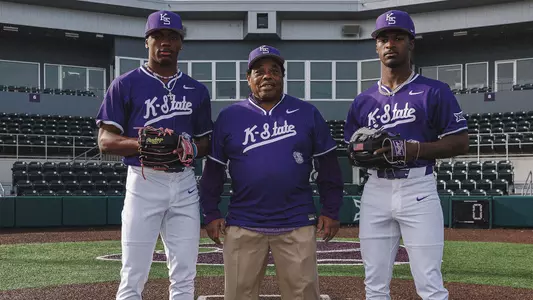
The man wore a purple ballcap and had kind eyes — eyes that had seen so much in 81 years. He had eyes that had seen the rolling cornfields where Tointon Family Stadium now resides, eyes that had once stared into those of the great Satchel Paige at Griffith Park in Manhattan, and eyes that knew no color when he was hired as Kansas State head baseball coach many moons ago. The man introduced himself to a visitor only as Dave Baker — not Coach Dave Baker, the only African American to serve as head baseball coach in Big 6, Big 7, Big 8 and Big 12 history.
Baker is standing inside the Tointon Family Stadium locker room with K-State head coach Pete Hughes just before lunchtime on Monday. Coach Baker thinks that he has been invited to the stadium for a casual visit. Instead, Hughes shows him his nameplate on a locker "DAVE BAKER." And Hughes holds a purple jersey, neatly unfolding it to reveal "K-State" in white cursive print. "BAKER" is stitched in block letters on the back of the jersey. The jersey is a splitting image to those jerseys that Baker's K-State teams wore in the late 1970s and early 1980s.
Baker is speechless.
Hughes makes an announcement.
"Coach, we're bringing back these unis as a tribute to you and your groundbreaking accomplishments," Hughes says. "It's our way to say thank you for all you've done for this program and college baseball. Coach, we'll wear the uniform with honor."
Baker holds the jersey and stands aghast at its grandeur.
"Thank you, thank you, thank you," Baker replies.
"We love having you back, Coach."
"I'm happy to be back."
"You're welcome," Hughes says. "Thank you."
"This," Baker says, "is just too much. I'll be here as long as the good Lord lets me. It's really a joy to come back and see where it was and where it is. It's a tribute to you guys and what you've done with it. If you were here in the 1960s, you could've never imagined this."
Baker takes another look at the jersey as he speaks.
"This," he says, "was my favorite one."

Baker grew up on Yuma Street in Manhattan and spent most of his youth hopping over the Rock Island railroad tracks (where Fort Riley Boulevard is now) and chasing foul balls hit by Earl Woods and his K-State teammates for nickels at Griffith Park, the Wildcats' baseball home in the 1950s and 1960s. In the third grade, Baker became the team's bat boy.
Baseball was in Baker's blood. His father, Jesse, was a baseball player and coach in the Negro Baseball League and one of the founders of youth baseball in Manhattan. After becoming a standout in Manhattan's American Legion team, Dave received an opportunity to sign with the Detroit Tigers out of Manhattan High School — a proposition that Jesse shot down as he insisted that his son pursue higher education.
Baker attended Coffeyville Community College, which did not offer baseball, and he played alongside four All-Americans as a 5-foot-8 point guard for a Jack Hartman squad that went 32-0 and captured the 1962 National Championship.
He eventually returned to Manhattan to play at K-State and hit .297 during the 1965-66 season. His NCAA eligibility expired following that campaign with the Wildcats, and he concluded his collegiate career at Emporia State Teachers College, where he earned his bachelor's degree in 1968 and his Master's degree in 1969. He played for the semi-pro Junction City Hawks, Manhattan Lumbermen and the 1965 National Baseball World Series champion Rapid Transit Dreamliners in the summer months.
As a member of the Hawks, Baker shined in a Friday night game against the legendary Kansas City Monarchs. The Monarchs organization asked Baker to play on their team in a Saturday game in Manhattan. In Baker's only game as a Monarch, he caught the first two innings for Satchel Paige at Griffith Park — and Baker also hit a home run.
Baker continued his path in baseball and eventually was hired by Creighton athletic director and legendary basketball coach Eddie Sutton to serve as the Blue Jays' head baseball coach in 1972.
Things came full circle, however, when K-State athletic director John Jermier hired 27-year-old Baker as head baseball coach in 1977 — a position he held for six seasons from 1978-83. Baker remains the only African American to serve as head baseball coach in Big 6, Big 7, Big 8 and Big 12 history.
"It was the furthest thing from my mind," Baker said in an interview in 2021. "My major goal was to try and win championships. It wasn't about the color of my skin. It was about the character in giving back. When you play the game, if you know anything about sports, people aren't looking at your color, they're looking at whether you have talent to perform and win. I've always felt that way."
He led the Wildcats to 137 wins, an appearance in the 1983 Big Eight Tournament (their first appearance since 1977) and he saw four players selected in the Major League Baseball draft. Baker was inducted into the Kansas Baseball Hall of Fame in 2018.

What does Baker like most about the jersey?
"Well, first of all, it's purple," he says, now holding the jersey up to his face inside the Tointon Family Stadium lounge. "It's a pretty basic uniform. You look at some uniforms today, and gosh, they don't even look like baseball uniforms. This one takes you back to the old days because it's a pretty basic uniform. That's what I like about it.
"The uniform takes me back to the time I was here and some of the things we were able to accomplish. I tell people all the time, we didn't win a championship, but we were very competitive, and it gave a lot of young men the opportunity to play baseball at K-State. It's very gratifying to know you made a difference."

The old-school jersey with cursive lettering saw some battles.
"We had some great rivalries in the Big 8," he says. "I remember beating Oklahoma and Oklahoma State, the teams to beat, but who we weren't supposed to beat, and we beat them on occasion. We just had a bunch of kids that worked hard and loved to play the game, and who came out and gave it all they had each and every day."
He continues.
"The greatest thing for me was the fact I was the bat boy for K-State when Earl Woods played baseball at Griffith Park, and Bob Brasher gave me a scholarship, and I played here in 1966. Then to have the opportunity to coach here, that was truly a blessing and a dream come true, because no one could ever imagine you'd be a bat boy, a player and a coach at the university. Being here in Manhattan and being a K-Stater all my life, I feel blessed for all of it."
The man wore a purple ballcap and had kind eyes — eyes that had seen so much in 81 years. He had eyes that had seen the rolling cornfields where Tointon Family Stadium now resides, eyes that had once stared into those of the great Satchel Paige at Griffith Park in Manhattan, and eyes that knew no color when he was hired as Kansas State head baseball coach many moons ago. The man introduced himself to a visitor only as Dave Baker — not Coach Dave Baker, the only African American to serve as head baseball coach in Big 6, Big 7, Big 8 and Big 12 history.
Baker is standing inside the Tointon Family Stadium locker room with K-State head coach Pete Hughes just before lunchtime on Monday. Coach Baker thinks that he has been invited to the stadium for a casual visit. Instead, Hughes shows him his nameplate on a locker "DAVE BAKER." And Hughes holds a purple jersey, neatly unfolding it to reveal "K-State" in white cursive print. "BAKER" is stitched in block letters on the back of the jersey. The jersey is a splitting image to those jerseys that Baker's K-State teams wore in the late 1970s and early 1980s.
Baker is speechless.
Hughes makes an announcement.
"Coach, we're bringing back these unis as a tribute to you and your groundbreaking accomplishments," Hughes says. "It's our way to say thank you for all you've done for this program and college baseball. Coach, we'll wear the uniform with honor."
Baker holds the jersey and stands aghast at its grandeur.
"Thank you, thank you, thank you," Baker replies.
"We love having you back, Coach."
"I'm happy to be back."
"You're welcome," Hughes says. "Thank you."
"This," Baker says, "is just too much. I'll be here as long as the good Lord lets me. It's really a joy to come back and see where it was and where it is. It's a tribute to you guys and what you've done with it. If you were here in the 1960s, you could've never imagined this."
Baker takes another look at the jersey as he speaks.
"This," he says, "was my favorite one."
Baker grew up on Yuma Street in Manhattan and spent most of his youth hopping over the Rock Island railroad tracks (where Fort Riley Boulevard is now) and chasing foul balls hit by Earl Woods and his K-State teammates for nickels at Griffith Park, the Wildcats' baseball home in the 1950s and 1960s. In the third grade, Baker became the team's bat boy.
Baseball was in Baker's blood. His father, Jesse, was a baseball player and coach in the Negro Baseball League and one of the founders of youth baseball in Manhattan. After becoming a standout in Manhattan's American Legion team, Dave received an opportunity to sign with the Detroit Tigers out of Manhattan High School — a proposition that Jesse shot down as he insisted that his son pursue higher education.
Baker attended Coffeyville Community College, which did not offer baseball, and he played alongside four All-Americans as a 5-foot-8 point guard for a Jack Hartman squad that went 32-0 and captured the 1962 National Championship.
He eventually returned to Manhattan to play at K-State and hit .297 during the 1965-66 season. His NCAA eligibility expired following that campaign with the Wildcats, and he concluded his collegiate career at Emporia State Teachers College, where he earned his bachelor's degree in 1968 and his Master's degree in 1969. He played for the semi-pro Junction City Hawks, Manhattan Lumbermen and the 1965 National Baseball World Series champion Rapid Transit Dreamliners in the summer months.
As a member of the Hawks, Baker shined in a Friday night game against the legendary Kansas City Monarchs. The Monarchs organization asked Baker to play on their team in a Saturday game in Manhattan. In Baker's only game as a Monarch, he caught the first two innings for Satchel Paige at Griffith Park — and Baker also hit a home run.
Baker continued his path in baseball and eventually was hired by Creighton athletic director and legendary basketball coach Eddie Sutton to serve as the Blue Jays' head baseball coach in 1972.
Things came full circle, however, when K-State athletic director John Jermier hired 27-year-old Baker as head baseball coach in 1977 — a position he held for six seasons from 1978-83. Baker remains the only African American to serve as head baseball coach in Big 6, Big 7, Big 8 and Big 12 history.
"It was the furthest thing from my mind," Baker said in an interview in 2021. "My major goal was to try and win championships. It wasn't about the color of my skin. It was about the character in giving back. When you play the game, if you know anything about sports, people aren't looking at your color, they're looking at whether you have talent to perform and win. I've always felt that way."
He led the Wildcats to 137 wins, an appearance in the 1983 Big Eight Tournament (their first appearance since 1977) and he saw four players selected in the Major League Baseball draft. Baker was inducted into the Kansas Baseball Hall of Fame in 2018.
What does Baker like most about the jersey?
"Well, first of all, it's purple," he says, now holding the jersey up to his face inside the Tointon Family Stadium lounge. "It's a pretty basic uniform. You look at some uniforms today, and gosh, they don't even look like baseball uniforms. This one takes you back to the old days because it's a pretty basic uniform. That's what I like about it.
"The uniform takes me back to the time I was here and some of the things we were able to accomplish. I tell people all the time, we didn't win a championship, but we were very competitive, and it gave a lot of young men the opportunity to play baseball at K-State. It's very gratifying to know you made a difference."
The old-school jersey with cursive lettering saw some battles.
"We had some great rivalries in the Big 8," he says. "I remember beating Oklahoma and Oklahoma State, the teams to beat, but who we weren't supposed to beat, and we beat them on occasion. We just had a bunch of kids that worked hard and loved to play the game, and who came out and gave it all they had each and every day."
He continues.
"The greatest thing for me was the fact I was the bat boy for K-State when Earl Woods played baseball at Griffith Park, and Bob Brasher gave me a scholarship, and I played here in 1966. Then to have the opportunity to coach here, that was truly a blessing and a dream come true, because no one could ever imagine you'd be a bat boy, a player and a coach at the university. Being here in Manhattan and being a K-Stater all my life, I feel blessed for all of it."
K-State Volleyball | Alumni Game Mic'd Up
Monday, May 04
K State Men's Basketball | Head Coach Casey Alexander Media Availability - April 30, 2026
Thursday, April 30
K-State Rowing | March Rower of the Month
Thursday, April 30
Women's Golf | NCAA Tournament Selection Show Reaction
Wednesday, April 29