Apr 13, 2026 | Men's Basketball, Sports Extra
By: D. Scott Fritchen
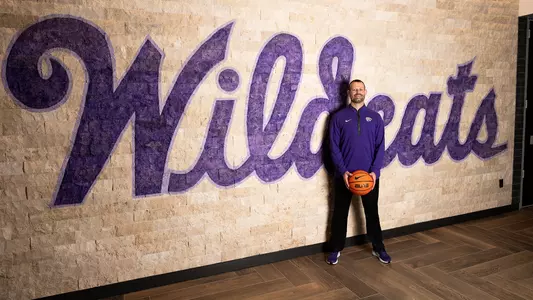
The "brotherhood of strength" is a closeknit fraternity of men's basketball strength coaches from across the Big 12 Conference — a crew that now includes Kansas State strength coach Lee Scott, who has been hired by first-year K-State head coach Casey Alexander to help shape the bodies and minds of the Wildcats as they arrive and dive into preparations for next season.
Lee was slated to embark upon his fourth year at Belmont this next season as director of sports performance after spending the previous nine seasons at Texas A&M-Corpus Christi, including the last seven as assistant athletic director for sports performance.
That all changed when Alexander asked Lee to join him on this Power 4 journey and don the purple and the Powercat and show the Big 12 that the Wildcats are built for success for years to come.
Shortly after, Scott joined the "brotherhood of strength."
"There are a lot of really, really good strength coaches and even better people in this league who I've already talked to and am excited to build relationships with," Scott says. "It's kind of a like a brotherhood of strength. We know in the iron game that none of us are recruiting the guys and we're not playing ourselves, so what I do or what they do, we can share all those ideas and then roll the ball out there and see who has the best guys that day. I'm looking forward to continuing to learn and grow from them."
Exactly why do Alexander and Scott work well together?
"We're both extremely competitive," Scott says. "We both want the best of those around us, but we'll be servants first. We understand we have to lead by how we do what we do and we both have a very high level of respect for one another and our craft. He has never once tried to dictate what I do, and I've never once have done that, either, but we work so well in conjunction with maximizing the capacities of the individuals that we're seeing. That's one reason why he's chosen me to be a part of this.
"I'm going to help continue to drive the culture and the expectation of how we do what we do and create an environment of toughness through day-in and day-out commitment to excellence. That's what's really helped us work well together."
Scott spoke with K-State Sports Extra's D. Scott Fritchen about his path to joining Alexander at K-State and his thoughts on establishing a culture and his philosophies inside the weight room.

D. Scott Fritchen: What was your immediate reaction when you heard Casey accepted the K-State job?
Lee Scott: Just excitement for him and his family. You spend a lot of hours in this field and college athletics is just a crazy environment to be a part of, and when you care about someone, and you care about people, and you realize they get that type of opportunity, you're very happy for him. We're a close-knit, family-oriented community, and realized there could be a lot of changes for myself and for Belmont at the time, and I didn't know where I fit into that. That didn't really matter to me as much as he deserves that, he's going to kill it, and I'm very happy for him.
It's still setting in that I'm at K-State, to be honest. I worked really hard for a long time. I like to think that I do it the right way. I know that I have a lot to learn and I'm by no means the best in the business, and that humble approach allows you to continue to learn and get better and to challenge yourself and those around you. I was really just grateful that he'd trust me with this area of his program. In doing that, I knew that I was going to be helping him build something special here, creating a culture and an environment where people can be proud of the product that hopefully we're able to put out there.
Fritchen: What do you admire most about Casey as a person and then what do you admire most about Casey as a coach?
Scott: He's genuine. There's not an ego. He knows what he's really good at. It's not that he's not confident. He's extremely confident, which you have to be if you're really, really good at something, but he doesn't let that rule how he does things or talks to people. He genuinely cares through and through for people. That's one of the reasons he's had so much success is because his players feel that, and they'll feel that here. He has more support and more resources to take better care of the people who choose to be a part of our program. That'll really help us quickly to be very competitive. That's a huge part of him.
As a coach, his ability to continue to adapt and evolve and coach in concepts and flows versus being super-specific and making things very complicated for guys. He's one of the best in the country at drawing up plays and doing those things and guys executing that. Like he's said a million times, you can watch film on us all you want, and you're really not going to know what we're doing because we're constantly evolving and adapting within the game situation. I really appreciate how he gives players the freedom to work out of a framework of understanding of basketball. That leads to a really exciting brand of basketball, I believe.
Fritchen: Describe your chemistry with Casey and what makes you both tick?
Scott: We're both extremely competitive. We both want the best of those around us, but we'll be servants first. We understand we have to lead by how we do what we do and we both have a very high level of respect for one another and our craft. He has never once tried to dictate what I do, and I've never once have done that, either, but we work so well in conjunction with maximizing the capacities of the individuals that we're seeing. That's one reason why he's chosen me to be a part of this. I'm going to help continue to drive the culture and the expectation of how we do what we do and create an environment of toughness through day-in and day-out commitment to excellence. That's what's really helped us work well together.

Fritchen: Culture is so important. Do you bring a culture in here, or do you allow a culture to manifest itself?
Scott: It's going to start with who we get and who they are and getting to know guys. We're going to have certain expectations about what we do, and there'll be a level of culture that's developed through who our players are and how they act and respond to stressful situations and how they overcome those things. Then we'll continue to give them strategies of how to maintain success in that environment. The last thing we want to do is throw a kid out there in an extremely tough environment in the Big 12 and have them not already been challenged really well. I want them to be able to trust their level of training and preparation, so the hardest thing they had to do that week wasn't a game, but what we did to get to that space.
Fritchen: You were to begin your fourth year at Belmont this next season as director of sports performance after spending the previous nine seasons at Texas A&M-Corpus Christi, including the last seven as assistant athletic director for sports performance. Now you're a first-year assistant on a Power 4 team that competes in arguably the toughest conference in the nation. What are the emotions that go along with making that jump?
Scott: To be completely honest, the first thing that comes to mind is "imposter syndrome" of, "Are you good enough? Can you do this?" and looking in the mirror and saying, "Yes, man, of course you are. You wouldn't be given this opportunity if you weren't." And then you walk boldly in all of the things I know I can do and trust that I'm going to continue to get better and learn and lean on people. I know a lot of guys in this league. There are a lot of really, really good strength coaches and even better people in this league who I've already talked to and am excited to build relationships with. It's kind of a like a brotherhood of strength. We know in the iron game that none of us are recruiting the guys and we're not playing ourselves, so what I do or what they do, we can share all those ideas and then roll the ball out there and see who has the best guys that day. I'm looking forward to continuing to learn and grow from them.
Fritchen: What kinds of thoughts were running through your head as you opened the front door and entered the K-State basketball facility for the first time?
Scott: Just that, "This is it." This is what it's about. The approach, what the Ice Family did in building that facility, and all of the intricate details, I was kind of in awe. I still think as I walk around and see everything, I feel an overwhelming appreciation and gratitude to be a part of this. I'm wearing the K-State shirt now. That's really, really cool to me. With that comes the standard of, "You're standing on the shoulders of giants, of what people have done before, it's now my responsibility to uphold those expectations and make sure we walk boldly into the future and continue to carve out our identity and legacy in this story."
Fritchen: How did this passion for sports performance and strength and conditioning begin?
Scott: Playing ball. I was a skinny kid growing up from the middle of nowhere in Elgin, Texas, a rural kid who was always outside, and I came from a home where my dad worked a lot off shore and mom was working and trying to survive. So, I was usually with friends or playing ball, whether that was soccer, baseball, or whatever. So, I was always doing something. As I got older, I realized I might be the biggest, fastest or strongest, but I could work hard, and I knew working hard might not necessarily lead to success, but it would push you past the guys that didn't. I remember being one of the last guys to leave the high school weight room, or I'd go there afterward, and I'd jump fences to kick footballs to stay ready to go. Then when I got into college, being surrounded by guys who were really passionate about the craft, that it wasn't just pick it up and put it down, there was a science to it, and ultimately, I get to work with the most complex system ever created — the human body. That was really, really cool. As I continued to learn more about it, it's just gotten more and more exciting to me.

Fritchen: What is your core philosophy that you incorporate into your players?
Scott: Just starting at the basics of grabbing the low-hanging fruit. All of these guys are going to have a really high level of gifts and physical capacities. The thing that I have to figure out is what's missing. So, we'll start with movement stuff, laying them down, rolling them around, doing Ninety 90s, challenging them into spaces and ranges of motion that maybe they haven't tried to access because they were so stuck on just being a basketball player. As they begin to evolve and learn that, it's about helping them neurologically understand what it feels like to do certain things, and to activate certain muscles, to really know what this should feel like versus what that should feel like. We train really hard. There has to be undulation in all the things you're doing and isometric and eccentric and tempos and restorative stuff and mobility. There are all these different parts, but I'm a big believer in that there is not one perfect way to do this. I haven't decided exactly how we're going to train with because I don't know exactly who we're going to have, but once the guys get here, then the process begins, and my process of refining what our training will look like will continue to evolve around what this team needs at this moment and then maximize all of those things to the best of my ability.
Fritchen: The NCAA Tournament has wrapped up. You were a part of Texas A&M-Corpus Christi's back-to-back Southland Conference championships with consecutive trips to the NCAA Tournament. What kind of hunger do you feel this time of year in just imagining making another trip to compete in a NCAA Tournament?
Scott: I still have the March Madness shorts and pullover. That's my sleeping attire. I always pull it out and wear it more in March. It reminds me of those times. It's such a special experience. I'm forever grateful to be a part of that. It's about breaking down a barrier. There are a lot of people who do this for a long time who never get that experience. Once you do, it's like, "Why can't we do this again? Why not us?" Now with where we are and with what we have access to, it's not easier by any means because the Big 12 is extremely competitive, but there's no reason that we shouldn't have the ability to be in the NCAA Tournament every year, and not only that, but to be a contender in each round. That has to be your approach when you step to this level. If you're not coming here to go to the NCAA Tournament and to go to the Elite Eight and try to win a National Championship, your mind isn't right, and maybe you don't need to be here. That's got to be the approach — helping our guys gain that confidence as we continue to do what we're supposed to do and then hopefully getting a whole lot more March Madness gear so I can sleep in it.
Fritchen: From that young boy growing up in Elgin, Texas, to the man you are today, what has Lee Scott learned most about himself during his journey?
Scott: That it's not about me. You have to hold onto something greater than yourself. For me, it's my faith. Being a man is a wonderful calling, being a father is the greatest job in the world, and being a husband is something that's extremely beautiful. You get called to do those things, and it's awesome. There's a time and a space for you to step into those things and sometimes it takes time to learn all those things, but you can't do it by yourself. If you make it about trying to do this or trying to do that or getting to the next thing, you're going to miss all of the things around you. The beauty in life is being where your feet are at and soak up all the moments you do get, and when you do that, you enter the space of gratitude and joy that nobody can take from you. I didn't chase a paycheck or a name on a shirt, I just tried to do my best day in and day out, and today I'm thankful I get to sit here and tell you about that. That's what it's about. If you're out there and not sure and have these doubts, just take a deep breath, be right where you're at, and work as hard as you can, and see what happens.
The "brotherhood of strength" is a closeknit fraternity of men's basketball strength coaches from across the Big 12 Conference — a crew that now includes Kansas State strength coach Lee Scott, who has been hired by first-year K-State head coach Casey Alexander to help shape the bodies and minds of the Wildcats as they arrive and dive into preparations for next season.
Lee was slated to embark upon his fourth year at Belmont this next season as director of sports performance after spending the previous nine seasons at Texas A&M-Corpus Christi, including the last seven as assistant athletic director for sports performance.
That all changed when Alexander asked Lee to join him on this Power 4 journey and don the purple and the Powercat and show the Big 12 that the Wildcats are built for success for years to come.
Shortly after, Scott joined the "brotherhood of strength."
"There are a lot of really, really good strength coaches and even better people in this league who I've already talked to and am excited to build relationships with," Scott says. "It's kind of a like a brotherhood of strength. We know in the iron game that none of us are recruiting the guys and we're not playing ourselves, so what I do or what they do, we can share all those ideas and then roll the ball out there and see who has the best guys that day. I'm looking forward to continuing to learn and grow from them."
Exactly why do Alexander and Scott work well together?
"We're both extremely competitive," Scott says. "We both want the best of those around us, but we'll be servants first. We understand we have to lead by how we do what we do and we both have a very high level of respect for one another and our craft. He has never once tried to dictate what I do, and I've never once have done that, either, but we work so well in conjunction with maximizing the capacities of the individuals that we're seeing. That's one reason why he's chosen me to be a part of this.
"I'm going to help continue to drive the culture and the expectation of how we do what we do and create an environment of toughness through day-in and day-out commitment to excellence. That's what's really helped us work well together."
Scott spoke with K-State Sports Extra's D. Scott Fritchen about his path to joining Alexander at K-State and his thoughts on establishing a culture and his philosophies inside the weight room.
D. Scott Fritchen: What was your immediate reaction when you heard Casey accepted the K-State job?
Lee Scott: Just excitement for him and his family. You spend a lot of hours in this field and college athletics is just a crazy environment to be a part of, and when you care about someone, and you care about people, and you realize they get that type of opportunity, you're very happy for him. We're a close-knit, family-oriented community, and realized there could be a lot of changes for myself and for Belmont at the time, and I didn't know where I fit into that. That didn't really matter to me as much as he deserves that, he's going to kill it, and I'm very happy for him.
It's still setting in that I'm at K-State, to be honest. I worked really hard for a long time. I like to think that I do it the right way. I know that I have a lot to learn and I'm by no means the best in the business, and that humble approach allows you to continue to learn and get better and to challenge yourself and those around you. I was really just grateful that he'd trust me with this area of his program. In doing that, I knew that I was going to be helping him build something special here, creating a culture and an environment where people can be proud of the product that hopefully we're able to put out there.
Fritchen: What do you admire most about Casey as a person and then what do you admire most about Casey as a coach?
Scott: He's genuine. There's not an ego. He knows what he's really good at. It's not that he's not confident. He's extremely confident, which you have to be if you're really, really good at something, but he doesn't let that rule how he does things or talks to people. He genuinely cares through and through for people. That's one of the reasons he's had so much success is because his players feel that, and they'll feel that here. He has more support and more resources to take better care of the people who choose to be a part of our program. That'll really help us quickly to be very competitive. That's a huge part of him.
As a coach, his ability to continue to adapt and evolve and coach in concepts and flows versus being super-specific and making things very complicated for guys. He's one of the best in the country at drawing up plays and doing those things and guys executing that. Like he's said a million times, you can watch film on us all you want, and you're really not going to know what we're doing because we're constantly evolving and adapting within the game situation. I really appreciate how he gives players the freedom to work out of a framework of understanding of basketball. That leads to a really exciting brand of basketball, I believe.
Fritchen: Describe your chemistry with Casey and what makes you both tick?
Scott: We're both extremely competitive. We both want the best of those around us, but we'll be servants first. We understand we have to lead by how we do what we do and we both have a very high level of respect for one another and our craft. He has never once tried to dictate what I do, and I've never once have done that, either, but we work so well in conjunction with maximizing the capacities of the individuals that we're seeing. That's one reason why he's chosen me to be a part of this. I'm going to help continue to drive the culture and the expectation of how we do what we do and create an environment of toughness through day-in and day-out commitment to excellence. That's what's really helped us work well together.
Fritchen: Culture is so important. Do you bring a culture in here, or do you allow a culture to manifest itself?
Scott: It's going to start with who we get and who they are and getting to know guys. We're going to have certain expectations about what we do, and there'll be a level of culture that's developed through who our players are and how they act and respond to stressful situations and how they overcome those things. Then we'll continue to give them strategies of how to maintain success in that environment. The last thing we want to do is throw a kid out there in an extremely tough environment in the Big 12 and have them not already been challenged really well. I want them to be able to trust their level of training and preparation, so the hardest thing they had to do that week wasn't a game, but what we did to get to that space.
Fritchen: You were to begin your fourth year at Belmont this next season as director of sports performance after spending the previous nine seasons at Texas A&M-Corpus Christi, including the last seven as assistant athletic director for sports performance. Now you're a first-year assistant on a Power 4 team that competes in arguably the toughest conference in the nation. What are the emotions that go along with making that jump?
Scott: To be completely honest, the first thing that comes to mind is "imposter syndrome" of, "Are you good enough? Can you do this?" and looking in the mirror and saying, "Yes, man, of course you are. You wouldn't be given this opportunity if you weren't." And then you walk boldly in all of the things I know I can do and trust that I'm going to continue to get better and learn and lean on people. I know a lot of guys in this league. There are a lot of really, really good strength coaches and even better people in this league who I've already talked to and am excited to build relationships with. It's kind of a like a brotherhood of strength. We know in the iron game that none of us are recruiting the guys and we're not playing ourselves, so what I do or what they do, we can share all those ideas and then roll the ball out there and see who has the best guys that day. I'm looking forward to continuing to learn and grow from them.
Fritchen: What kinds of thoughts were running through your head as you opened the front door and entered the K-State basketball facility for the first time?
Scott: Just that, "This is it." This is what it's about. The approach, what the Ice Family did in building that facility, and all of the intricate details, I was kind of in awe. I still think as I walk around and see everything, I feel an overwhelming appreciation and gratitude to be a part of this. I'm wearing the K-State shirt now. That's really, really cool to me. With that comes the standard of, "You're standing on the shoulders of giants, of what people have done before, it's now my responsibility to uphold those expectations and make sure we walk boldly into the future and continue to carve out our identity and legacy in this story."
Fritchen: How did this passion for sports performance and strength and conditioning begin?
Scott: Playing ball. I was a skinny kid growing up from the middle of nowhere in Elgin, Texas, a rural kid who was always outside, and I came from a home where my dad worked a lot off shore and mom was working and trying to survive. So, I was usually with friends or playing ball, whether that was soccer, baseball, or whatever. So, I was always doing something. As I got older, I realized I might be the biggest, fastest or strongest, but I could work hard, and I knew working hard might not necessarily lead to success, but it would push you past the guys that didn't. I remember being one of the last guys to leave the high school weight room, or I'd go there afterward, and I'd jump fences to kick footballs to stay ready to go. Then when I got into college, being surrounded by guys who were really passionate about the craft, that it wasn't just pick it up and put it down, there was a science to it, and ultimately, I get to work with the most complex system ever created — the human body. That was really, really cool. As I continued to learn more about it, it's just gotten more and more exciting to me.
Fritchen: What is your core philosophy that you incorporate into your players?
Scott: Just starting at the basics of grabbing the low-hanging fruit. All of these guys are going to have a really high level of gifts and physical capacities. The thing that I have to figure out is what's missing. So, we'll start with movement stuff, laying them down, rolling them around, doing Ninety 90s, challenging them into spaces and ranges of motion that maybe they haven't tried to access because they were so stuck on just being a basketball player. As they begin to evolve and learn that, it's about helping them neurologically understand what it feels like to do certain things, and to activate certain muscles, to really know what this should feel like versus what that should feel like. We train really hard. There has to be undulation in all the things you're doing and isometric and eccentric and tempos and restorative stuff and mobility. There are all these different parts, but I'm a big believer in that there is not one perfect way to do this. I haven't decided exactly how we're going to train with because I don't know exactly who we're going to have, but once the guys get here, then the process begins, and my process of refining what our training will look like will continue to evolve around what this team needs at this moment and then maximize all of those things to the best of my ability.
Fritchen: The NCAA Tournament has wrapped up. You were a part of Texas A&M-Corpus Christi's back-to-back Southland Conference championships with consecutive trips to the NCAA Tournament. What kind of hunger do you feel this time of year in just imagining making another trip to compete in a NCAA Tournament?
Scott: I still have the March Madness shorts and pullover. That's my sleeping attire. I always pull it out and wear it more in March. It reminds me of those times. It's such a special experience. I'm forever grateful to be a part of that. It's about breaking down a barrier. There are a lot of people who do this for a long time who never get that experience. Once you do, it's like, "Why can't we do this again? Why not us?" Now with where we are and with what we have access to, it's not easier by any means because the Big 12 is extremely competitive, but there's no reason that we shouldn't have the ability to be in the NCAA Tournament every year, and not only that, but to be a contender in each round. That has to be your approach when you step to this level. If you're not coming here to go to the NCAA Tournament and to go to the Elite Eight and try to win a National Championship, your mind isn't right, and maybe you don't need to be here. That's got to be the approach — helping our guys gain that confidence as we continue to do what we're supposed to do and then hopefully getting a whole lot more March Madness gear so I can sleep in it.
Fritchen: From that young boy growing up in Elgin, Texas, to the man you are today, what has Lee Scott learned most about himself during his journey?
Scott: That it's not about me. You have to hold onto something greater than yourself. For me, it's my faith. Being a man is a wonderful calling, being a father is the greatest job in the world, and being a husband is something that's extremely beautiful. You get called to do those things, and it's awesome. There's a time and a space for you to step into those things and sometimes it takes time to learn all those things, but you can't do it by yourself. If you make it about trying to do this or trying to do that or getting to the next thing, you're going to miss all of the things around you. The beauty in life is being where your feet are at and soak up all the moments you do get, and when you do that, you enter the space of gratitude and joy that nobody can take from you. I didn't chase a paycheck or a name on a shirt, I just tried to do my best day in and day out, and today I'm thankful I get to sit here and tell you about that. That's what it's about. If you're out there and not sure and have these doubts, just take a deep breath, be right where you're at, and work as hard as you can, and see what happens.
Monday, October 26
Sunday, October 25
Saturday, October 24
Saturday, October 24