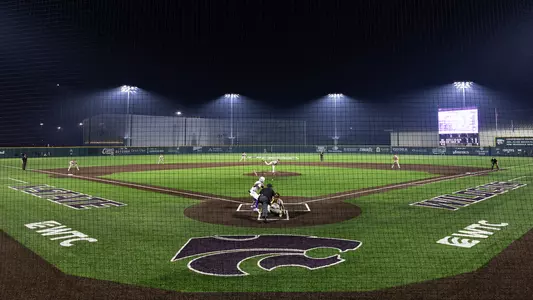
‘19 Ways’ Ranks No. 1
Jun 01, 2026 | Baseball, Sports Extra
By: D. Scott Fritchen
Kansas State baseball finished No. 1 among all men's Division I sports teams in community engagement during the 2025-26 academic year, according to the Helper Helper, a volunteer management platform that tracks and coordinates the community service of more than 200 athletic departments across the nation.
Helper Helper, developed by University of Michigan student-athlete Krista Clement in 2013 and soon after partnered with the NCAA, is a service available for companies, high schools, non-profit organizations, colleges and universities, college athletic departments, and sororities and fraternities.
In the realm of collegiate athletics, the service ranks institutions by percent of hours per student-athlete and percent of participation, using both pieces to tabulate institutional rankings, while also ranking teams by hours per student-athlete.
K-State baseball and its "19 Ways" initiative proved unbeatable — but the Manhattan community along with the Oklahoma Children's Hospital were the big winners.
"It's something we take pride in," said K-State assistant coach Thomas Hughes, who heads the "19 Ways" initiative. "In our '19 Ways' community service program, we do 19 things a year to give back to the community, whether it's getting goods for Cats 4 Cans, or hosting a Special Olympics event, or anything that is giving back to our incredible community in Manhattan. We don't take for granted the community we're a part of and work for every day.
"We feel like giving back is the least we can do and it's something we want to do."

The mission of the Helper Helper platform is to make it easier for athletic departments to help student-athletes get out into the community. Between July 1, 2025 and May 5, 2026, Division I men's and women's teams logged 348,548 total community engagement hours in 13,544 community engagement opportunities.
Over the years, hundreds of student-athlete development professionals have shaped the Helper Helper platform that exists today, and it's proven to enhance the student-athlete experience and take student-athlete development to the next level. Helper Helper helps athletic departments spend less time tracking service efforts and more time nurturing the next generation of leaders.
Which is precisely one of the goals of K-State baseball.
"Athletics are athletics, but at the end of the day, as coaches we're in this business to build better players and better people for life after baseball," Hughes said. "Community service events and getting guys out of their comfort zone and interacting with people and doing things they might not have done on their own, it prepares players for after athletics with an opportunity to give back to the community.
"It becomes a part of who they are as people, and when they leave Kansas State baseball, we hope they take advantage of community service opportunities after school. It's been really special for us to see as a K-State coaching staff."
K-State baseball head coach Pete Hughes installed "19 Ways" eight years ago when he arrived in Manhattan as a community service imitative designed to have a positive impact on the community on 19 different occasions. Hughes and his teams have connected and supported the community through signature events such as Shave for the Brave and the ALS Awareness Halloween Game.
Shave for the Brave culminated in the program's fundraising campaign for College Baseball vs. Cancer to benefit the Pediatric Brain Tumor Foundation. The Wildcats were four-time defending national fundraising champions, raising more than $130,000 in that span. In 2020, K-State's players and coaches raised $38,019 — nearly $10,000 more than any other college baseball program.
"Actually, in seven years we've raised $400,000 for College Baseball vs. Cancer," Thomas Hughes said. "Fifty percent of the funds go directly to pediatric brain cancer research and 50% goes to Oklahoma Children's Hospital in Oklahoma City for cancer patients who basically live in the hospital.
"Three years ago, three players and I went to the hospital and gave them a check for more than $35,000 raised that year. It's our biggest fundraiser, and we've been able to see the benefits right away. The hospital used that money to build a state-of-the-art entertainment room as an escape for the child cancer patients."

For K-State baseball, the process of identifying and participating in community service events and initiatives began years ago. Since then, organizations have requested the return of K-State baseball players to aid in their activities and fundraisers, while other organizations have taken note and have elicited the involvement of K-State baseball as well.
"We've created relationships with organizations throughout the community," Hughes said. "Whenever we do a fundraiser, they come back and want our guys to help again, because our guys do such a good job participating in these events. It's almost an annual thing where organizations with reach out to us and we put dates on the calendar. We maintain relationships to read to elementary school classrooms.
"It seems like little things to do and a small investment, but it means so much, and our guys love it. Community service just is a part of who we are and a part of our program."
And in men's college athletics, nobody does it better.
Kansas State baseball finished No. 1 among all men's Division I sports teams in community engagement during the 2025-26 academic year, according to the Helper Helper, a volunteer management platform that tracks and coordinates the community service of more than 200 athletic departments across the nation.
Helper Helper, developed by University of Michigan student-athlete Krista Clement in 2013 and soon after partnered with the NCAA, is a service available for companies, high schools, non-profit organizations, colleges and universities, college athletic departments, and sororities and fraternities.
In the realm of collegiate athletics, the service ranks institutions by percent of hours per student-athlete and percent of participation, using both pieces to tabulate institutional rankings, while also ranking teams by hours per student-athlete.
K-State baseball and its "19 Ways" initiative proved unbeatable — but the Manhattan community along with the Oklahoma Children's Hospital were the big winners.
"It's something we take pride in," said K-State assistant coach Thomas Hughes, who heads the "19 Ways" initiative. "In our '19 Ways' community service program, we do 19 things a year to give back to the community, whether it's getting goods for Cats 4 Cans, or hosting a Special Olympics event, or anything that is giving back to our incredible community in Manhattan. We don't take for granted the community we're a part of and work for every day.
"We feel like giving back is the least we can do and it's something we want to do."
The mission of the Helper Helper platform is to make it easier for athletic departments to help student-athletes get out into the community. Between July 1, 2025 and May 5, 2026, Division I men's and women's teams logged 348,548 total community engagement hours in 13,544 community engagement opportunities.
Over the years, hundreds of student-athlete development professionals have shaped the Helper Helper platform that exists today, and it's proven to enhance the student-athlete experience and take student-athlete development to the next level. Helper Helper helps athletic departments spend less time tracking service efforts and more time nurturing the next generation of leaders.
Which is precisely one of the goals of K-State baseball.
"Athletics are athletics, but at the end of the day, as coaches we're in this business to build better players and better people for life after baseball," Hughes said. "Community service events and getting guys out of their comfort zone and interacting with people and doing things they might not have done on their own, it prepares players for after athletics with an opportunity to give back to the community.
"It becomes a part of who they are as people, and when they leave Kansas State baseball, we hope they take advantage of community service opportunities after school. It's been really special for us to see as a K-State coaching staff."
K-State baseball head coach Pete Hughes installed "19 Ways" eight years ago when he arrived in Manhattan as a community service imitative designed to have a positive impact on the community on 19 different occasions. Hughes and his teams have connected and supported the community through signature events such as Shave for the Brave and the ALS Awareness Halloween Game.
Shave for the Brave culminated in the program's fundraising campaign for College Baseball vs. Cancer to benefit the Pediatric Brain Tumor Foundation. The Wildcats were four-time defending national fundraising champions, raising more than $130,000 in that span. In 2020, K-State's players and coaches raised $38,019 — nearly $10,000 more than any other college baseball program.
"Actually, in seven years we've raised $400,000 for College Baseball vs. Cancer," Thomas Hughes said. "Fifty percent of the funds go directly to pediatric brain cancer research and 50% goes to Oklahoma Children's Hospital in Oklahoma City for cancer patients who basically live in the hospital.
"Three years ago, three players and I went to the hospital and gave them a check for more than $35,000 raised that year. It's our biggest fundraiser, and we've been able to see the benefits right away. The hospital used that money to build a state-of-the-art entertainment room as an escape for the child cancer patients."
For K-State baseball, the process of identifying and participating in community service events and initiatives began years ago. Since then, organizations have requested the return of K-State baseball players to aid in their activities and fundraisers, while other organizations have taken note and have elicited the involvement of K-State baseball as well.
"We've created relationships with organizations throughout the community," Hughes said. "Whenever we do a fundraiser, they come back and want our guys to help again, because our guys do such a good job participating in these events. It's almost an annual thing where organizations with reach out to us and we put dates on the calendar. We maintain relationships to read to elementary school classrooms.
"It seems like little things to do and a small investment, but it means so much, and our guys love it. Community service just is a part of who we are and a part of our program."
And in men's college athletics, nobody does it better.

Monday, September 14
Monday, September 14
Saturday, September 12
Saturday, September 12