Apr 20, 2026 | Men's Basketball, Sports Extra
By: D. Scott Fritchen
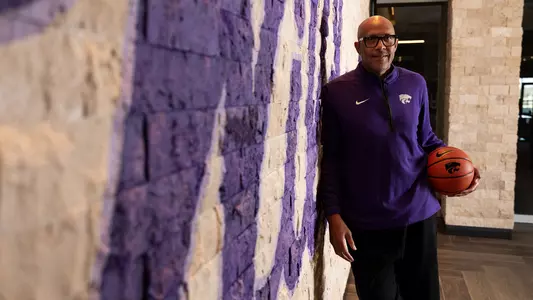
John Cooper knows Kansas State. Because Lon Kruger recruited John Cooper to K-State. Cooper, a native of Kansas City, Kansas, grew up watching Rolando Blackman. He played in elite basketball camps in Ahearn Field House. When Cooper opted to play at Wichita State, the 18-year-old freshman came off the bench to play against Mitch Richmond. And Steve Henson. And Will Scott. During Cooper's senior season at Wichita State, he played in one of the first games in Bramlage Coliseum.
So, Cooper, who spent three seasons as an assistant coach to Kevin Kruger (Lon Kruger's son) at UNLV, was thrilled at the opportunity to return to the Midwest and to a place he knew very well when new K-State head coach Casey Alexander phoned him in April with the opportunity to join him in Manhattan.
"I was recruited to K-State by Coach Lon Kruger and Dana Altman and that staff, I came here for an elite camp and all those things, so all those people and all those names I knew growing up," Cooper says. "There's a familiarity. When I grew up, it was K-State basketball and Rolando Blackman and all those guys. That's what I watched. I understood the significance and great opportunity Casey had in being able to get this job, so I was certainly excited for him."
Prior to UNLV, Cooper served as assistant coach under K-State alum Tim Jankovich at SMU. Before that, Cooper served as special assistant to head coach Mike Boynton Jr. from 2017-20. He also served as an assistant coach at Oregon in 2002-04, Auburn in 2004-09, and South Carolina in 1995 to 2001 with back-to-back NCAA Tournament appearances in 1997 and 1998.
As a head coach, Cooper spent eight seasons at Tennessee State from 2009-12 and Miami (Ohio) from 2012-17.
All those experiences make the 57-year-old Cooper an asset to Alexander's first coaching staff, as Cooper has a proven record of bringing in and developing talent and helping foster a foundation for programs.
"Some of our coaching duties are evolving," Cooper says. "There's going to be recruitment and positional assignments and scouting and film work, and continuing to grow the K-State brand, and growing it in the right way, and making the K-State faithful happy and proud, as we put a product on the court that not only they can be proud of, but one that has sustainability. That's easier said than done in this day in age, but K-State has a person in Casey Alexander who not only has a plan, but a blueprint of what he wants, what it looks like, and that makes it, in my opinion, as a person who's out recruiting or trying to find the right pieces and fits and help, a little bit easier.
"If you're going out and buying a new Mercedes, you go to the Mercedes dealership. You know what you're looking for to fit the style, and it can help streamline the process and keep you in the right direction."
From an early age, Cooper knew what he was looking for. He wanted to play college basketball. He did so at Wichita State from 1987 to 1991 where he was a two-time team captain, scored more than 1,100 points, and averaged 17.0 points and 7.2 rebounds per game his senior season.
Now he's wearing the Powercat. And he looks to help K-State direct its path to the NCAA Tournament again.
"Heck, I go back to my freshman year at Wichita State when we played in the NCAA Tournament, and I still have my watch because the 1987-88 season was the 50th anniversary, and that was at Kemper Arena," Cooper says. "All those little things that you come back and think about, either as a player or as a coach, those are all things that are fun about the NCAA Tournament. Wichita State was in the same region with K-State at Notre Dame in that NCAA Tournament. We lost to DePaul, and K-State made its run with Coach Kruger.
"Man, it's about the memories and the fans being able to talk about big-time games and big-time plays. That's what you do it for. You want the experience of the NCAA Tournament, and you want the young men to have that experience as they age. You think it's going to last forever, but boy, does it go fast."
John Cooper spoke with K-State Sports Extra's D. Scott Fritchen about K-State, college basketball, coaching and life.

D. Scott Fritchen: What was your immediate reaction when you learned that Casey Alexander was named head coach at K-State?
John Cooper: I was excited for him. I knew Casey when I was the head coach at Tennessee State. Casey was the assistant coach at Belmont. You have Tennessee State, Belmont, Lipscomb and Vanderbilt that are all right there in Nashville and all are separated just by miles. When you're there, eventually, you'll see each other, and you become friendly. Then there was a point where we lived in the same neighborhood, but then I took the job at Miami of Ohio, but we always remained friendly. It was that kind of relationship. I'm from Kansas City, born and raised, so I have probably a better feel than a lot of people that aren't from this part of the country about K-State.
I was recruited to K-State by Coach Lon Kruger and Dana Altman and that staff. I came here for an elite camp and all those things. I worked for Tim Jankovich. All those people and all those names I knew growing up. There's a familiarity. When I grew up, it was K-State basketball and Rolando Blackman and all those guys. That's what I watched. I understood the significance and great opportunity Casey had in being able to get this job, so I was certainly excited for him.
Fritchen: Did you either watch or play games in Ahearn Field House?
Cooper: Yeah, so my freshman year at Wichita State in 1987-88 when Mitch Richmond, Steve Henson and Will Scott were on that K-State team, I actually played in both arenas. My freshman year we played in Ahearn Field House, and then the next year K-State came to us at Wichita State, and then the next year we played K-State in Bramlage Coliseum in its first year. My freshman year, I played about 18-20 minutes a game and came onto the court inside Ahearn Field House and Mitch Richmond told me, "You have your hands full, young fella." Mitch didn't say anything on the court. He chewed that gum and he gave you work. There was a picture of me playing in Ahearn Field House that hung in Rockhurst High School for a long time.
Fritchen: How does it feel to now wear the Powercat?
Cooper: Heck, man, it's awesome. It's the closest I've ever been to home. I've never been one of those people who is like, "I want to get back close to home." I just knew basketball and the life, and I knew a lot of people that are K-State grads and who are in Kansas City, so to be back here, it's certainly exciting. Obviously, it's a different time than when I was growing up, but it's exciting.
Fritchen: Could you have imagined if NIL had been around when you were at Wichita State?
Cooper: It would be different. I would've made me some money. Maybe I wouldn't be sitting here. I wonder for the kids today if they'll be able to say the names of the former players like Blackman. It used to be you were able to identify with those names like Mitch Richmond, Steve Henson and Lon Kruger — and Kruger is in the rafters. But you think about these small-town Kansas guys who came here and certainly they were recruited and may not have been recruited on the national level, and they had great careers. The familiarity of schools and names has changed a little bit because sometimes players are there one year. It can affect fan bases. It's hard. How do you establish the loyalty? That's the thing. It's no different than my friends who I played with or played at Wichita State before me. I knew those names before I ever got there because they were intertwined with the history of the program. That's one of the things about the NIL. That's how it's changed. Would I be sitting here? I don't know. It's just a different time.
Fritchen: What kinds of thoughts were running through your head as you opened the front door to the K-State basketball facility for the first time?
Cooper: I've known guys who've been assistants here. I was with Mike Boynton at Oklahoma State. But I walked in here, man, and I was like, 'This is different. This is nice." To see the commitment on all fronts with athletics, you feel good. You feel like this is real. There was definitely excitement. There are a lot of really, really nice people here. I've known Casey Scott for almost 40 years now since I was a player at Wichita State. It's exciting.

Fritchen: What's a thumbnail sketch of what your coaching duties will entail?
Cooper: Some of our coaching duties are evolving. There's going to be recruitment and positional assignments and scouting and film work, and continuing to grow the K-State brand, and growing it in the right way, and making the K-State faithful happy and proud, as we put a product on the court that not only they can be proud of, but one that has sustainability. That's easier said than done in this day in age, but K-State has a person in Casey Alexander who not only has a plan, but a blueprint of what he wants, what it looks like, and that makes it, in my opinion, as a person who's out recruiting or trying to find the right pieces and fits and help, a little bit easier. If you're going out and buying a new Mercedes, you go to the Mercedes dealership. You know what you're looking for to fit the style, and it can help streamline the process and keep you in the right direction.
Fritchen: You know Casey and you know his teams. What would be the best description for a Casey Alexander player?
Cooper: He'll be savvy, skilled and know how to play. He'll be smart, unselfish, and about "us" and not "me." He'll be willing to do the little things, maybe a screen, maybe delivering the pass in the right spot, and he'll be someone who wants to play with and together. He'll obviously have the ability to shoot. If you look at Casey's teams, programs, and background, and what that's all entailed, style has involved, but those are always things you saw in his teams. They're unselfish with good spacing, and there's a sense in knowing this is what it'll take to be successful. The sum of the parts is greater than the individual and how they fit together. Those are all things that when you look at the teams you're like, "Man, that's a good team."
Fritchen: The Big 12 has continued to evolve…
Cooper: Yes, and you think about it and I was with Tim Jankovich at SMU, so I'm familiar with UCF and Houston and Cincinnati, who were all in the American Conference when I was at SMU. So, it's kind of funny that here I am, I come back to the Big 12, and it's added some of those same programs.
Fritchen: The Big 12 had five teams finish in the Top 25 this year. What are some selling points to get players to come to K-State?
Cooper: First, you talk about a conference that arguably in the past 10 years has been maybe the best conference in basketball. I don't think anyone can debate that looking at the numbers and metrics. That's obviously a selling point. You're talking about a place that's had tremendous success from a basketball standpoint, a place that is a college town, a place that has unbelievable support, a place that's seen its share of terrific basketball, coaches and basketball players. You start talking about history and tradition and all of those things are there. This isn't like, "Hey, we're hoping we can be good and we're trying to find our first taste in the Big Dance." These are all things that have traditionally happened at K-State. Given the opportunity, you get this thing going and have success, then the Octagon is special, and it's a terrific environment. So, you start there and then you talk about what this looks like.
You look at big players who've played here, and you think of those players' games, and those players are players who fit even today with what Casey Alexander wants to do. It's a style of basketball that has not gone anywhere. You can still be extremely successful in the game although the game has changed. Does that mean the game has gone from its roots? No, but it's a different game. It's more positional. You talk about having those skillsets, to pass, to shoot, to space, to open up the court, and those are things that are fun and kids want to play in. The pace of the play offensively, those are things, too that draw themselves to being easy on the eyes for the fan base and the excitement that it creates. You're not going to find someone that's going to say something bad about Casey Alexander as far as who he is as a person. The basketball and what he stands for and what he's about, in recruiting, I can sell that to a parent — I have two children and one is in college and one will be in a couple years — and it's important when coaches sit in front of you and are talking. I understand that and those are things you still want to hear as a parent.
Even though we have the portal now and we're dealing with older kids, when you look at what Casey Alexander is talking about, you want to get players and not have to be in the portal getting 10 or 11 guys every year. Having three, four, five or six mainstay guys who stay through it and develop into really, really good players, that's how you form a basis and foundation that's rock solid.

Fritchen: You've had a long, great career in the industry. What are some of the most important things you've learned over the course of your career that you're bringing to K-State?
Cooper: It's about people. It's about being with people on both sides — good people. Administrations win championships and being fortunate enough to have an administration that supports you is important. The older you get, the more you appreciate the little things and the things you say you're going to do. That goes a long way. Stand on your word and treat people the right way whether it's student-athletes or custodiams. How do you go about it when people aren't watching? It's one of those things in 30 years of coaching experience that certainly rings true as you get into the bowels of it with people who don't see the everyday life and inner workings of things. They only see a lot of times what's on the court. But it's really interesting when you see the things behind the curtain and you start looking at programs that have had sustained success — the coaching is extremely important as are the relationships with the young men, all behind the curtain.
Fritchen: When you think of the NCAA Tournament, what's your most vivid memory and experience, and what kind of hunger do you have to help take K-State to the NCAA Tournament in 2027?
Cooper: Isn't that what we want to do this for? Isn't that part of it? It's part of it. That's the excitement. Let's get back to the NCAA Tournament. I'm from Kansas City, man. Everyone thinks about the NCAA being in Indianapolis now. No, the NCAA was in Overland Park not far from where I lived. I grew up with that, and Kemper Arena, and all those things. The NCAA Tournament is a big deal. You play to get to the NCAA Tournament and to have the opportunity and to play on that last Monday of the year. There's an unbelievable hunger to get there and to be in it.
Heck, I go back to my freshman year at Wichita State when we played in the NCAA Tournament, and I still have my watch because the 1987-88 was the 50th anniversary, and that was at Kemper Arena. All those little things that you go back and think about, either as a player or as a coach, those are all things that are fun. Wichita State was in the same region with K-State at Notre Dame in the NCAA Tournament. We lost to DePaul and K-State made its run with Coach Kruger. It's about the memories and the fans being able to talk about big-time games and big-time plays. That's what you do it for. You want the experience, and you want the young men to have that experience as they age. You think it's going to last forever, but boy, does it go fast.
Fritchen: From that little boy growing up in Kansas City to the man you are today, what have you learned most about yourself during your journey?
Cooper: For me, it goes back to being able to look back now and see the formative years and the people that impacted my life. Number one, how blessed and fortunate I was as a kid to have a mother and father that I did and their value system and what that meant to me, and second, moving on through the years, the impact of Rockhurst High School. It's hard to grow as a person if you aren't exposed to things. The exposure Rockhurst gave me and taught me, the one thing it taught me through the years is that you have to be true to yourself, and how you treat people is extremely important. Being respectful and respecting is extremely important, and it's something I learned, and I learned about being humble, because this is a fleeting business. Being humble, respectful and treating people the right way is extremely important to me and to who I am and what I'm about.
John Cooper knows Kansas State. Because Lon Kruger recruited John Cooper to K-State. Cooper, a native of Kansas City, Kansas, grew up watching Rolando Blackman. He played in elite basketball camps in Ahearn Field House. When Cooper opted to play at Wichita State, the 18-year-old freshman came off the bench to play against Mitch Richmond. And Steve Henson. And Will Scott. During Cooper's senior season at Wichita State, he played in one of the first games in Bramlage Coliseum.
So, Cooper, who spent three seasons as an assistant coach to Kevin Kruger (Lon Kruger's son) at UNLV, was thrilled at the opportunity to return to the Midwest and to a place he knew very well when new K-State head coach Casey Alexander phoned him in April with the opportunity to join him in Manhattan.
"I was recruited to K-State by Coach Lon Kruger and Dana Altman and that staff, I came here for an elite camp and all those things, so all those people and all those names I knew growing up," Cooper says. "There's a familiarity. When I grew up, it was K-State basketball and Rolando Blackman and all those guys. That's what I watched. I understood the significance and great opportunity Casey had in being able to get this job, so I was certainly excited for him."
Prior to UNLV, Cooper served as assistant coach under K-State alum Tim Jankovich at SMU. Before that, Cooper served as special assistant to head coach Mike Boynton Jr. from 2017-20. He also served as an assistant coach at Oregon in 2002-04, Auburn in 2004-09, and South Carolina in 1995 to 2001 with back-to-back NCAA Tournament appearances in 1997 and 1998.
As a head coach, Cooper spent eight seasons at Tennessee State from 2009-12 and Miami (Ohio) from 2012-17.
All those experiences make the 57-year-old Cooper an asset to Alexander's first coaching staff, as Cooper has a proven record of bringing in and developing talent and helping foster a foundation for programs.
"Some of our coaching duties are evolving," Cooper says. "There's going to be recruitment and positional assignments and scouting and film work, and continuing to grow the K-State brand, and growing it in the right way, and making the K-State faithful happy and proud, as we put a product on the court that not only they can be proud of, but one that has sustainability. That's easier said than done in this day in age, but K-State has a person in Casey Alexander who not only has a plan, but a blueprint of what he wants, what it looks like, and that makes it, in my opinion, as a person who's out recruiting or trying to find the right pieces and fits and help, a little bit easier.
"If you're going out and buying a new Mercedes, you go to the Mercedes dealership. You know what you're looking for to fit the style, and it can help streamline the process and keep you in the right direction."
From an early age, Cooper knew what he was looking for. He wanted to play college basketball. He did so at Wichita State from 1987 to 1991 where he was a two-time team captain, scored more than 1,100 points, and averaged 17.0 points and 7.2 rebounds per game his senior season.
Now he's wearing the Powercat. And he looks to help K-State direct its path to the NCAA Tournament again.
"Heck, I go back to my freshman year at Wichita State when we played in the NCAA Tournament, and I still have my watch because the 1987-88 season was the 50th anniversary, and that was at Kemper Arena," Cooper says. "All those little things that you come back and think about, either as a player or as a coach, those are all things that are fun about the NCAA Tournament. Wichita State was in the same region with K-State at Notre Dame in that NCAA Tournament. We lost to DePaul, and K-State made its run with Coach Kruger.
"Man, it's about the memories and the fans being able to talk about big-time games and big-time plays. That's what you do it for. You want the experience of the NCAA Tournament, and you want the young men to have that experience as they age. You think it's going to last forever, but boy, does it go fast."
John Cooper spoke with K-State Sports Extra's D. Scott Fritchen about K-State, college basketball, coaching and life.
D. Scott Fritchen: What was your immediate reaction when you learned that Casey Alexander was named head coach at K-State?
John Cooper: I was excited for him. I knew Casey when I was the head coach at Tennessee State. Casey was the assistant coach at Belmont. You have Tennessee State, Belmont, Lipscomb and Vanderbilt that are all right there in Nashville and all are separated just by miles. When you're there, eventually, you'll see each other, and you become friendly. Then there was a point where we lived in the same neighborhood, but then I took the job at Miami of Ohio, but we always remained friendly. It was that kind of relationship. I'm from Kansas City, born and raised, so I have probably a better feel than a lot of people that aren't from this part of the country about K-State.
I was recruited to K-State by Coach Lon Kruger and Dana Altman and that staff. I came here for an elite camp and all those things. I worked for Tim Jankovich. All those people and all those names I knew growing up. There's a familiarity. When I grew up, it was K-State basketball and Rolando Blackman and all those guys. That's what I watched. I understood the significance and great opportunity Casey had in being able to get this job, so I was certainly excited for him.
Fritchen: Did you either watch or play games in Ahearn Field House?
Cooper: Yeah, so my freshman year at Wichita State in 1987-88 when Mitch Richmond, Steve Henson and Will Scott were on that K-State team, I actually played in both arenas. My freshman year we played in Ahearn Field House, and then the next year K-State came to us at Wichita State, and then the next year we played K-State in Bramlage Coliseum in its first year. My freshman year, I played about 18-20 minutes a game and came onto the court inside Ahearn Field House and Mitch Richmond told me, "You have your hands full, young fella." Mitch didn't say anything on the court. He chewed that gum and he gave you work. There was a picture of me playing in Ahearn Field House that hung in Rockhurst High School for a long time.
Fritchen: How does it feel to now wear the Powercat?
Cooper: Heck, man, it's awesome. It's the closest I've ever been to home. I've never been one of those people who is like, "I want to get back close to home." I just knew basketball and the life, and I knew a lot of people that are K-State grads and who are in Kansas City, so to be back here, it's certainly exciting. Obviously, it's a different time than when I was growing up, but it's exciting.
Fritchen: Could you have imagined if NIL had been around when you were at Wichita State?
Cooper: It would be different. I would've made me some money. Maybe I wouldn't be sitting here. I wonder for the kids today if they'll be able to say the names of the former players like Blackman. It used to be you were able to identify with those names like Mitch Richmond, Steve Henson and Lon Kruger — and Kruger is in the rafters. But you think about these small-town Kansas guys who came here and certainly they were recruited and may not have been recruited on the national level, and they had great careers. The familiarity of schools and names has changed a little bit because sometimes players are there one year. It can affect fan bases. It's hard. How do you establish the loyalty? That's the thing. It's no different than my friends who I played with or played at Wichita State before me. I knew those names before I ever got there because they were intertwined with the history of the program. That's one of the things about the NIL. That's how it's changed. Would I be sitting here? I don't know. It's just a different time.
Fritchen: What kinds of thoughts were running through your head as you opened the front door to the K-State basketball facility for the first time?
Cooper: I've known guys who've been assistants here. I was with Mike Boynton at Oklahoma State. But I walked in here, man, and I was like, 'This is different. This is nice." To see the commitment on all fronts with athletics, you feel good. You feel like this is real. There was definitely excitement. There are a lot of really, really nice people here. I've known Casey Scott for almost 40 years now since I was a player at Wichita State. It's exciting.
Fritchen: What's a thumbnail sketch of what your coaching duties will entail?
Cooper: Some of our coaching duties are evolving. There's going to be recruitment and positional assignments and scouting and film work, and continuing to grow the K-State brand, and growing it in the right way, and making the K-State faithful happy and proud, as we put a product on the court that not only they can be proud of, but one that has sustainability. That's easier said than done in this day in age, but K-State has a person in Casey Alexander who not only has a plan, but a blueprint of what he wants, what it looks like, and that makes it, in my opinion, as a person who's out recruiting or trying to find the right pieces and fits and help, a little bit easier. If you're going out and buying a new Mercedes, you go to the Mercedes dealership. You know what you're looking for to fit the style, and it can help streamline the process and keep you in the right direction.
Fritchen: You know Casey and you know his teams. What would be the best description for a Casey Alexander player?
Cooper: He'll be savvy, skilled and know how to play. He'll be smart, unselfish, and about "us" and not "me." He'll be willing to do the little things, maybe a screen, maybe delivering the pass in the right spot, and he'll be someone who wants to play with and together. He'll obviously have the ability to shoot. If you look at Casey's teams, programs, and background, and what that's all entailed, style has involved, but those are always things you saw in his teams. They're unselfish with good spacing, and there's a sense in knowing this is what it'll take to be successful. The sum of the parts is greater than the individual and how they fit together. Those are all things that when you look at the teams you're like, "Man, that's a good team."
Fritchen: The Big 12 has continued to evolve…
Cooper: Yes, and you think about it and I was with Tim Jankovich at SMU, so I'm familiar with UCF and Houston and Cincinnati, who were all in the American Conference when I was at SMU. So, it's kind of funny that here I am, I come back to the Big 12, and it's added some of those same programs.
Fritchen: The Big 12 had five teams finish in the Top 25 this year. What are some selling points to get players to come to K-State?
Cooper: First, you talk about a conference that arguably in the past 10 years has been maybe the best conference in basketball. I don't think anyone can debate that looking at the numbers and metrics. That's obviously a selling point. You're talking about a place that's had tremendous success from a basketball standpoint, a place that is a college town, a place that has unbelievable support, a place that's seen its share of terrific basketball, coaches and basketball players. You start talking about history and tradition and all of those things are there. This isn't like, "Hey, we're hoping we can be good and we're trying to find our first taste in the Big Dance." These are all things that have traditionally happened at K-State. Given the opportunity, you get this thing going and have success, then the Octagon is special, and it's a terrific environment. So, you start there and then you talk about what this looks like.
You look at big players who've played here, and you think of those players' games, and those players are players who fit even today with what Casey Alexander wants to do. It's a style of basketball that has not gone anywhere. You can still be extremely successful in the game although the game has changed. Does that mean the game has gone from its roots? No, but it's a different game. It's more positional. You talk about having those skillsets, to pass, to shoot, to space, to open up the court, and those are things that are fun and kids want to play in. The pace of the play offensively, those are things, too that draw themselves to being easy on the eyes for the fan base and the excitement that it creates. You're not going to find someone that's going to say something bad about Casey Alexander as far as who he is as a person. The basketball and what he stands for and what he's about, in recruiting, I can sell that to a parent — I have two children and one is in college and one will be in a couple years — and it's important when coaches sit in front of you and are talking. I understand that and those are things you still want to hear as a parent.
Even though we have the portal now and we're dealing with older kids, when you look at what Casey Alexander is talking about, you want to get players and not have to be in the portal getting 10 or 11 guys every year. Having three, four, five or six mainstay guys who stay through it and develop into really, really good players, that's how you form a basis and foundation that's rock solid.
Fritchen: You've had a long, great career in the industry. What are some of the most important things you've learned over the course of your career that you're bringing to K-State?
Cooper: It's about people. It's about being with people on both sides — good people. Administrations win championships and being fortunate enough to have an administration that supports you is important. The older you get, the more you appreciate the little things and the things you say you're going to do. That goes a long way. Stand on your word and treat people the right way whether it's student-athletes or custodiams. How do you go about it when people aren't watching? It's one of those things in 30 years of coaching experience that certainly rings true as you get into the bowels of it with people who don't see the everyday life and inner workings of things. They only see a lot of times what's on the court. But it's really interesting when you see the things behind the curtain and you start looking at programs that have had sustained success — the coaching is extremely important as are the relationships with the young men, all behind the curtain.
Fritchen: When you think of the NCAA Tournament, what's your most vivid memory and experience, and what kind of hunger do you have to help take K-State to the NCAA Tournament in 2027?
Cooper: Isn't that what we want to do this for? Isn't that part of it? It's part of it. That's the excitement. Let's get back to the NCAA Tournament. I'm from Kansas City, man. Everyone thinks about the NCAA being in Indianapolis now. No, the NCAA was in Overland Park not far from where I lived. I grew up with that, and Kemper Arena, and all those things. The NCAA Tournament is a big deal. You play to get to the NCAA Tournament and to have the opportunity and to play on that last Monday of the year. There's an unbelievable hunger to get there and to be in it.
Heck, I go back to my freshman year at Wichita State when we played in the NCAA Tournament, and I still have my watch because the 1987-88 was the 50th anniversary, and that was at Kemper Arena. All those little things that you go back and think about, either as a player or as a coach, those are all things that are fun. Wichita State was in the same region with K-State at Notre Dame in the NCAA Tournament. We lost to DePaul and K-State made its run with Coach Kruger. It's about the memories and the fans being able to talk about big-time games and big-time plays. That's what you do it for. You want the experience, and you want the young men to have that experience as they age. You think it's going to last forever, but boy, does it go fast.
Fritchen: From that little boy growing up in Kansas City to the man you are today, what have you learned most about yourself during your journey?
Cooper: For me, it goes back to being able to look back now and see the formative years and the people that impacted my life. Number one, how blessed and fortunate I was as a kid to have a mother and father that I did and their value system and what that meant to me, and second, moving on through the years, the impact of Rockhurst High School. It's hard to grow as a person if you aren't exposed to things. The exposure Rockhurst gave me and taught me, the one thing it taught me through the years is that you have to be true to yourself, and how you treat people is extremely important. Being respectful and respecting is extremely important, and it's something I learned, and I learned about being humble, because this is a fleeting business. Being humble, respectful and treating people the right way is extremely important to me and to who I am and what I'm about.
Sunday, October 25
Saturday, October 24
Saturday, October 24
Saturday, October 24